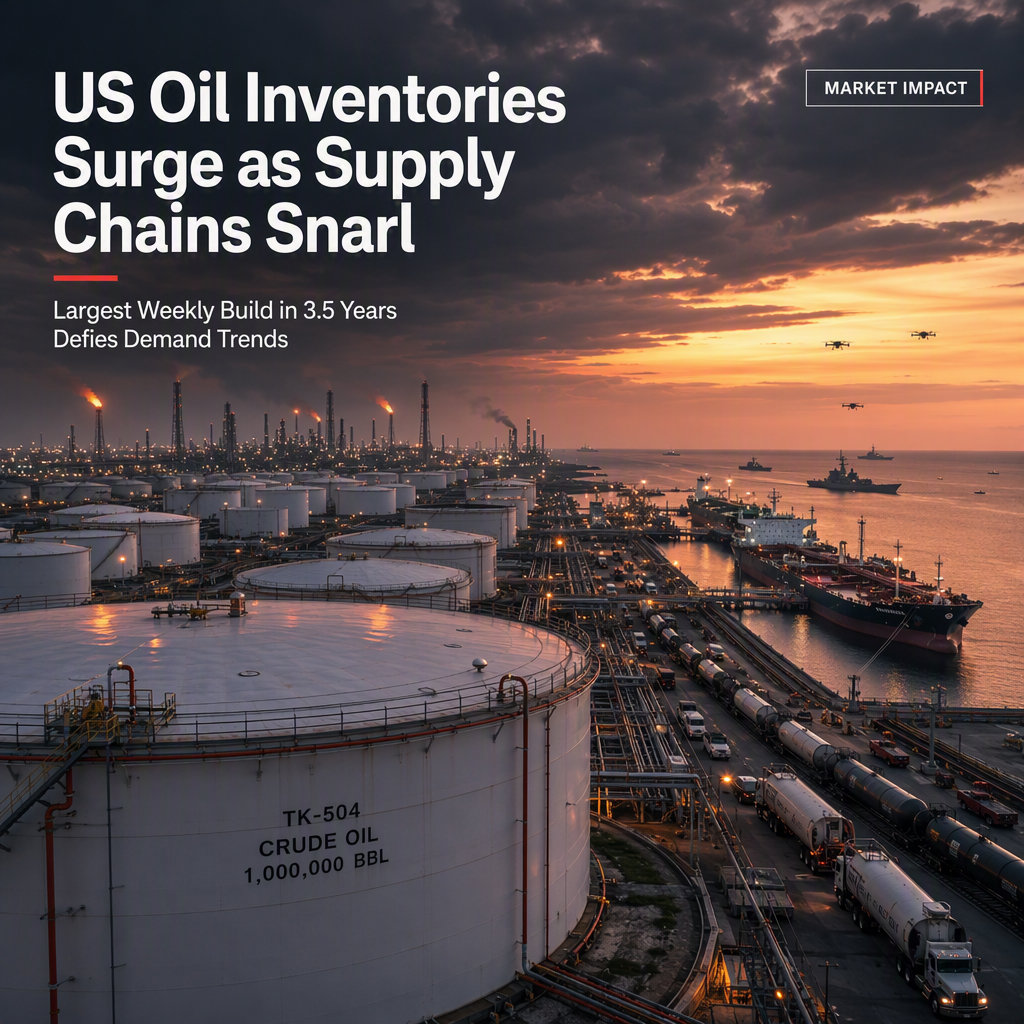
The US crude oil market experienced its largest weekly inventory build in three and a half years, with commercial stocks rising to 424.4 million barrels for the week ended August 7, defying expectations of a 1.4 million barrel draw [1]. Despite this build, inventories remain about 2% below the five-year average [1]. The increase was attributed to a surge in imports, which rose by 1.14 million barrels per day to 7.3 million, while exports slumped, resulting in most of the accumulation being concentrated on the Gulf Coast rather than distributed across the US system [1]. Refineries operated at 96.2% of capacity, and inputs edged higher, indicating that domestic consumption did not decline [1].
Contrary to the crude build, refined product data showed gasoline inventories fell to 208.7 million barrels (6% under the five-year average) and distillates dropped to 107.1 million barrels (roughly 12% under the average), with European refining margins reaching new records this month [1]. This suggests the build is more a result of logistical bottlenecks than a true supply glut, as strong demand for refined products persists [1].
On the demand side, both the International Energy Agency (IEA) and OPEC revised their 2026 crude oil demand forecasts downward on the same day. The IEA now expects demand to contract by 1.6 million barrels per day in 2026, a reduction 510,000 barrels per day deeper than its July forecast, while OPEC trimmed its 2026 growth estimate to about 600,000 barrels per day from 780,000 [1]. These revisions reflect demand destruction caused by high prices and logistical disruptions, not by economic weakness [1]. Despite these cuts, the market is still projected to be short by 1.8 million barrels per day this quarter [1].
Geopolitical developments also played a role, with US Central Command announcing the expansion of its multinational attack drone task force and the War Secretary stating that the naval blockade of Iranian ports can be sustained indefinitely, as the redirected-vessel count continues to rise [1]. These factors contribute to ongoing supply uncertainty and volatility in oil prices, with West Texas Intermediate (WTI) trading near $80.50 after a volatile session [1].
CONCLUSION
The US crude oil inventory build reflects a logistical bottleneck rather than a true supply glut, as strong refined product demand and ongoing geopolitical tensions persist. Despite downward revisions to global demand forecasts, the market remains physically tight, suggesting continued volatility and high market impact.