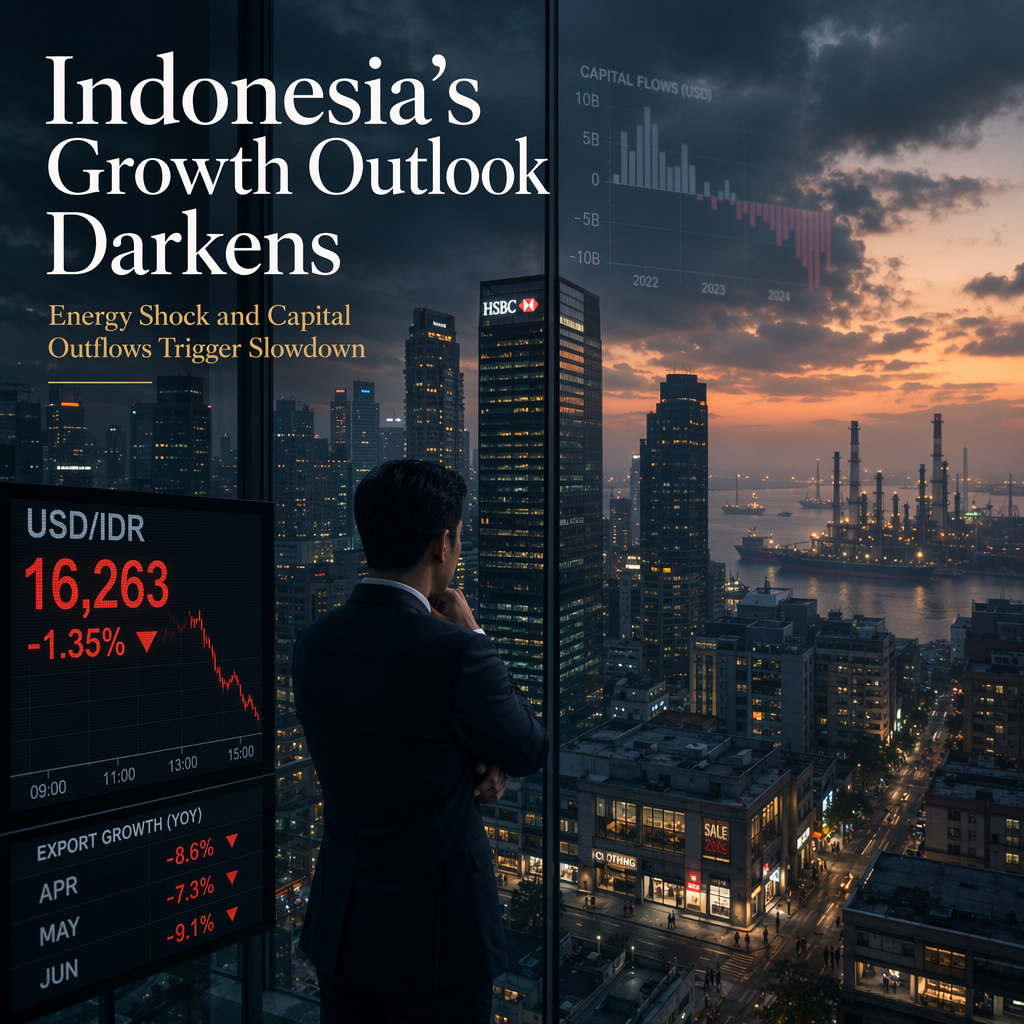
HSBC strategists have highlighted that Indonesia's economic growth is showing signs of slowing as the effects of an energy shock begin to impact activity and the balance of payments. While Indonesia's Gross Domestic Product (GDP) remains solid and inflation is contained for now, the latest data indicates a decline in retail spending, consumer sentiment, and export orders, signaling a weakening economic outlook [1].
HSBC forecasts that Indonesia's GDP will grow by 5.1% year-on-year in 2025, but this is expected to slow to 4.7% in 2026. Inflation is also projected to rise, with an average of 1.9% in 2025 and 3.5% in 2026. The strategists note that input prices measured by the Purchasing Managers' Index (PMI) have increased rapidly, gradually pushing up output prices as well [1].
The Indonesian rupiah (IDR) has come under pressure, with HSBC identifying the balance of payments as a key factor behind its depreciation. The balance of payments is expected to post its second consecutive negative annual reading in 2026. While the current account deficit is relatively modest at -0.1% of GDP in 2025, weak capital inflows—measured at -0.3% of GDP in 2025—are a more significant concern. HSBC points out that these two factors are interconnected, as subdued investment appetite and weak growth prospects deter capital inflows [1].
Additionally, HSBC observes that Indonesian corporates are cash rich but reluctant to invest, which further dampens investment and growth prospects. The report also mentions that fiscal expenditure has been frontloaded, suggesting that fiscal tightening may be necessary in the coming months to adhere to the 3% fiscal cap [1].
CONCLUSION
HSBC's analysis signals a cautious outlook for Indonesia, with slower GDP growth, rising inflation, and persistent challenges from weak capital inflows and the energy shock. Market participants may need to monitor the rupiah and fiscal policy closely as these macroeconomic headwinds develop. The overall sentiment is cautious, with medium market impact expected.