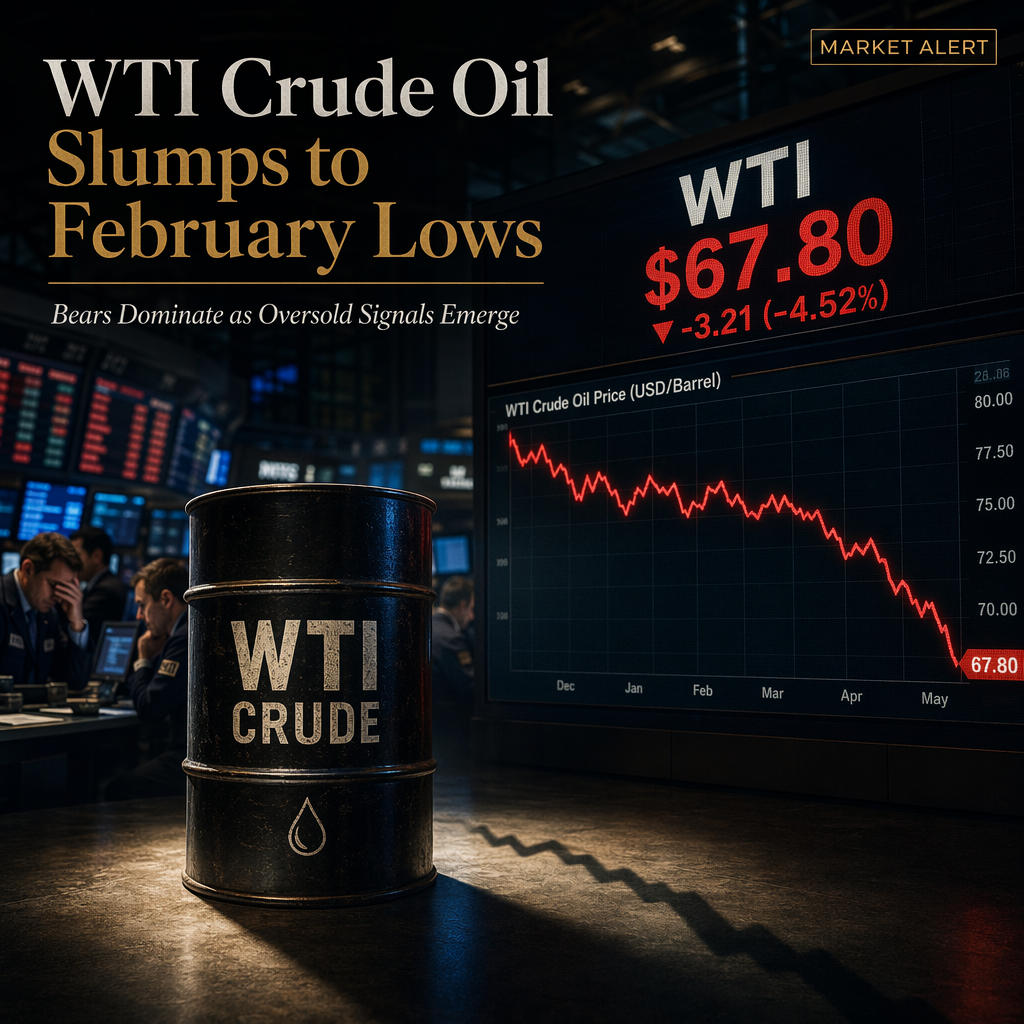
West Texas Intermediate (WTI), the benchmark for US crude oil, entered a bearish consolidation phase, trading below $68.00 during the first half of the European session on Friday. This marks its lowest level since late February, with the recent breakdown below the technically significant 200-day Simple Moving Average (SMA) acting as a key trigger for bearish traders and reinforcing a negative near-term outlook for crude oil prices [1]. The Moving Average Convergence Divergence (MACD) indicator remains in negative territory at -0.43, while the Relative Strength Index (RSI) is at 27.58, indicating oversold conditions [1].
Technical analysis suggests that while momentum indicators point to oversold conditions, a period of near-term consolidation or a modest bounce may occur before any further extension of the downtrend. Any meaningful recovery attempt is expected to face resistance near the 200-day SMA at $73.17, with additional barriers at the 61.8% Fibonacci retracement level ($77.67), the 50% level ($84.34), the 38.2% retracement ($91.02), and the 23.6% level ($99.27) [1]. On the downside, the main structural support is identified near $56.06, which is the year-to-date low touched in January [1].
The article highlights that the current technical setup validates a bearish bias for WTI, with the potential for further declines if selling pressure persists. However, the oversold RSI suggests that some consolidation or a modest bounce could occur in the near term before the downtrend resumes [1].
CONCLUSION
WTI crude oil prices have fallen to their lowest level since February, with technical indicators confirming a bearish outlook and the potential for further declines. However, oversold conditions may prompt a short-term consolidation or modest recovery before the downtrend continues. Key resistance and support levels will be critical in determining the next move for WTI.