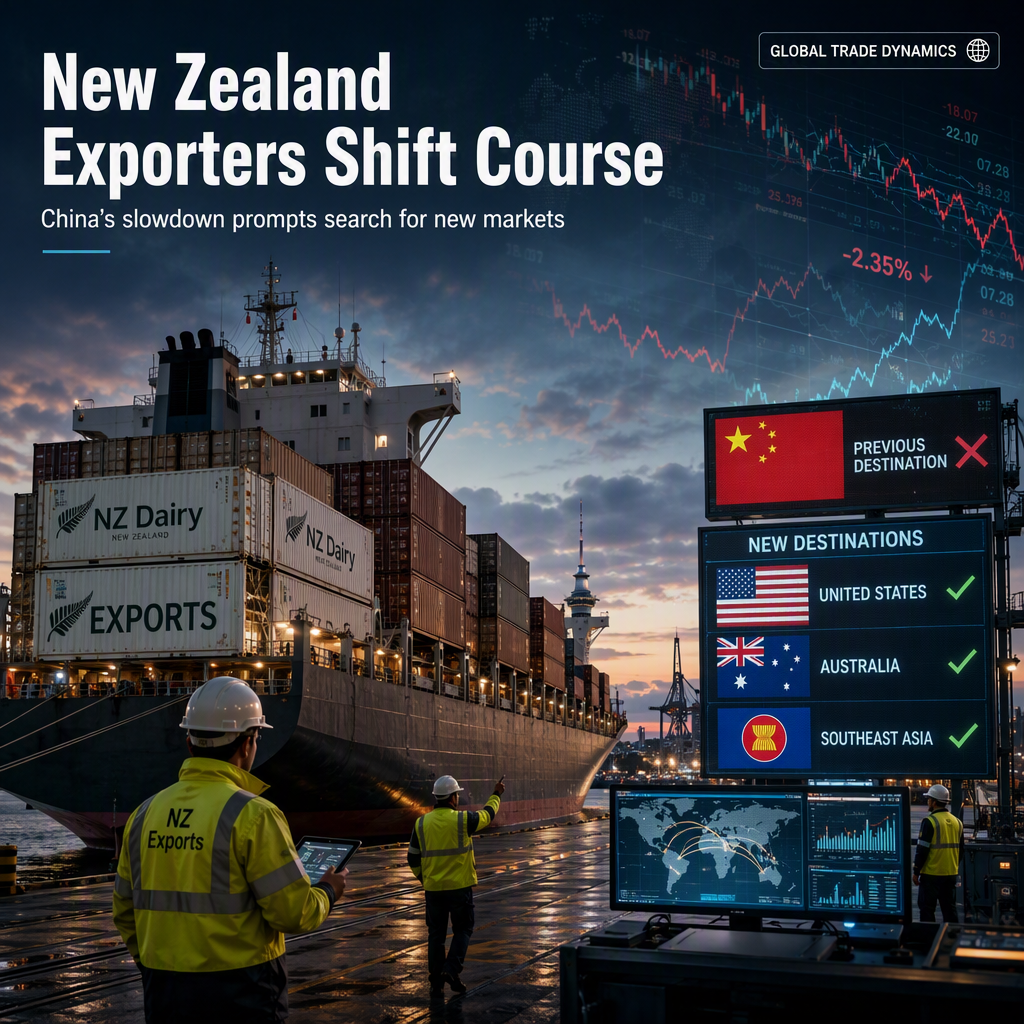
New Zealand exporters are actively diverting shipments originally destined for China into alternative markets as demand from their largest trading partner weakens, according to Karen Silk, assistant governor at the Reserve Bank of New Zealand (RBNZ) [1]. This shift comes in response to China's economic slowdown, which has reached multi-year lows in the second quarter due to subdued domestic demand and a prolonged real estate slump [1]. Silk emphasized that New Zealand exporters are not solely reliant on China and are exploring other markets to mitigate the impact [1].
China has historically been New Zealand's top export destination, accounting for roughly a quarter of New Zealand's total exports over the 12 months ending in July. In 2025, the value of New Zealand's exports to China was nearly double that of its next two largest markets, the U.S. and Australia, combined, as reported by the New Zealand China Council [1]. New Zealand supplies more than half of China's dairy imports, a position strengthened by a bilateral trade agreement since 2008 and full duty-free access for dairy products granted in 2024 [1]. However, any sustained reduction in Chinese demand challenges the speed at which New Zealand can diversify its trade relationships [1].
Global factors are also influencing the situation. The ongoing Middle East war and resulting shipping disruptions through the Strait of Hormuz have increased global commodity costs, further dampening China's appetite for commodity imports [1]. Despite softer China-bound volumes, elevated global commodity prices, including for wheat, have provided New Zealand's pasture-based farmers with a relative cost advantage, according to Silk [1]. She noted, "In some ways, New Zealand actually benefits from a price perspective when we have those supply factors going on globally" [1].
On the monetary policy front, the RBNZ raised its key interest rate by a quarter percentage point to 2.75% on Wednesday to combat inflation and signaled that another increase could follow by the end of the year [1].
CONCLUSION
China's economic slowdown is prompting New Zealand exporters to diversify away from their largest market, with the RBNZ highlighting both challenges and relative advantages in the current global environment. While softer Chinese demand poses risks, elevated global commodity prices are providing some offsetting benefits for New Zealand's agricultural sector. The RBNZ's recent rate hike underscores ongoing concerns about inflation and economic stability.