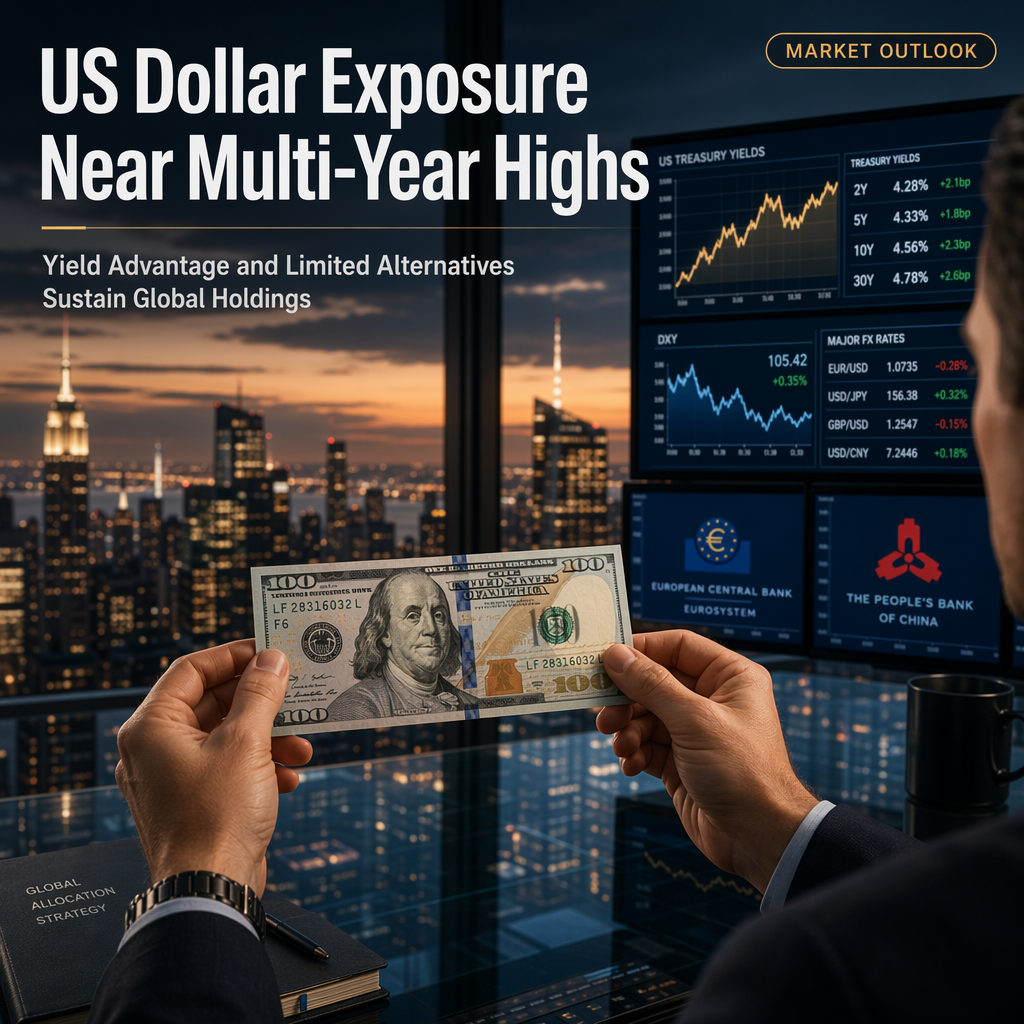
BNY’s Geoff Yu reports that cross-border investors’ US Dollar holdings are close to multi-year highs, primarily due to strong exposure to US assets and a reduction in FX hedges [1]. This elevated dollar exposure is underpinned by stable Federal Reserve expectations and the dollar’s yield advantage, which has made hedging increasingly expensive for investors [1]. Yu notes that the current dollar exposure differs from the April 2025 episode, which was distorted by extreme moves related to Liberation Day tariffs [1].
The European Central Bank is stepping back from further tightening, and China is easing policy, while other major central banks show little inclination to raise rates further, limiting alternatives to the US Dollar [1]. Yu warns that unhedged flows remain a currency risk, especially if US assets underperform, and that concentrated asset weakness could challenge the prevailing 'U.S. exceptionalism' narrative [1].
Some of the risk may rotate into more defensive US sectors rather than out of the dollar entirely, and barring a clear pivot from the Fed, limited alternatives are expected to keep USD exposure above long-term averages [1]. Yu suggests that if disinflation data continues to validate, investors should consider fading their dollar exposure by adding hedges and positioning for curve flattening [1].
CONCLUSION
Cross-border investors maintain elevated US Dollar exposure, supported by a durable yield advantage and limited alternatives from other central banks. While unhedged flows pose currency risk if US assets weaken, the current environment favors continued high dollar holdings unless Fed policy shifts or disinflation trends prompt investors to hedge. The market takeaway is cautious optimism for the dollar, with potential defensive repositioning if asset performance falters.