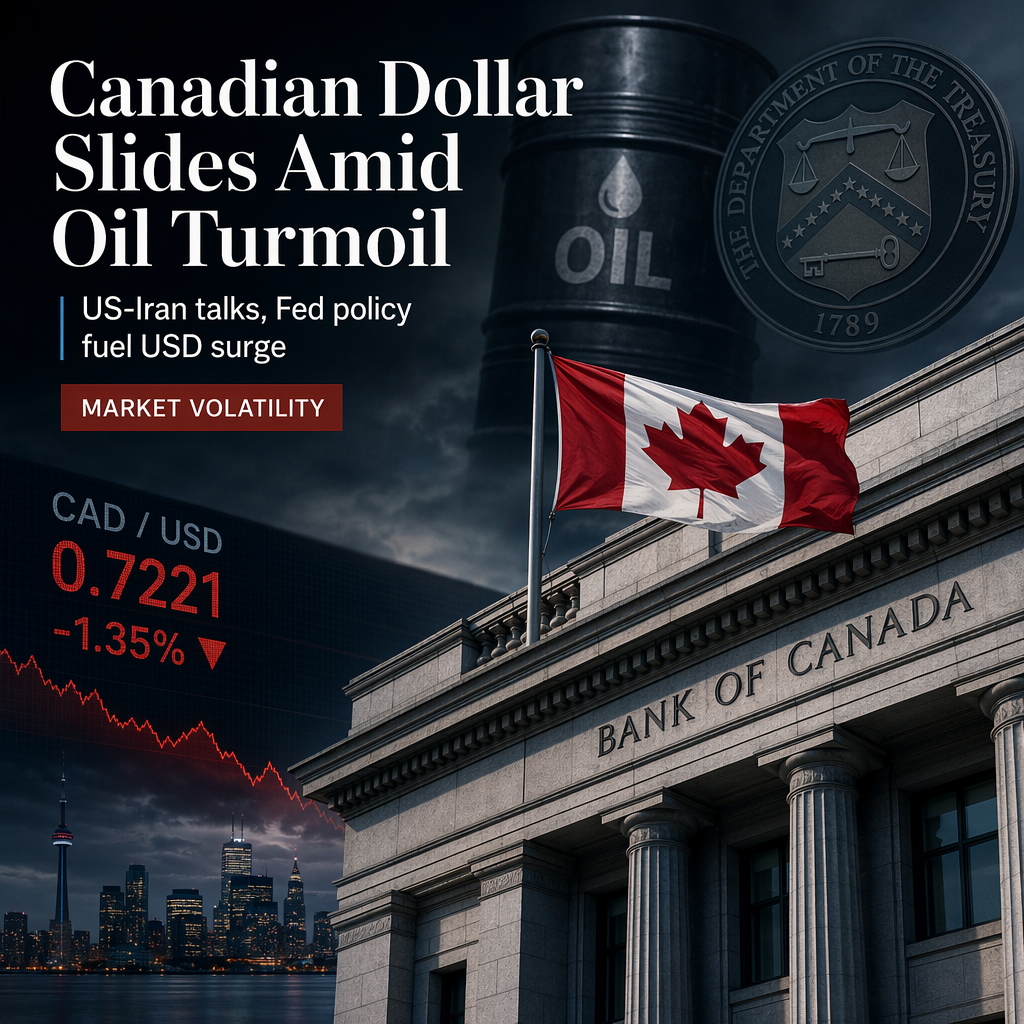
The Canadian Dollar (CAD) is trading near its lowest levels against the US Dollar (USD) since April 2025, with the USD/CAD pair hovering around the 1.4165-1.4170 region during the Asian session on Tuesday [1]. This weakness in the CAD is largely attributed to depressed crude oil prices, which remain vulnerable following the US Treasury Department's announcement of a temporary easing of sanctions on Iranian crude exports [1][2]. West Texas Intermediate (WTI), the benchmark US crude oil price, is consolidating near $74.00 per barrel and remains close to its lowest level since March, touched last Thursday [2].
Progress in US-Iran peace talks has contributed to the bearish sentiment in oil markets. Mediators Qatar and Pakistan reported that the first round of negotiations concluded with encouraging progress, and both sides have agreed on a roadmap towards a final deal within 60 days, according to a joint statement following talks in Switzerland [2]. The easing of sanctions is seen as a headwind for crude oil prices, overshadowing recent hot Canadian inflation data. Statistics Canada reported that the annual inflation rate accelerated to 3.2% in May, marking a 29-month high and moving outside the Bank of Canada's (BoC) 1%-3% target range [1].
Despite the elevated inflation, the BoC is expected to maintain its dovish policy stance, prioritizing a sluggish economy over inflation threats [1]. This contrasts with the US Federal Reserve's indication that policy rates could rise to 3.8% by year-end, implying a 25-basis-point rate hike in the coming months [1]. The divergence between BoC and Fed policy, combined with skepticism about the sustainability of the US-Iran peace deal, continues to support the USD's safe-haven status and the upside for USD/CAD [1][2].
Traders are awaiting BoC Governor Tiff Macklem's scheduled speech later in the North American session and the release of flash US PMIs for further market direction [1]. The ongoing developments in the Middle East crisis are expected to infuse volatility in financial markets, with the fundamental backdrop favoring USD bulls and suggesting further upside for USD/CAD [1].
CONCLUSION
The Canadian Dollar remains under pressure as oil prices struggle amid US-Iran diplomatic progress and eased sanctions, while the US Dollar benefits from safe-haven flows and policy divergence. Despite rising Canadian inflation, the BoC's dovish stance contrasts with the Fed's hawkish outlook, reinforcing USD strength. Market volatility is likely to persist as traders monitor geopolitical developments and upcoming economic events.