
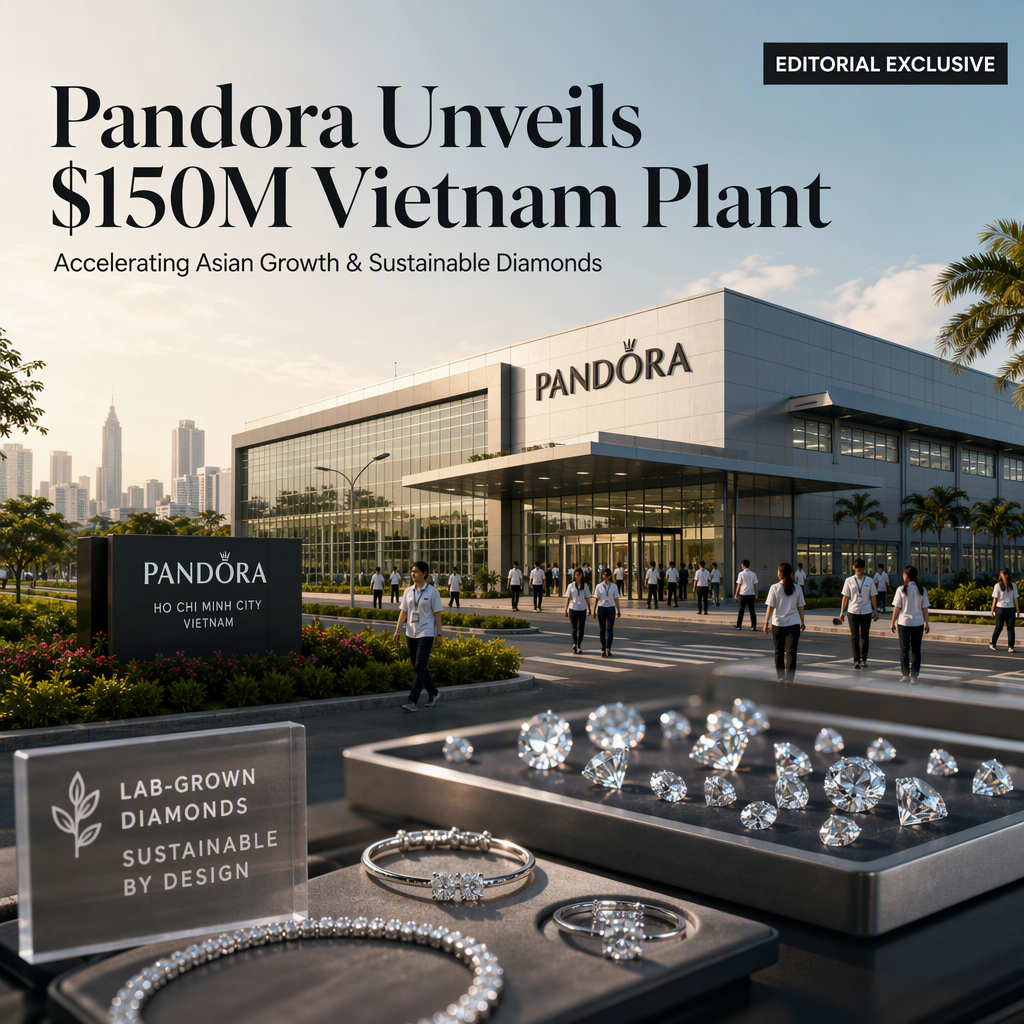
Pandora, the Danish jewelry giant, has inaugurated a $150 million manufacturing facility in Ho Chi Minh City, Vietnam, marking its first production site outside of Thailand and signaling a strategic push for growth in Asia and the lab-grown diamond market [1]. The new plant is expected to increase Pandora's manufacturing capacity by approximately 50%, with the ability to produce up to 60 million pieces of jewelry annually and employ about 7,000 people when fully operational [1].
President and CEO Berta de Pablos-Barbier emphasized that the expansion is aimed at capturing future growth opportunities in Asia, describing the region as 'very positive' for Pandora after the company achieved 10% growth in the second quarter [1]. She highlighted Japan as a standout market, noting that Pandora's business there has 'pretty much doubled' in size over three years and continues to grow at 'very high double digits' [1]. In contrast, China has experienced three years of declines, but Pandora now expects to return to growth in the country this year, with recent performance surpassing the previous year's results [1].
Pandora is also intensifying its focus on lab-grown diamonds, citing increased consumer demand for more affordable and sustainable alternatives to mined stones [1]. Pablos-Barbier stated that lab-grown diamonds allow Pandora to offer diamond jewelry at more accessible prices while producing around 90% fewer carbon emissions compared to mined diamonds [1]. She noted that younger consumers, in particular, are more environmentally conscious, though preferences differ by geography [1].
The CEO described the move into lab-grown diamonds as an 'obvious' choice, referencing Pandora's ongoing commitment to sustainability through the use of recycled silver and gold, as well as renewable energy at the new Vietnam facility [1].
CONCLUSION
Pandora's opening of its Vietnam plant marks a significant step in expanding its manufacturing capacity and strengthening its presence in Asia. The company's strategic focus on lab-grown diamonds and sustainability initiatives positions it to capture evolving consumer preferences and drive future growth in key markets.