
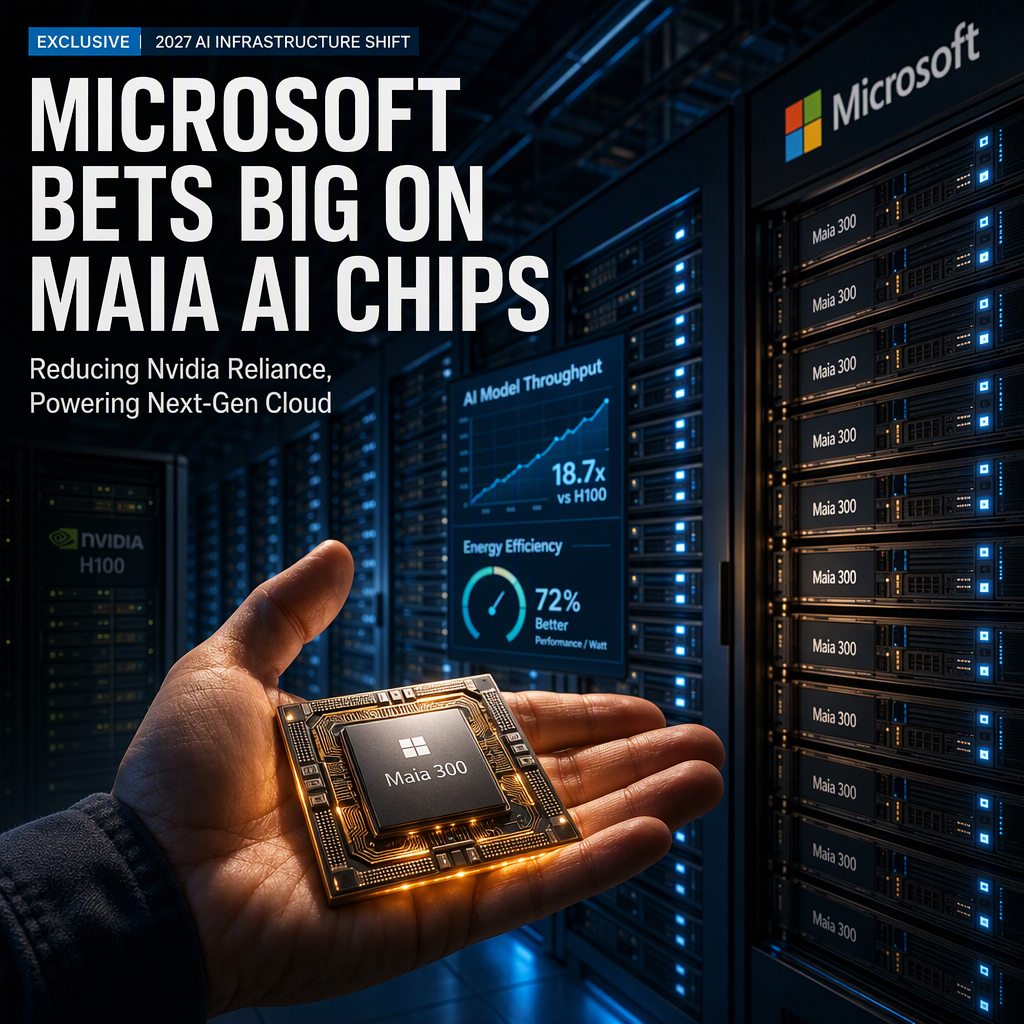
Microsoft announced a significant shift in its artificial intelligence infrastructure, revealing plans to rely primarily on its own Maia chips for AI inference, thereby reducing its dependence on Nvidia's graphics processing units (GPUs) [1]. The company intends to make Maia its primary architecture for running AI models, with the next-generation Maia 300 chip entering production in 2027 [1]. Microsoft expects to deploy multiple gigawatts worth of Maia chips, targeting multi-gigawatt deployments across its data centers [1].
The Maia 300 chip will be packed at a density of 96 chips per data center rack, doubling the number compared to the Maia 200. This new version is designed to process up to seven times more AI tokens per rack and deliver 40% more tokens per megawatt compared to GPUs [1]. CEO Satya Nadella previously stated that the Maia 200 chip delivers 30% better performance per dollar than the latest generation hardware in Microsoft's fleet and is already handling OpenAI models [1].
Microsoft's Azure cloud remains a core strength, running a series of AI models for clients, including Microsoft 365 Copilot and GitHub Copilot. The company has developed in-house models, though they have not yet achieved significant market share compared to leaders like OpenAI, Anthropic, and Google [1]. The move to homegrown chips is driven by unrelenting demand for advanced processors and the market's desire for more choice, as other companies such as Amazon, AMD, Cerebras, and Google have also introduced their own silicon [1].
Finance chief Amy Hood noted at a Goldman Sachs conference that using Microsoft's own chips has contributed to margin improvement over the past decade [1]. While Microsoft is targeting large-scale deployments, Alistair Speirs, a general manager, declined to provide a specific timeline, citing the fast-changing nature of the industry and the need to deploy the right silicon for the right models at the right time [1].
CONCLUSION
Microsoft's strategic pivot to its Maia AI chips signals a major shift in the competitive landscape for AI infrastructure, potentially impacting Nvidia and other chipmakers. The company's focus on performance, efficiency, and margin improvement suggests positive market sentiment and high impact for both Microsoft and the broader AI ecosystem. Investors and industry observers will be watching closely as production of the Maia 300 begins in 2027 and Microsoft ramps up its multi-gigawatt deployments.