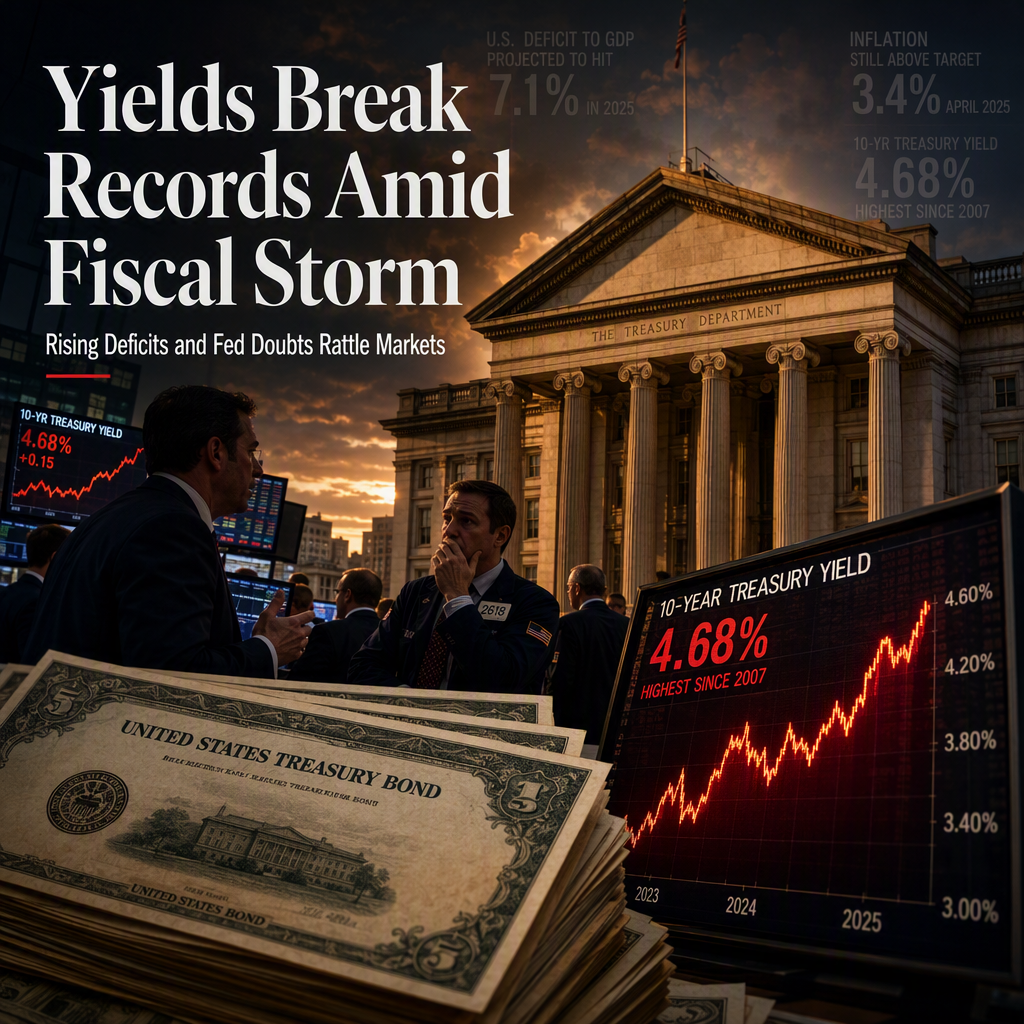
US Treasury yields have continued their upward trajectory this week, with the 30-year Treasury bond yield reaching 5.33% on Monday, marking its highest level since 2007 during the global financial crisis [1]. The benchmark 10-year yield has climbed to one-year highs above 4.7%, while the 2-year yield hit six-month highs above 4.3% on Monday before easing to the 4.2% area on Tuesday [1]. This surge in yields is attributed to mounting concerns over the expanding US fiscal deficit and increasing doubts regarding the Federal Reserve's independence [1].
According to data from the US Treasury, the budget deficit rose to $432 billion in July, representing a 48% increase compared to July of the previous year and the largest gap since the $660 billion deficit in March 2021, which was driven by COVID-19 relief spending [1]. Investors are demanding higher yields to compensate for the perceived risks associated with the growing deficit and the lack of a clear plan to address it [1].
Doubts about the Federal Reserve's commitment to combating above-target inflation have also contributed to the rise in yields. The latest Fed monetary policy meeting has raised concerns that Governor Kevin Warsh may yield to pressures from US President Trump to avoid tightening borrowing costs, thereby putting the central bank's independence into question and adding further pressure on government bonds [1]. DBS Group Research notes that this policy uncertainty, combined with heavy Treasury issuance, could undermine the US dollar's traditional safe-haven status [1].
The trend of rising long-term yields is not limited to the US. Rabobank analysts highlight that most major economies are experiencing similar pressures due to high levels of public debt. For example, UK 30-year Gilt yields have reached 5.84%, the highest since May 1998; German 30-year Bunds are at 3.74%, the highest since August 2007; and Japanese 30-year JGBs stand at 4.12%, the highest since the maturity was introduced in 1999 [1]. Rabobank questions the ability of central banks to intervene effectively in the current environment, given the constraints posed by high debt levels and the need for continued government spending [1].
CONCLUSION
US Treasury yields have surged to multi-year highs amid growing fiscal concerns and doubts about the Federal Reserve's independence, prompting investors to demand higher compensation for holding government debt. This trend is mirrored in other major economies, raising questions about central banks' ability to manage rising yields in a high-debt environment. The market impact is significant, with heightened uncertainty around US policy and funding.