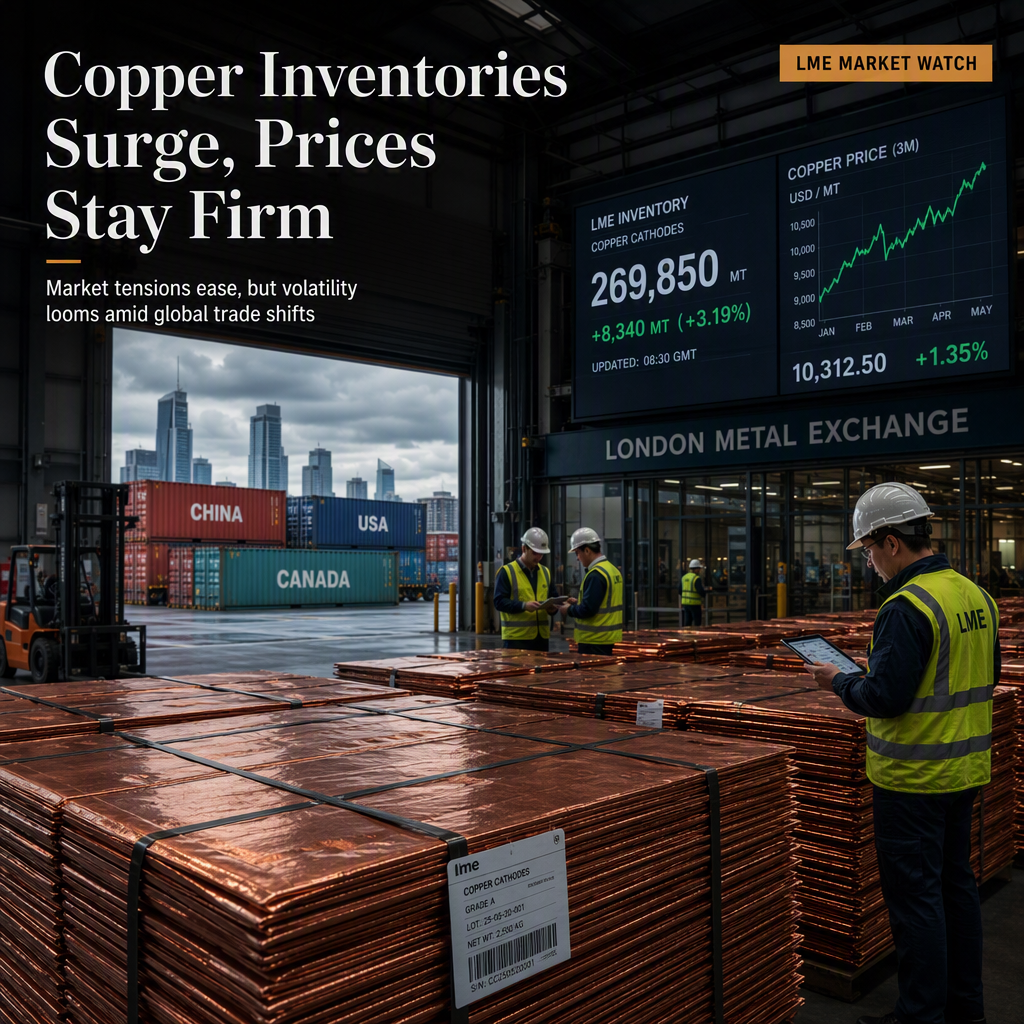
The copper market has experienced a slight easing in tightness as London Metal Exchange (LME) inventories increased by more than 55,000 tonnes over two sessions, according to ING’s commodities team led by Ewa Manthey and Warren Patterson [1]. Specifically, over 35,000 tonnes of copper were added to available LME inventories in one day, following a previous session's increase of over 20,000 tonnes [1]. This inventory build has narrowed the cash-to-three-month backwardation to $176 per tonne, down from as much as $545 per tonne on Monday [1]. Despite this, ING notes that tightness persists at the very front of the curve, indicating that the market squeeze has not fully resolved [1].
The market remains vulnerable after months of inventory outflows, which have been partly attributed to the diversion of metal to the US in anticipation of expected tariffs [1]. ING expects copper prices to remain supported by ongoing tight physical supply, although further inventory inflows could reduce near-term pressure and introduce additional volatility [1].
In terms of production, data from China’s National Bureau of Statistics shows that refined copper output rose by 1.3% year-on-year to 1.3 million tonnes in July, driven by higher sulphuric acid by-product prices that improved smelter margins and encouraged increased operating rates [1]. In contrast, lead output fell by 7.3% year-on-year to 580,000 tonnes, and zinc production declined by 0.8% year-on-year to 629,000 tonnes during the same period [1].
Additionally, the US and Canada are reportedly in discussions to reduce tariffs on certain Canadian aluminium and steel shipments to 25% from 50% as part of a tentative trade deal [1].
CONCLUSION
Copper market tightness has eased with a significant build in LME inventories, but ING analysts caution that the market remains vulnerable due to ongoing physical supply constraints and tariff-related uncertainties. While prices are expected to stay supported, further inventory inflows could introduce volatility in the near term.