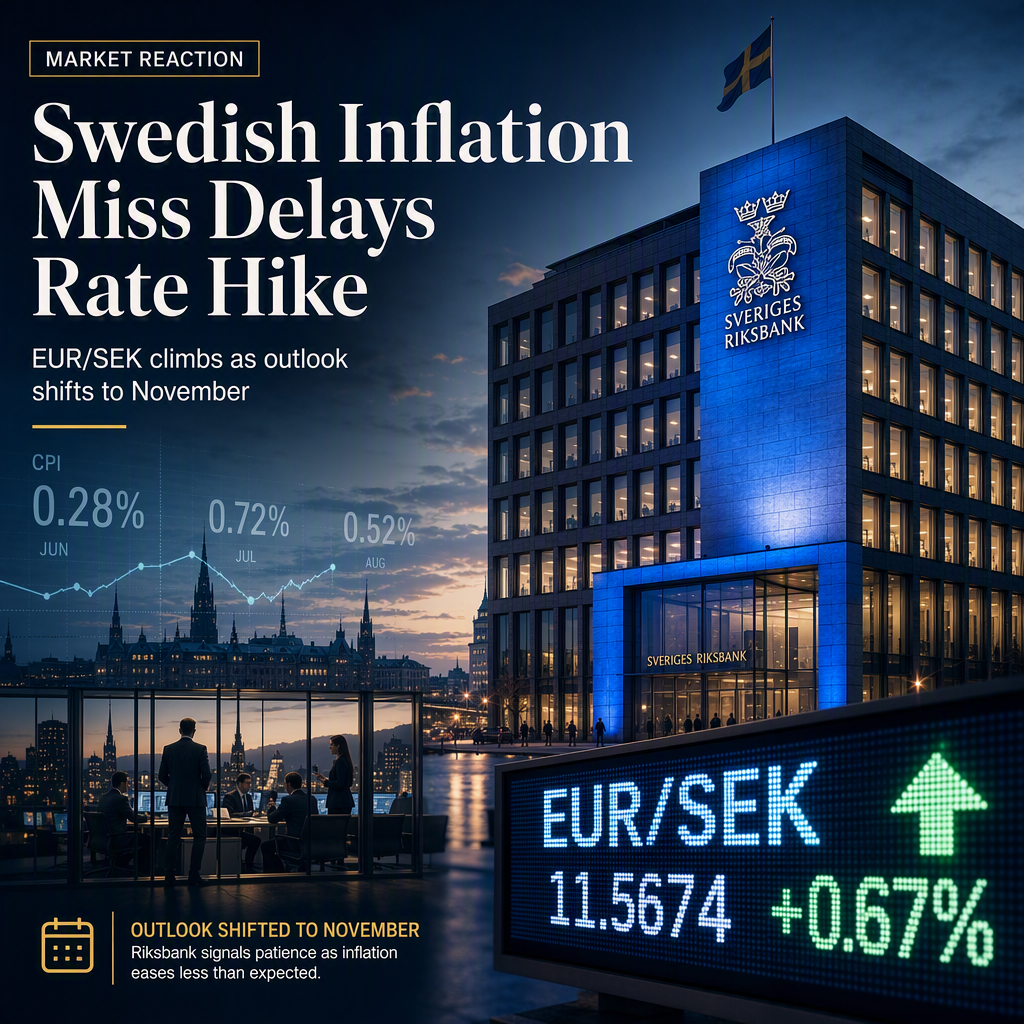
Sweden's August inflation figures came in softer than anticipated, with CPI at 0.28% year-on-year (y/y), CPIF at 0.72% y/y, and CPIF-XE at 0.52% y/y, all undershooting Danske Bank's forecasts and the Riksbank's expectations [1]. The downside surprise was broad-based, affecting both goods and services, while food and energy inflation remained in line with projections [1]. Prior to the inflation release, markets had priced in a roughly 30% probability of a Riksbank rate hike at the September meeting, but this likelihood was largely erased following the data [1]. Danske Bank now expects the Riksbank to delay its first rate hike until November [1].
The lower-than-expected inflation print has exerted upward pressure on the EUR/SEK currency pair, indicating a weaker Swedish Krona relative to the euro [1]. Meanwhile, the Norwegian Krone (NOK) is supported by higher energy prices and is trading below 10.80 against the euro [1].
Analysts at Danske Bank emphasize that the inflation surprise has shifted the outlook for Swedish monetary policy, with the central bank likely to postpone tightening measures [1]. No additional forward-looking statements or analyst opinions are provided beyond Danske Bank's revised rate hike expectation [1].
CONCLUSION
Softer-than-expected Swedish inflation has prompted markets and analysts to push back expectations for a Riksbank rate hike to November, resulting in upward pressure on EUR/SEK. The market reaction underscores the sensitivity of currency movements to inflation data and central bank policy outlooks.