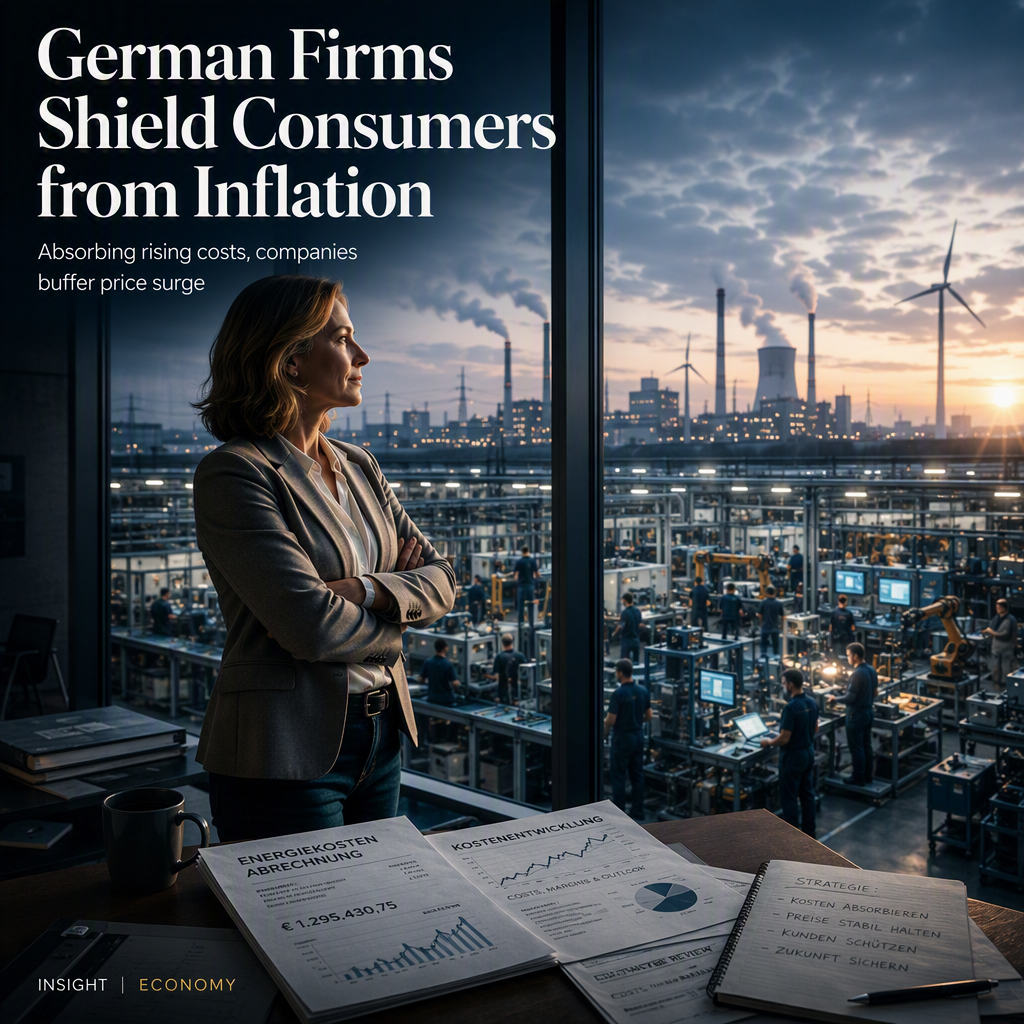
ING economists Carsten Brzeski and Franziska Biehl report that German inflation is expected to rise above 3% and remain elevated until the end of the year, but a repeat of the double-digit inflation seen in 2022 is considered unlikely [1]. The economists attribute this to weak demand, a softer labour market, and the depletion of pandemic-era savings, which have collectively reduced consumers' ability and willingness to pay higher prices [1]. As a result, companies are absorbing increased cost pressures through lower profits rather than passing these costs on to consumers, effectively tempering price risks [1].
The report notes that while some knock-on effects from higher energy costs to other goods may occur, these have not yet become visible in the data [1]. The conditions that allowed inflation to become a broad-based issue in 2022—such as strong consumer demand and robust wage growth—are not currently present [1]. The economists highlight that pricing power is increasingly limited as goods move down the production chain, meaning that the pass-through of higher energy prices to final consumer inflation remains unlikely [1].
The article also references the temporary impact of the war in the Middle East and surging energy prices on headline inflation across the eurozone. In Germany, this impact was mitigated by a government two-month fuel tax rebate, which helped curb price increases [1]. As of August, German inflation stood at 2.9%, about one percentage point higher than in February, but still far below the double-digit rates experienced during the 2022 energy crisis [1].
ING concludes that, unlike in 2022 when profits were seen as contributing to inflation ('greedflation' and 'shrinkflation'), the current environment is characterized by profit-squeezing, which is expected to dampen rather than enhance inflationary pressures [1].
CONCLUSION
German inflation is set to rise above 3% and remain elevated, but the risk of a return to 2022's double-digit inflation is low due to weak demand and limited consumer pricing power. Companies are absorbing cost increases through lower profits, which should help contain inflationary pressures in the coming months.