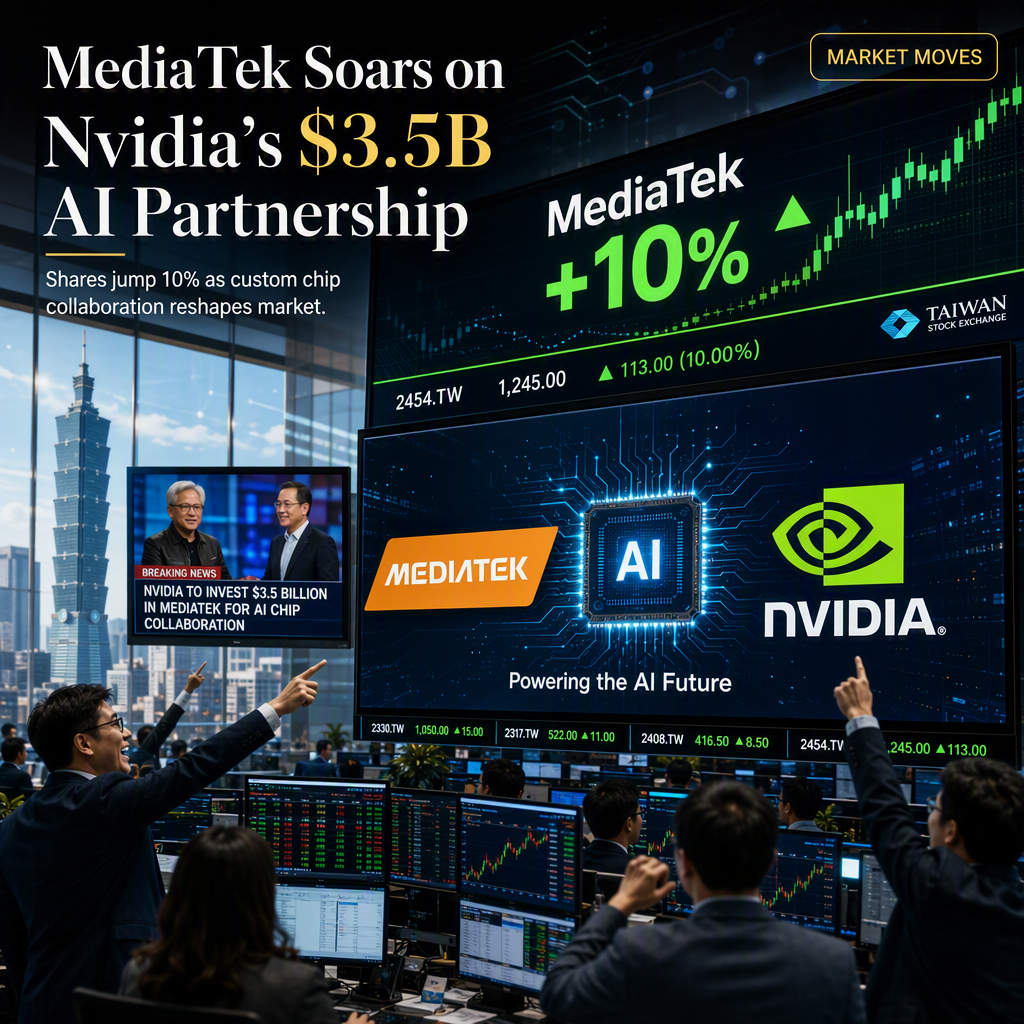
MediaTek shares closed 10% higher on Tuesday following the announcement of a $3.5 billion investment from Nvidia in the form of convertible bonds, marking a significant partnership between the two semiconductor companies [1]. The deal aims to integrate Nvidia technology with MediaTek's custom AI chip business, as well as expand collaboration into areas such as PCs and automotive systems [1]. This partnership is expected to bolster MediaTek's push into the data center market, an area where the company has been seeking to diversify beyond its core smartphone chip business [1].
Nvidia's $3.5 billion investment adds momentum to a nearly 200% rally in MediaTek's shares this year [1]. MediaTek, recognized as the world's largest smartphone chip company by market share according to Counterpoint Research, is positioning itself as a competitor to both Qualcomm and Broadcom by developing custom chips for data centers and AI workloads [1]. The partnership will enable MediaTek to offer Nvidia's NVLink Fusion platform to customers developing custom AI chips, allowing integration with Nvidia's AI infrastructure and systems [1].
NVLink Fusion is a key part of Nvidia's strategy to maintain its central role in AI infrastructure, even as more companies develop their own chips for AI processes [1]. The collaboration will also focus on 'local AI computing,' targeting chips for PCs and automotive systems [1]. In June, MediaTek projected its custom AI chip business would generate $2 billion in revenue this year, with a total addressable market of up to $80 billion by 2027; however, it is not yet clear if the Nvidia deal will alter this guidance [1].
Nvidia CEO Jensen Huang described MediaTek as 'one of the world's great semiconductor companies' in a press release issued on Monday [1].
CONCLUSION
The $3.5 billion investment and partnership with Nvidia mark a major step for MediaTek in expanding its AI chip business and diversifying beyond smartphones. The market responded positively, with MediaTek shares surging 10% on the news. This collaboration positions both companies to capitalize on the growing demand for custom AI chips in data centers, PCs, and automotive systems.