
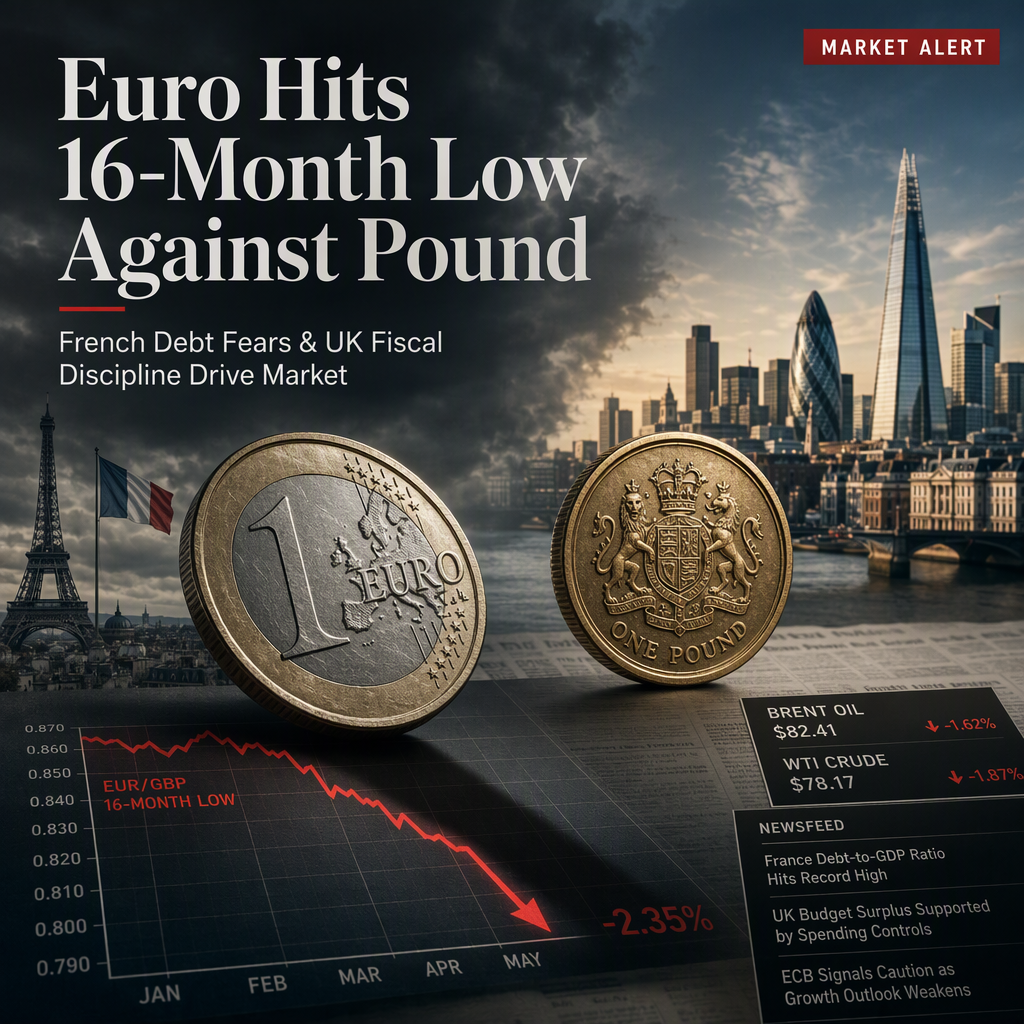
The Euro (EUR) has fallen to a fresh 16-month low against the British Pound (GBP), with the EUR/GBP pair reaching 0.8442, marking a 1.92% decline in less than three weeks [1]. This sharp move is attributed to mounting concerns over France’s public debt, which has reached post-war highs and is raising fears of a potential credit crisis in the Eurozone [1]. In contrast, the UK Government has pledged fiscal discipline, with UK Finance Minister John Healey reportedly planning to fund new initiatives through higher taxes or spending cuts rather than increasing public debt, a stance that has provided additional support to the Pound [1].
European Central Bank (ECB) President Christine Lagarde has urged the French government to consolidate its fiscal policy and has ruled out the possibility of the ECB purchasing French bonds to ease borrowing costs [1]. Meanwhile, high oil prices—Brent crude remaining above $104 due to geopolitical tensions in the Middle East—are increasing the risk of stagflation in the Eurozone, characterized by low growth and high consumer prices [1]. The Pound has so far shown resilience to the energy shock, supported by strong UK economic data and hawkish comments from Bank of England (BoE) policymakers, which have fueled expectations of a potential rate hike at the BoE's November meeting [1].
Looking ahead, analysts at Societe Generale highlight that EUR/GBP has broken below its July lows, emphasizing the ongoing downward momentum. They caution that failure to reclaim last week's high at 0.8500 could lead to further declines, with the next technical targets at 0.8405 and 0.8370/0.8355 [1]. Upcoming UK monthly GDP and industrial production data, due on Thursday, are expected to be closely watched for confirmation of the current market trends [1].
CONCLUSION
The Euro's decline against the Pound is being driven by contrasting fiscal outlooks in France and the UK, as well as broader macroeconomic risks such as high oil prices. Market sentiment remains negative for the Euro, with analysts warning of further downside unless key technical levels are reclaimed. Investors are now focused on upcoming UK economic data and ongoing developments in Eurozone fiscal policy.