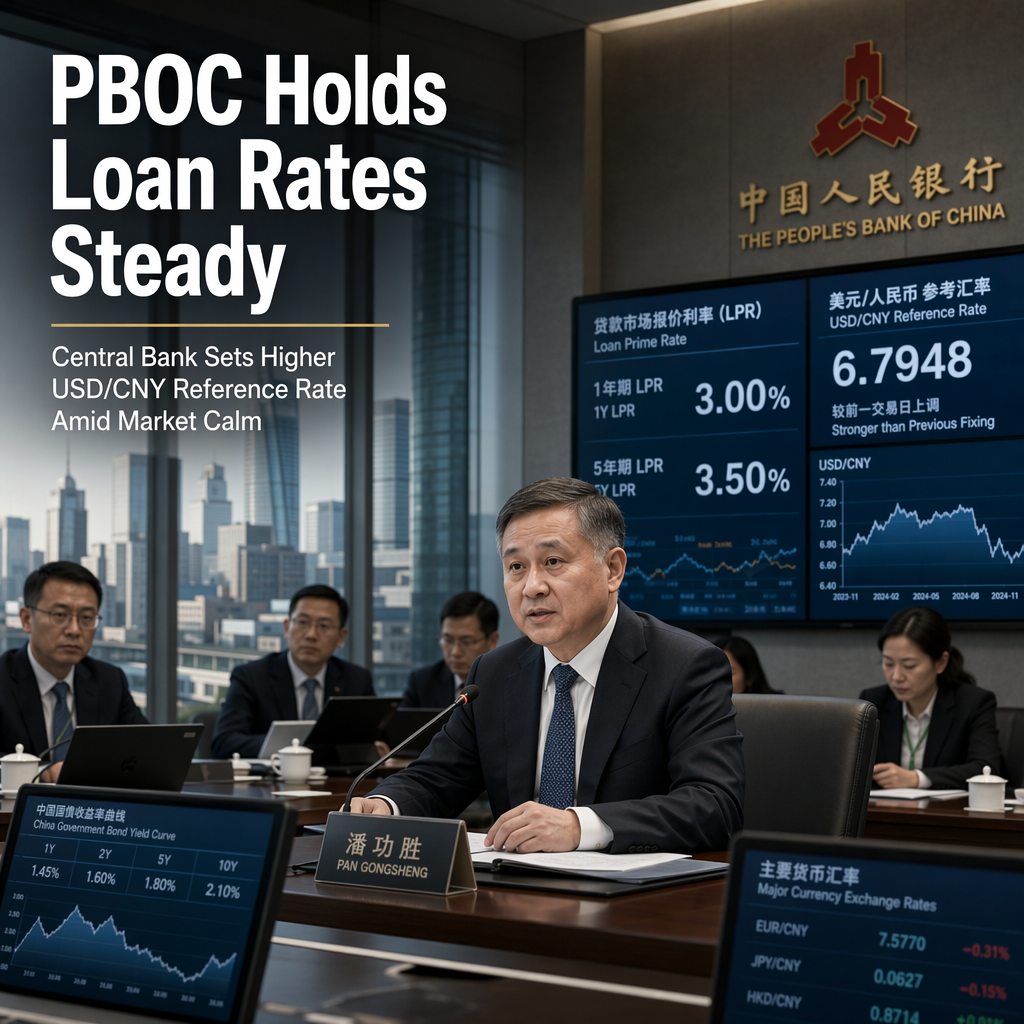
On Monday, the People's Bank of China (PBOC) announced that it would leave its Loan Prime Rates (LPRs) unchanged for July, maintaining the one-year LPR at 3.00% and the five-year LPR at 3.50% [2]. In addition to holding the LPR steady, the PBOC set the USD/CNY central reference rate for the trading session at 6.7948, which is slightly higher than the previous fix of 6.7934 and above the Reuters estimate of 6.7577 [1].
The market reaction to the PBOC's interest rate decision was muted, with the China-proxy Australian Dollar (AUD) showing little to no response. At the time of reporting, the AUD/USD was trading 0.02% higher on the day at 0.6983 [2].
Both articles highlight the PBOC's primary monetary policy objectives, which include safeguarding price stability, maintaining exchange rate stability, and promoting economic growth. The central bank utilizes a range of policy tools, such as the seven-day Reverse Repo Rate (RRR), Medium-term Lending Facility (MLF), foreign exchange interventions, and the Reserve Requirement Ratio (RRR). The LPR serves as China's benchmark interest rate, directly influencing loan and mortgage rates as well as the interest paid on savings [1][2].
Leadership at the PBOC is noted to be under the influence of the Chinese Communist Party (CCP) Committee Secretary, with Mr. Pan Gongsheng currently holding both the CCP Committee Secretary and governor positions [1][2].
CONCLUSION
The PBOC's decision to keep the Loan Prime Rates unchanged and set a slightly higher USD/CNY reference rate resulted in minimal market reaction, as reflected in the stable AUD/USD exchange rate. The central bank continues to focus on maintaining price and exchange rate stability while supporting economic growth.