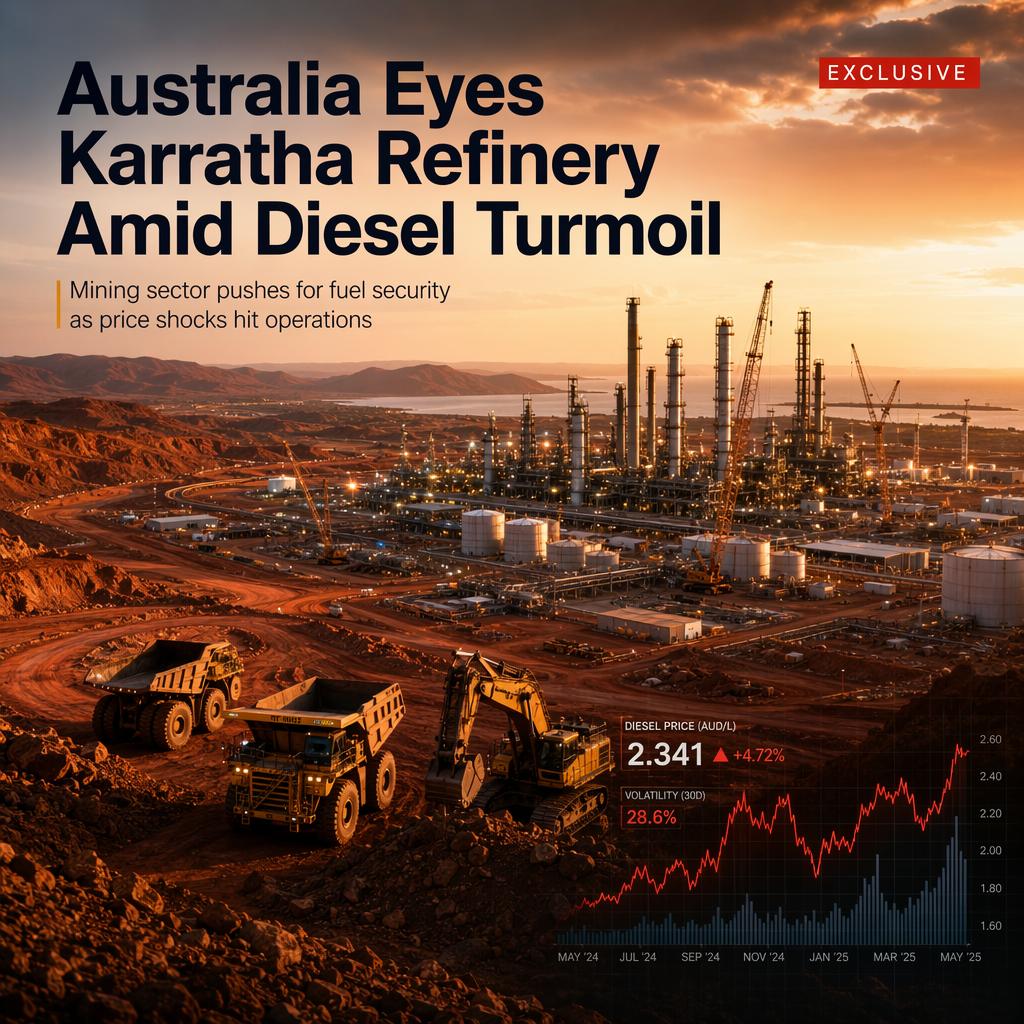
Australia is evaluating the construction of a new fuel refinery in Karratha, Western Australia, in response to ongoing supply concerns and volatile diesel prices resulting from the U.S.-Iran war [1]. This would be the country's first new refinery since the 1960s, reflecting the severity of the current situation for the mining industry [1].
The CEO of Whitehaven, a leading Australian mining company, stated that the unpredictability of diesel prices has made it very difficult to accurately forecast operating costs, impacting everything from expansion plans to daily operational decisions [1]. Technical analysis indicates that diesel prices have experienced sharp swings since the onset of the Iran war, with support levels near AUD 1.50 per liter and spikes reaching as high as AUD 2.10 during periods of heightened tension [1].
Market analysts suggest that a new refinery could help stabilize domestic fuel supplies and provide greater price support for industrial consumers, particularly miners who are heavily reliant on diesel [1]. The mining sector is actively lobbying for government intervention and investment in fuel infrastructure, as persistent volatility threatens profit margins and global competitiveness [1].
Market sentiment remains cautious, with traders recommending close monitoring of geopolitical developments and supply chain disruptions. Many advise hedging fuel exposure and securing longer-term contracts to mitigate further volatility [1]. The government's study into a new refinery is seen as a critical step toward insulating the industry from external shocks and maintaining stable operations [1].
CONCLUSION
Australia's consideration of a new refinery in Karratha highlights the mining sector's vulnerability to diesel price volatility amid Middle East tensions. While the study is only in its early stages, it signals a proactive approach to stabilizing fuel supplies and supporting industrial competitiveness.