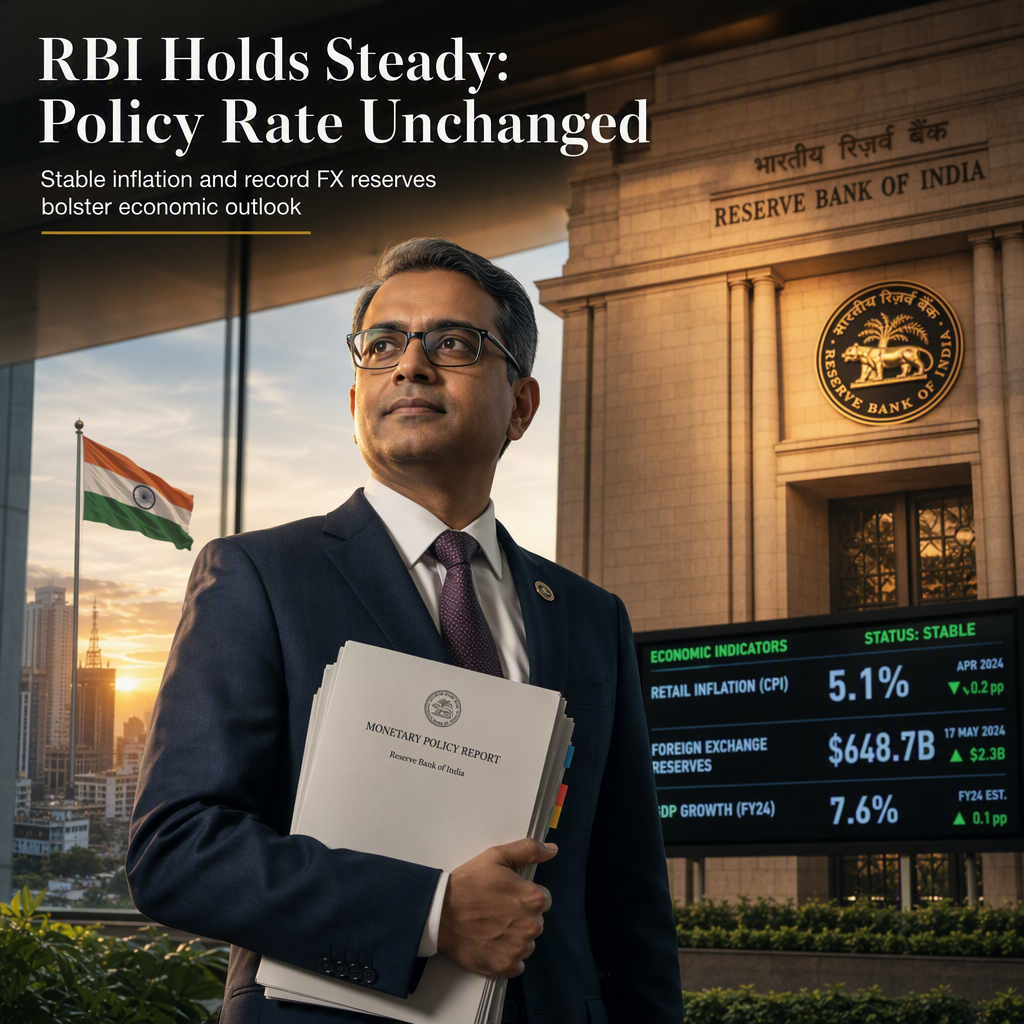
Commerzbank analysts Dr. Henry Hao and Moses Lim report that the Reserve Bank of India (RBI) is expected to maintain its current policy rate at 5.25% throughout the fiscal year, citing stable inflation and robust economic fundamentals as key factors supporting this stance [1]. India's economy is projected to grow by 6.7% in fiscal 2026-2027, a moderation from the previous year's 8% growth, but still underpinned by strong domestic demand and encouraging export performance [1].
Inflation is forecast at 5% for the current fiscal year, comfortably within the RBI's 2-6% target range, which allows the central bank to remain in a 'wait-and-see' mode regarding further policy adjustments [1]. The RBI's efforts to attract foreign capital and stabilize the Indian Rupee (INR) have been described as successful, with a notable decision to close the Foreign Currency Non-Resident (Bank) or FCNR(B) deposit scheme one month ahead of schedule, now set for 31 August [1].
The INR remains vulnerable to potential increases in global crude oil and gold prices, which are identified as key risks to currency stability [1]. However, India's foreign exchange reserves have surpassed USD700 billion, providing the RBI with significant capacity to manage and smooth out any volatility in the currency markets should pressures arise [1].
No explicit market reactions or analyst opinions regarding future rate changes beyond the current fiscal year are provided in the source [1].
CONCLUSION
The RBI is expected to keep its policy rate unchanged at 5.25% this year, supported by stable inflation and strong FX reserves. While growth is moderating, the economic outlook remains positive, though risks from higher oil and gold prices persist. The RBI's proactive measures and ample reserves position it well to manage potential volatility in the Indian Rupee.