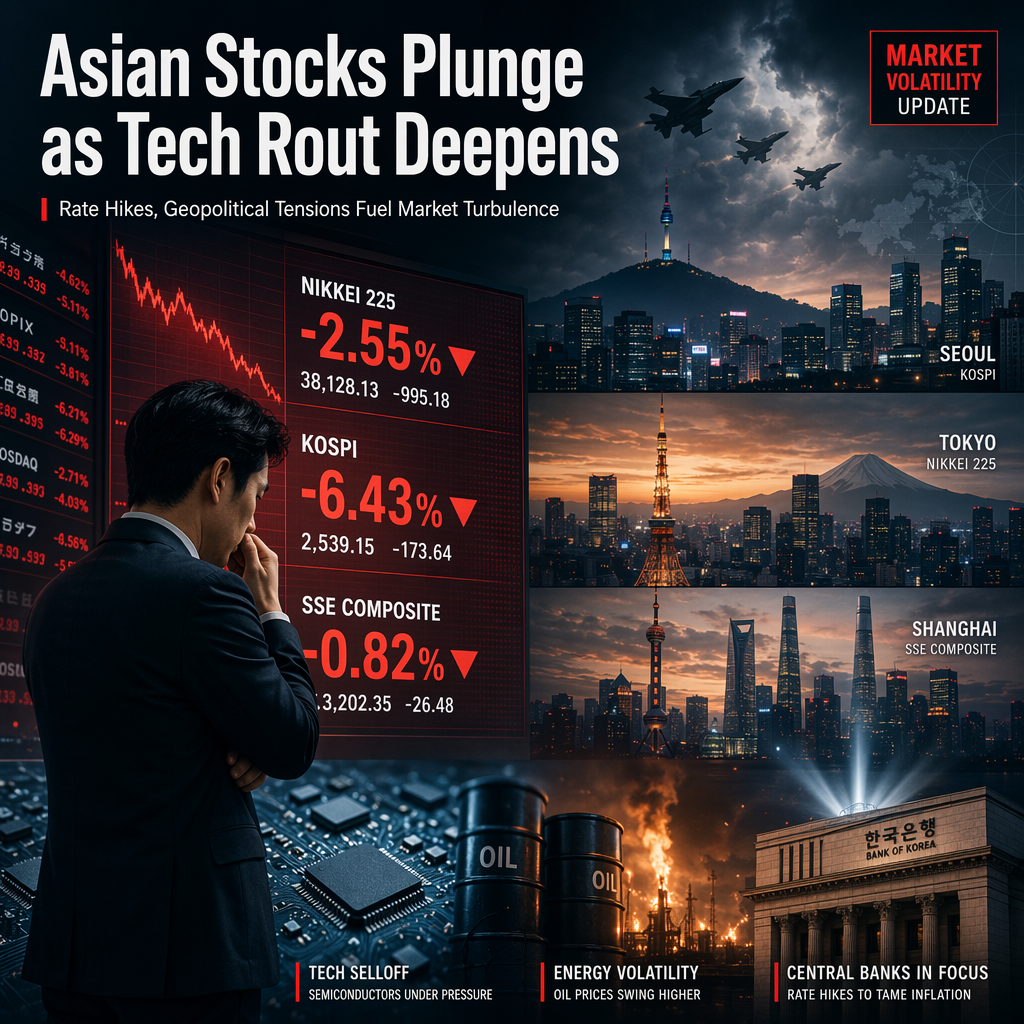
Asian equity markets experienced notable declines on Thursday, with a renewed sell-off in semiconductor shares exerting significant downward pressure on the technology sector [1]. Japan’s Nikkei 225 dropped 2.55% to approximately 67,000, South Korea’s KOSPI plunged 6.43% to around 6,820, and China’s SSE Composite fell 0.82% to about 3,920 [1]. In contrast, Hong Kong’s Hang Seng Index rose 1.93% to roughly 25,150, buoyed by improved investor sentiment following softer-than-expected US inflation data and global optimism, which led to strong capital inflows and aggressive buying in the financial, consumer, and technology sectors [1].
The sell-off in South Korea was particularly severe, as the KOSPI was dragged down by a global semiconductor rout that mirrored steep overnight losses in major US chipmakers. This led to sharp declines in South Korea’s leading semiconductor companies, including SK Hynix and Samsung Electronics, amid renewed concerns about the sustainability of artificial intelligence-related valuations [1].
Geopolitical tensions also weighed on market sentiment, with escalating military actions in the Middle East driving crude oil prices sharply higher. The resulting energy price spike has reignited global fears of a secondary inflation wave, complicating the outlook for central bank interest rates [1].
In response to domestic economic pressures, the Bank of Korea raised its benchmark interest rate by 25 basis points to 2.75%, marking the start of a new monetary tightening cycle. This move was in line with consensus market expectations and is intended to curb domestic inflation [1].
CONCLUSION
Asian stock markets faced significant volatility, with technology shares leading declines amid renewed concerns over AI valuations and rising geopolitical tensions. The Bank of Korea’s rate hike signals a shift toward tighter monetary policy to address inflation risks. Market sentiment remains cautious as investors weigh inflationary pressures and central bank responses.