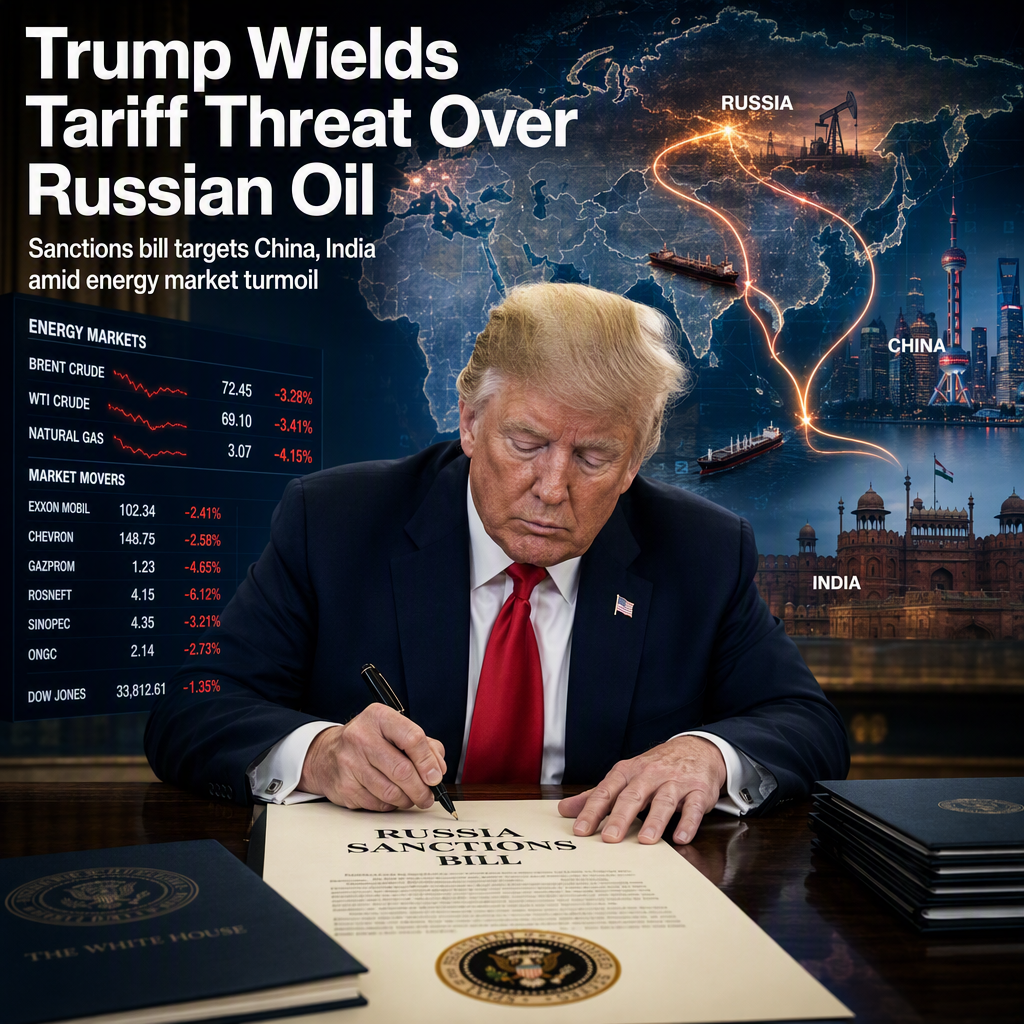
U.S. President Donald Trump signed a Russian sanctions bill on Friday, granting him the authority to impose tariffs of up to 100% on countries that continue to purchase significant volumes of Russian oil and gas, including China and India [1]. The law specifically targets top importers of Russian energy and is intended to escalate economic pressure on Moscow by curtailing its revenue streams from energy exports [1]. This move comes just days before Chinese President Xi Jinping's scheduled visit to Washington, adding geopolitical significance to the timing [1].
The bill's passage occurs amid heightened volatility in global energy markets. Analysts have warned that the prospect of U.S.-imposed tariffs on Russian energy imports could further disrupt oil prices, particularly if major buyers such as China and India refuse to comply or retaliate with their own countermeasures [1]. Early market reaction was cautious, with energy sector stocks fluctuating as investors evaluated the potential impact on global supply chains [1]. A senior analyst from a New York-based investment bank noted, "This move could have far-reaching consequences for commodity markets. If China and India are hit with tariffs, we could see significant shifts in trade flows and price levels" [1].
The legislation provides the Trump administration with flexibility to adjust tariffs based on the volume of Russian energy imports and the level of cooperation from other countries [1]. Technical indicators suggest that oil price support levels may be tested in the coming weeks, as traders consider the likelihood of tit-for-tat trade measures and possible supply disruptions [1]. A White House spokesperson emphasized, "The president now has the authority to go as far as 100% tariffs on Russian energy buyers. This sends a clear message to Moscow and its partners that the U.S. is prepared to use economic tools to uphold international norms" [1].
As President Xi Jinping prepares for his U.S. summit, the sanctions bill is expected to remain a focal point for market participants and policymakers. Any signals from Beijing or New Delhi regarding their response to the new law will be closely monitored for their potential impact on energy prices and broader market sentiment [1].
CONCLUSION
The signing of the Russian sanctions bill by President Trump introduces significant uncertainty to global energy markets, with the potential for major shifts in trade flows and price levels if China and India are targeted with tariffs. Market participants are closely watching for responses from Beijing and New Delhi, as their actions could further influence energy prices and overall market sentiment. The bill's flexible tariff provisions and timing ahead of a key U.S.-China summit underscore its high market impact.