
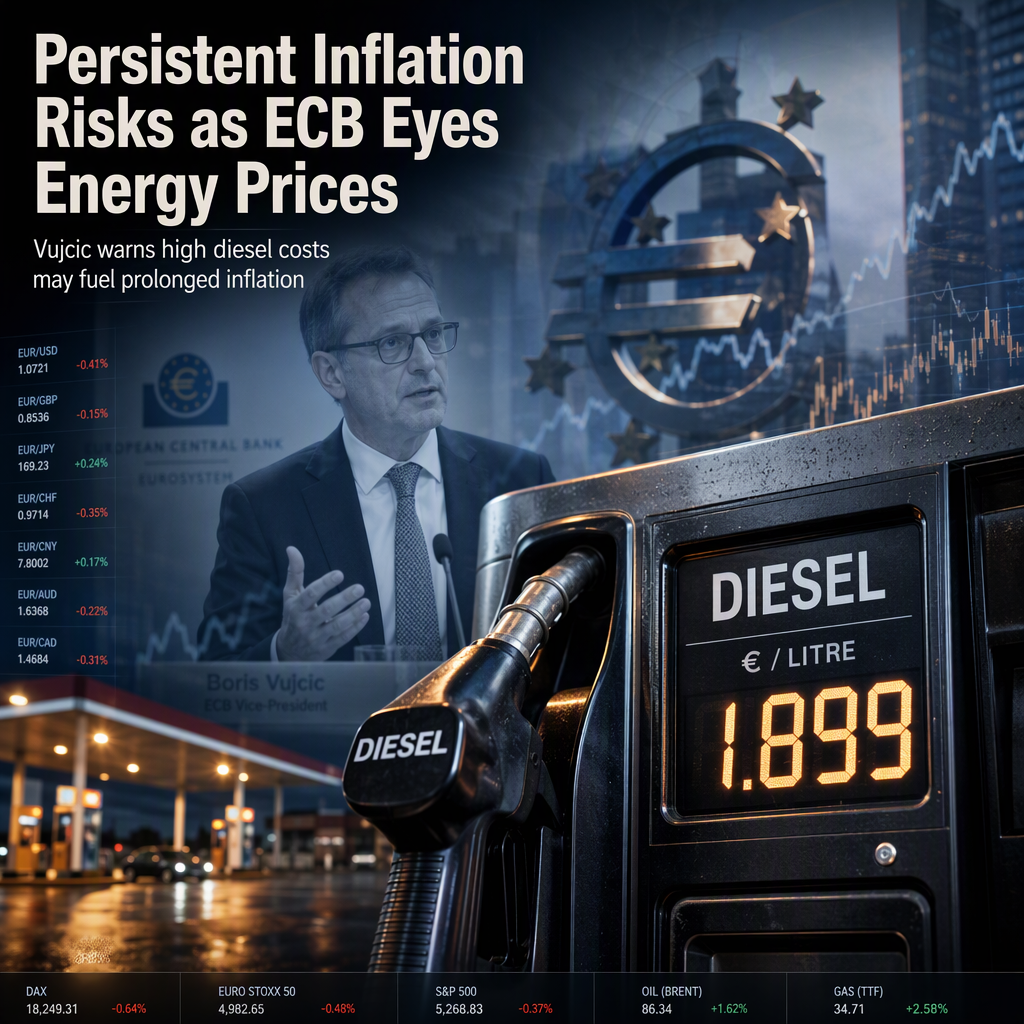
European Central Bank (ECB) Vice President Boris Vujcic stated on Friday that the ECB has initiated a tightening cycle in response to inflationary pressures, particularly those stemming from energy markets [1]. Vujcic highlighted a significant risk that energy prices, especially for refined products like diesel, could remain elevated for an extended period, thereby sustaining upward pressure on inflation [1]. He noted that while crude oil prices may decline, the prices of refined products such as diesel are expected to stay high for a long time, which will continue to feed into inflation [1].
On the currency front, the Euro (EUR) showed mixed performance against major currencies. The Euro strengthened most notably against the Canadian Dollar (CAD), gaining 0.21%, and also posted gains against the Swiss Franc (CHF) and the US Dollar (USD), up 0.20% and 0.14% respectively [1]. However, the Euro weakened against the Japanese Yen (JPY) by 0.90% and saw slight declines versus the British Pound (GBP), Australian Dollar (AUD), and New Zealand Dollar (NZD) [1].
No explicit forward-looking statements or analyst opinions were provided beyond Vujcic’s warning about the persistence of high energy prices and their inflationary impact [1]. Market implications center on the ECB’s tightening stance and the potential for continued inflationary pressures if energy prices do not moderate as anticipated [1].
CONCLUSION
ECB Vice President Vujcic’s comments underscore ongoing concerns about persistent inflation driven by elevated energy prices, particularly for refined products like diesel. The Euro showed relative strength against some major currencies, but the outlook remains cautious as inflation risks linger. Market participants are likely to monitor energy price developments and ECB policy responses closely.