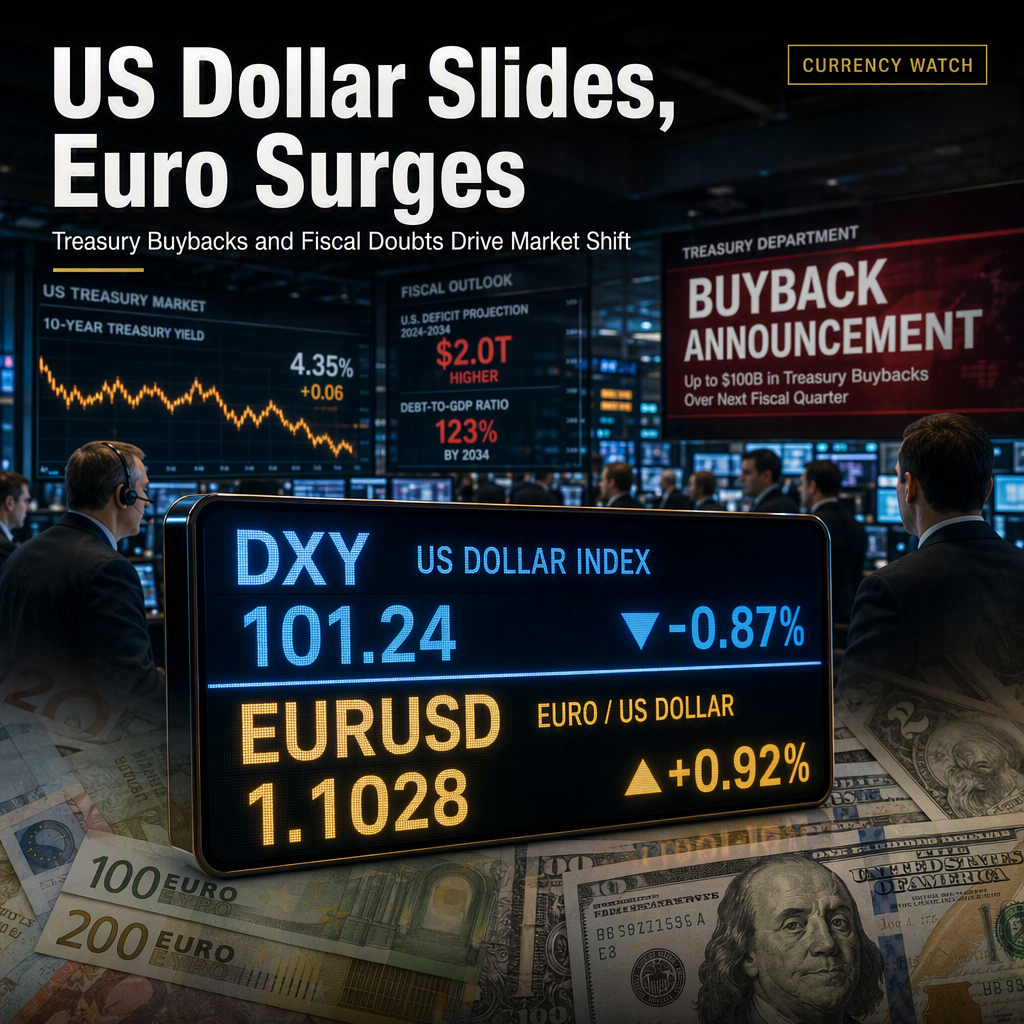
The US Dollar (USD) experienced broad weakness against major currencies on Friday, driven by the US Treasury Department's announcement to double bond buybacks starting in September and persistent concerns over US fiscal policy credibility [4][5][6]. The Dollar Index (DXY) fell 0.17% to near 98.67, revisiting a three-month low at 98.56 [5]. Treasury Secretary Scott Bessent indicated the buyback operation could exceed the $4bn previously announced, and promised an 'increased focus on fiscal consolidation,' though analysts and the Congressional Budget Office (CBO) remain skeptical about the effectiveness of these measures, citing projections of US debt rising to 120% of GDP by 2036 [6].
The Euro (EUR) capitalized on Dollar weakness, trading 0.21% higher at around 1.1710 against the USD, marking its highest level in over three months [5]. Nomura strategists and ING analysts highlighted strong foreign inflows into Euro area bonds and comparatively better fiscal dynamics as key drivers for EUR outperformance versus GBP, USD, and JPY [3][5]. Nomura noted that the UK faces greater fiscal vulnerabilities, with rising debt-to-GDP and net interest payments, while the Euro area benefits from less political uncertainty and more resilient fiscal positions [3].
Preliminary PMI data released by S&P Global showed steady business activity in both the Eurozone and UK, with Eurozone and UK PMIs exceeding market forecasts [1][2]. In the UK, Retail Sales contracted 0.5% in July, meeting consensus, but year-over-year growth slowed to 1.6% from 3.8% in June [2]. The UK services PMI accelerated to 52.8 from 52.1, while manufacturing slowed to 51.5 from 51.9 [2]. In Australia, the AUD rallied above 0.7150 against the USD, supported by steady PMI readings and Dollar weakness [4].
Technical analysis for EUR/GBP shows the pair trading around 0.8567, capped beneath key moving averages and Fibonacci levels, with a neutral RSI at 53 and subdued upside momentum [1]. Immediate resistance is at 0.8573, while support lies at 0.8545 and 0.8511 [1]. The Euro was the strongest against the US Dollar, while the Dollar was weakest against the Australian Dollar, according to daily percentage change tables [1][5].
Analysts at Commerzbank and BBH expect continued Dollar vulnerability, with Commerzbank forecasting pronounced Fed rate cuts in 2027 due to political pressure and BBH warning that Treasury interventions may cap yields but undermine USD credibility [5][6]. ING analysts describe the Dollar's decline as 'benign,' supporting EUR/USD upside, and note that any move toward true US fiscal consolidation would be Dollar-positive, though such action is not anticipated [5].
CONCLUSION
The US Dollar's weakness, fueled by expanded Treasury buybacks and fiscal concerns, has provided near-term upside for the Euro and other major currencies. Analysts and strategists expect the Euro to outperform, citing strong inflows and better fiscal dynamics, while skepticism persists regarding US fiscal consolidation efforts. Market sentiment remains positive for EUR/USD, with technical and macroeconomic factors supporting further gains.