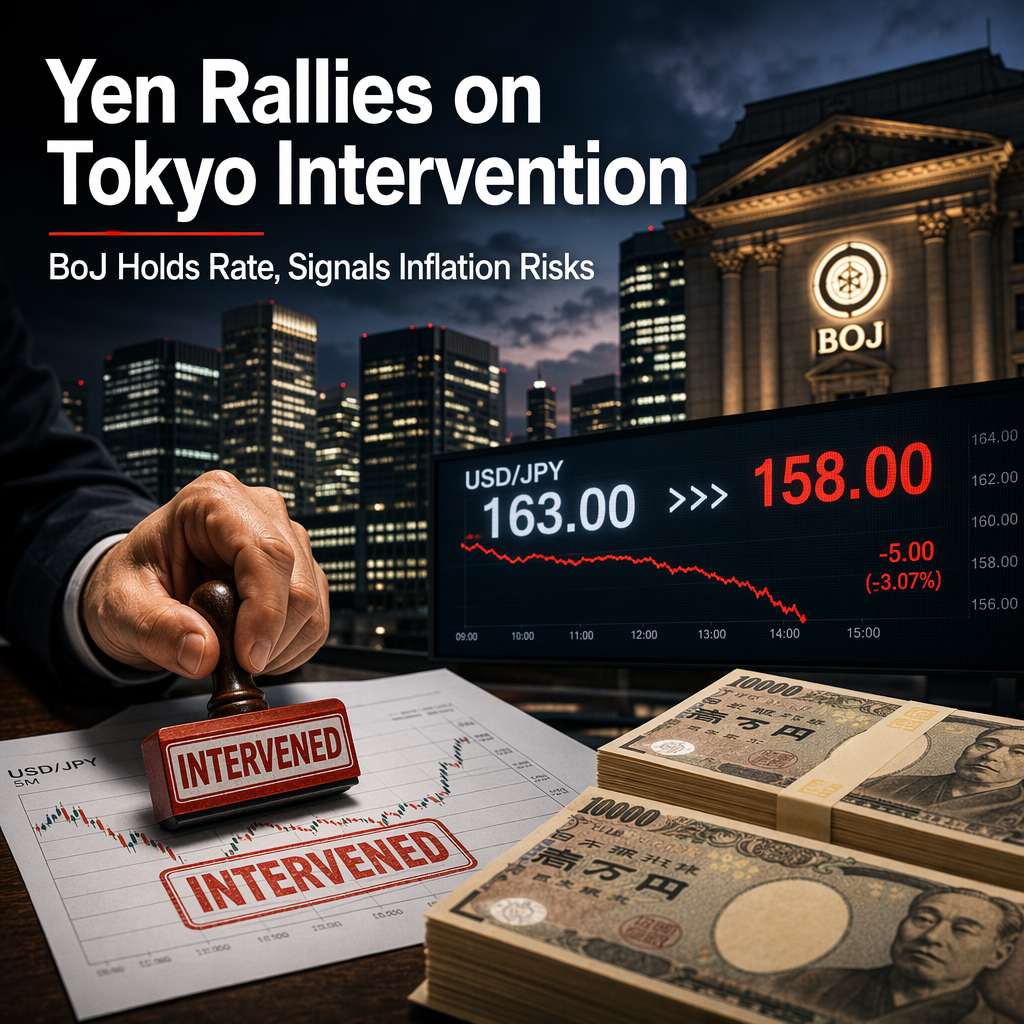
The Japanese Yen experienced a sharp surge, with USD/JPY dropping from 163.00 to 158.00, a move attributed by MUFG analysts to probable intervention by Japan's Ministry of Finance (MoF) during New York trading hours [1]. Commerzbank analysts also confirmed that the MoF's intervention in the foreign exchange market was a clear demonstration of the government's concern over the Yen's weakness, and noted explicit support from the US Treasury Department, suggesting international backing for Tokyo's efforts to stabilize the currency [2].
Following the intervention, the Bank of Japan (BoJ) kept its key policy rate unchanged at 1.00%, with an 8-1 vote, and released an updated Outlook for Economic Activity and Prices. The BoJ's guidance was modestly more hawkish, referencing upside inflation risks and highlighting that foreign exchange developments are increasingly contributing to these risks. The forecast for core nationwide CPI for FY2026 was lowered from 2.8% to 2.5%, while the FY2027 forecast was raised to 2.4% from 2.3%, indicating building inflationary pressures [1]. BoJ Governor Kazuo Ueda warned in a press conference that there is a risk of underlying CPI deviating upward above the 2% price stability target [2].
The USD/JPY pair rebounded to around 160.30 during the European trading session on Friday, still 0.5% higher, after a significant decline the previous day. Technical analysis shows the pair maintains a bearish near-term tone, trading below the 20-period EMA at 162.23, with the RSI at 35.94 just above oversold territory. Immediate resistance is at the 20-day EMA (162.23), while Thursday's low at 158.00 serves as key support; a break below could expose 157.00 [2].
MUFG analysts suggest that while the MoF often acts on a second occasion when intervening, there may be reluctance in the market to buy USD/JPY now. However, they warn that buyers could soon return given the BoJ's lack of conviction on the necessity for faster monetary tightening, as the current pace remains at every six months [1].
CONCLUSION
Japan's Ministry of Finance intervention triggered a sharp Yen rally, underscoring official concern over currency weakness and receiving international support. The BoJ maintained its policy rate and issued hawkish inflation guidance, but signaled no acceleration in tightening. Market sentiment remains cautious, with technical indicators suggesting further downside risk for USD/JPY if key support levels are breached.