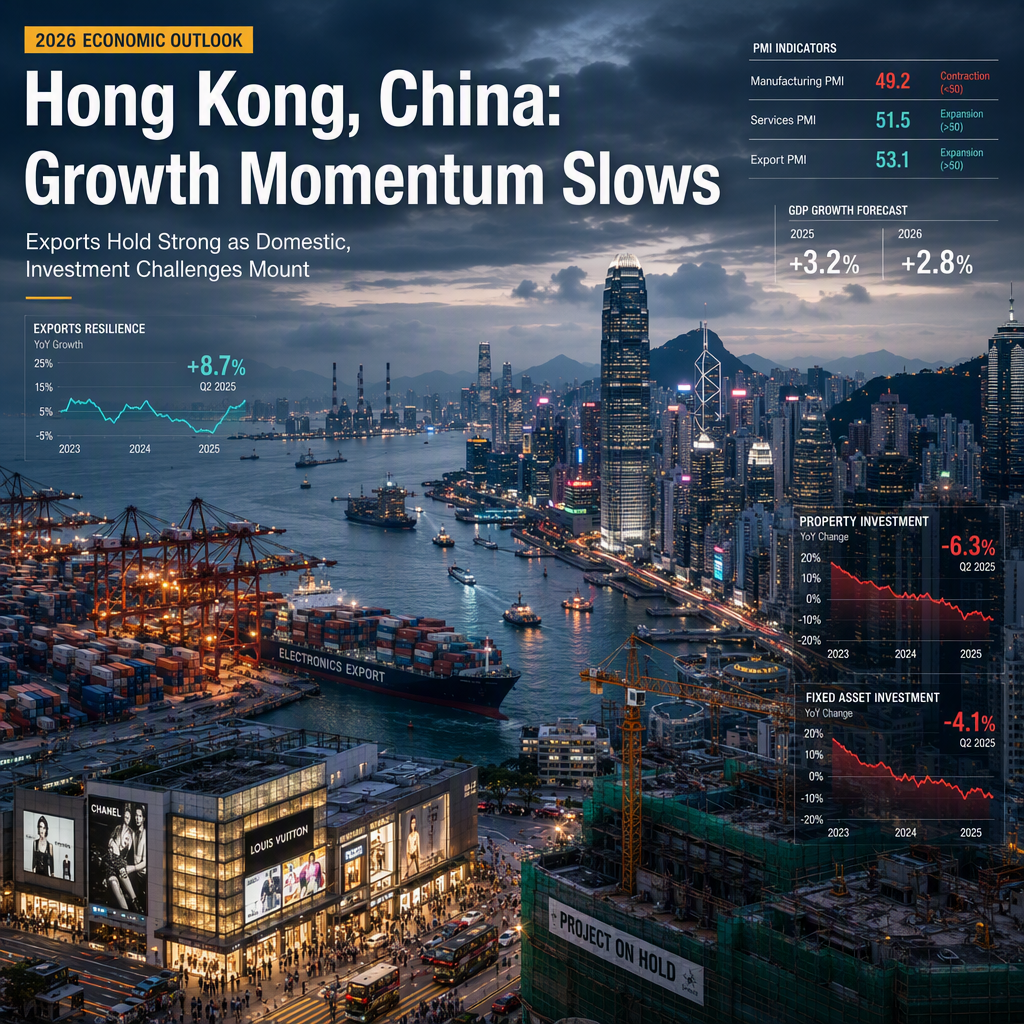
Hong Kong's economic growth moderated in the second quarter of 2026, with GDP rising 4.3% year-on-year, down from 5.9% in the first quarter, and contracting 0.6% quarter-on-quarter—the first decline since the fourth quarter of 2022. This slowdown was sharper than expected, as Bloomberg estimated 4.9% and UOB forecasted 4.4% for the quarter. Despite the moderation, goods exports, particularly electronics products such as semiconductors and ICT equipment, remained robust, accounting for 57% of Hong Kong's exports in the first five months of 2026. The ongoing global AI investment cycle is expected to continue supporting Hong Kong's export performance throughout the year. Domestic consumption has shown resilience, with retail sales by value growing for the 13th consecutive month in May, driven by consumer durables and a 13% year-on-year rise in visitor arrivals in the first half of 2026. The residential property market also strengthened, with home prices rising for the 13th consecutive month in June, up 0.3% month-on-month and 12.7% year-on-year, and a 7.9% gain in the first half of 2026, more than double the increase seen in 2025. UOB maintains its GDP growth forecast for Hong Kong at 3.9% for 2026 and 2.4% for 2027, above the government's official forecast range of 2.5%-3.5% for 2026. However, downside risks remain due to tighter Mainland capital controls and geopolitical uncertainties [1].
In China, Standard Chartered economists report that July data likely showed weaker momentum, with official PMIs for manufacturing, services, and construction all below 50 and at multi-year lows. The manufacturing PMI dropped to 49.2, indicating contraction, and new orders PMI fell deeper below 49. Trade and industrial production remained resilient but eased, with the semiconductor sector continuing to support activity. CPI inflation likely eased to 0.5% year-on-year in July, the first below-1% reading in six months, mainly due to declines in food and fuel prices. PPI likely dropped month-on-month on falling petrol-related product prices, but headline inflation may have stayed at 4.1% year-on-year. Retail sales growth was supported by base effects, while fixed-asset investment remained in contraction and adverse weather disrupted construction activity. Real-estate investment continued to be a key drag, and overall loan demand likely remained weak, though corporate and government bond financing supported broad credit growth [2].
Both Hong Kong and China are experiencing a moderation in growth momentum after strong starts to the year. Hong Kong's export sector, particularly electronics, remains a bright spot, while domestic consumption and property markets show resilience. In China, manufacturing and services activity have softened, with inflation easing and investment remaining subdued. Analysts highlight ongoing risks from capital controls, geopolitical uncertainties, and adverse weather effects, but also note continued support from global technology cycles and bond financing [1][2].
CONCLUSION
Hong Kong and China are both seeing a slowdown in growth momentum, with Hong Kong's exports and property market providing some support, while China faces contraction in manufacturing and investment. Market sentiment is cautious, with analysts maintaining moderate growth forecasts but highlighting downside risks from external and domestic factors. The outlook remains mixed, with resilience in certain sectors but broader challenges weighing on overall economic performance.