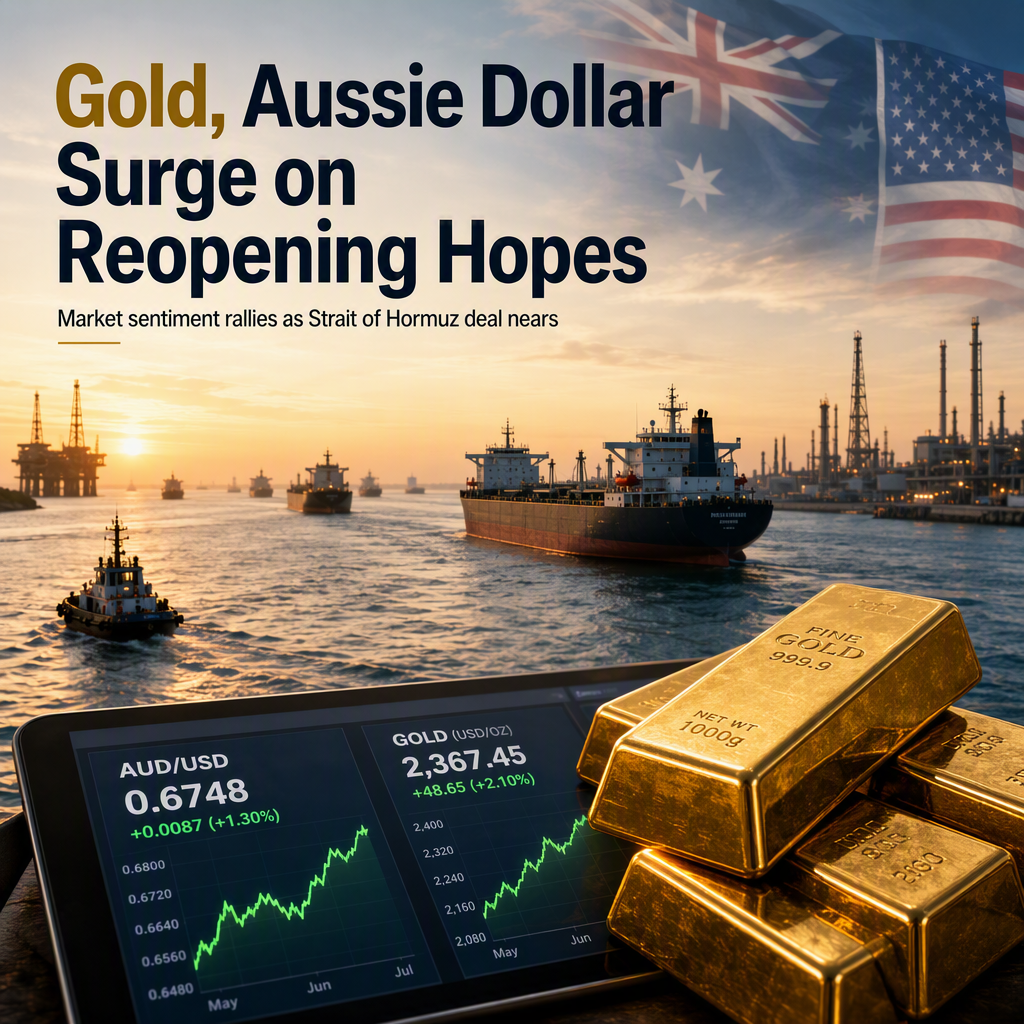
On Tuesday, both Gold (XAU/USD) and the Australian Dollar (AUD/USD) experienced notable gains as market sentiment improved following encouraging headlines about a potential agreement to reopen the Strait of Hormuz. US Treasury Secretary Scott Bessent stated in a CNBC interview, 'We are in talks with the Iranians,' and suggested that a deal to open the Strait could be reached as soon as Tuesday or Wednesday, although no official confirmation has been released by Tehran or Washington [1][2]. Al Arabiya also reported, citing a high-ranking source, that an announcement on reopening the Strait is expected shortly [1].
Gold rebounded to around $4,087, recovering from an intraday low near $4,042, supported by a weaker US Dollar and lower US Treasury yields. West Texas Intermediate (WTI) crude oil prices dropped to $75.50, their lowest level in three weeks, as markets priced in a normalization of global energy supplies [1][2]. Lower oil prices have eased inflation risks and reduced pressure on the Federal Reserve (Fed) to raise interest rates, with the CME FedWatch Tool showing the probability of a September rate hike falling to 57.1% from 67.2% a day earlier [1]. Source 2 reports a similar decline in rate hike expectations, with the probability at 56.9% [2].
The Australian Dollar climbed above 0.7000, trading around 0.7035 and up 0.50% on the day, benefiting from improved risk sentiment and positive domestic data. ANZ-Indeed Job Ads rose by 2% in July, and the TD-MI Inflation Gauge rebounded by 1% month-on-month, marking its first increase since April [2]. RBA Governor Michele Bullock reiterated concerns about persistently high underlying inflation and warned of potential acceleration in price pressures, supporting expectations for a restrictive monetary policy stance with markets fully pricing in one additional rate hike this year [2].
Technical analysis for Gold shows consolidation below $4,100, with the daily chart indicating neutral momentum and resistance at $4,100 and $4,200, while support is seen at $4,062 and $4,000 [1]. For AUD/USD, the pair maintains a bullish near-term bias, trading above key moving averages and trend-line supports, with the RSI near 70 indicating strong but stretched upside momentum [2].
US JOLTS Job Openings fell to 7.359 million in June from 7.594 million, slightly below the 7.4 million expected, and traders await further US labor market data later in the week, which could influence Fed rate hike expectations and impact both Gold and the US Dollar [1][2].
CONCLUSION
Market sentiment has improved on hopes of a deal to reopen the Strait of Hormuz, lifting Gold and the Australian Dollar while dragging oil prices and US rate hike expectations lower. However, the situation remains fluid with no official confirmation from Iranian authorities, and upcoming US labor market data could further influence monetary policy outlooks. Investors are advised to monitor developments closely as both Gold and AUD/USD consolidate gains amid shifting global risk dynamics.