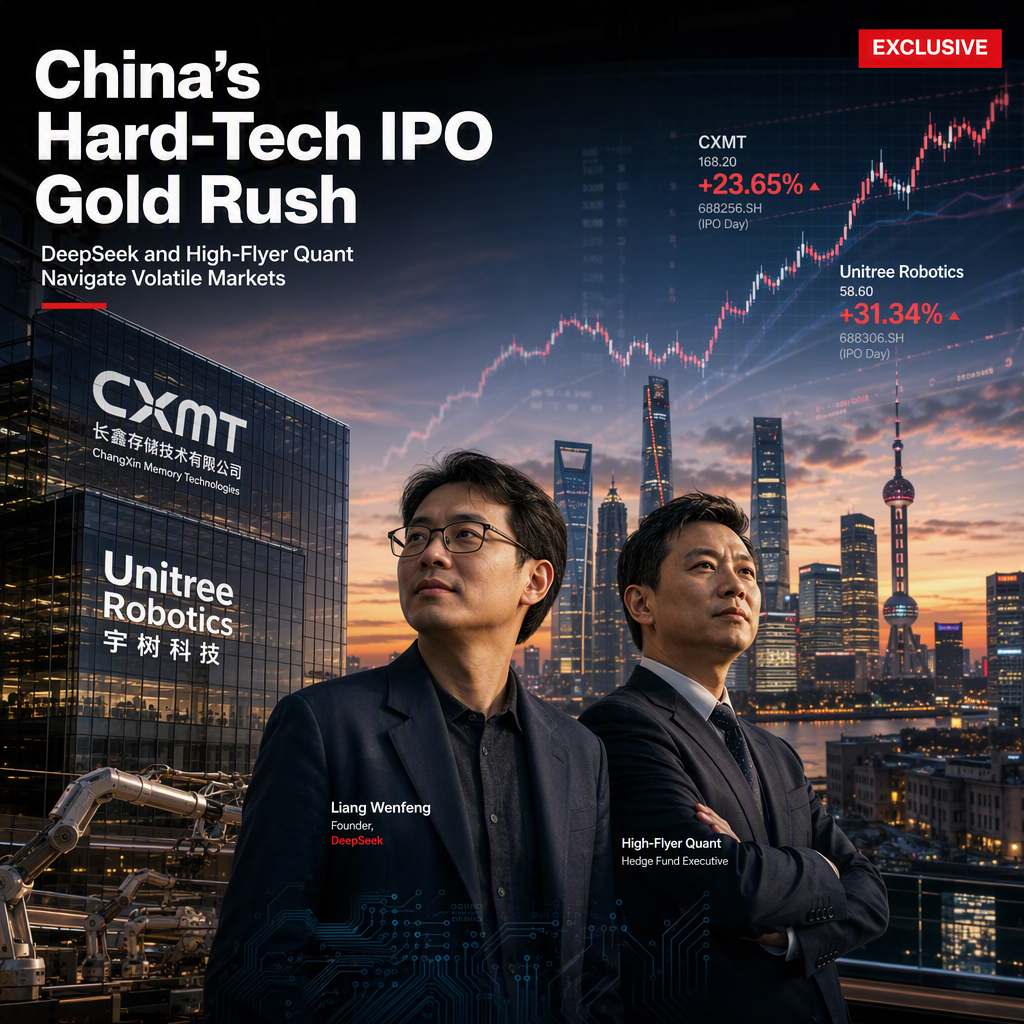
DeepSeek, the Chinese AI lab that gained prominence for its ChatGPT-like model, has historically relied on funding and computing power from High-Flyer Quant, a hedge fund co-founded by its founder Liang Wenfeng. As DeepSeek's ambitions and capital requirements expand, the company is now seeking external investors, signaling a shift away from dependence on High-Flyer Quant, whose revenue has become 'unstable' due to recent volatility in AI and chip stocks [1].
High-Flyer Quant and its affiliates, Zhejiang High-Flyer Asset Management and Ningbo High-Flyer Quantitative Investment Management, have secured significant pre-IPO allocations in several of China's leading hard-tech companies. Notably, the funds invested a combined $26 million (175 million yuan) in pre-IPO shares of CXMT, China's leading memory chipmaker. CXMT's stock surged more than fivefold upon its Shanghai debut in July and has gained an additional 20% as of Thursday, making it China's most valuable company [1].
The funds also participated in the IPO of Unitree Robotics, with a combined $5.8 million investment. DeepSeek itself received 2.31% of Unitree's offering as one of nine strategic investors and agreed to a 36-month lock-up period, which is notably longer than the typical 12-month commitment from most strategic backers [1].
According to Rhodium Group research analyst Ciel Qi, Beijing's push for strategically important tech firms to list domestically has created lucrative pre-IPO investment opportunities for funds like High-Flyer. Qi notes that maximizing returns in China's market increasingly requires alignment with Beijing's strategic agenda [1]. High-Flyer and DeepSeek did not respond to requests for comment [1].
CONCLUSION
DeepSeek's transition to seeking outside capital marks a pivotal moment as High-Flyer Quant faces revenue instability amid market volatility. The substantial gains from pre-IPO investments in companies like CXMT and Unitree Robotics highlight the lucrative opportunities in China's hard-tech sector, especially for funds aligning with national strategic priorities. The market takeaway is that strategic pre-IPO placements remain a key driver of outsized returns despite underlying volatility.