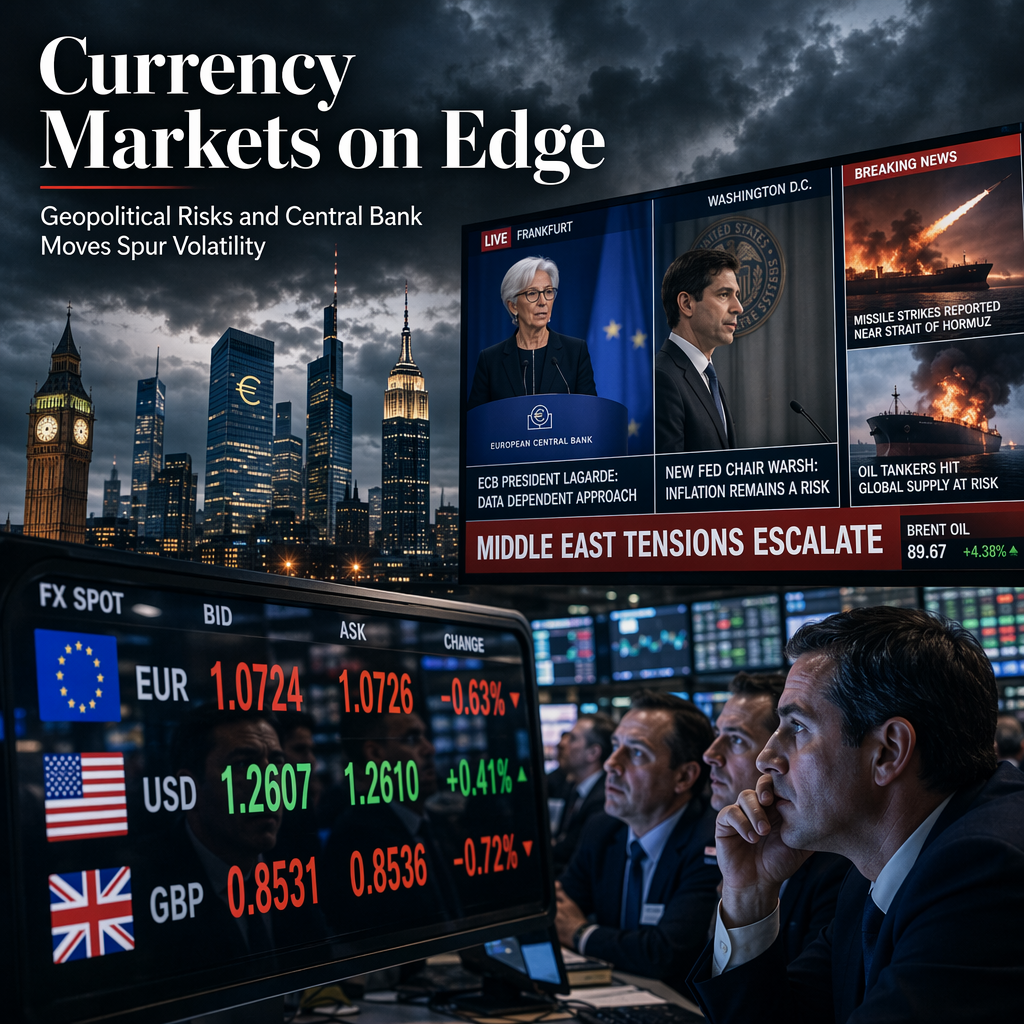
Currency markets are experiencing heightened volatility as geopolitical tensions in the Middle East intensify and major central banks prepare for key policy decisions. The Euro (EUR) extended its gains for a second consecutive day, with EUR/USD trading around 1.1410 during Asian hours on Thursday. This advance comes as the European Central Bank (ECB) is widely expected to keep its deposit facility rate unchanged at 2.25%. Market participants are closely watching ECB President Christine Lagarde’s upcoming press conference for signals on future monetary policy direction [1].
Meanwhile, the US Dollar (USD) is under pressure due to renewed inflation concerns stemming from surging energy costs and a softening US economic outlook. Uncertainty around the Federal Reserve’s policy stance, particularly with new Fed Chair Kevin Warsh’s unclear guidance, has added to the Dollar’s volatility. However, safe-haven demand for the USD may provide some support as tensions in the Middle East escalate [1].
The geopolitical backdrop has become increasingly fraught after US President Donald Trump threatened to strike Iranian infrastructure if Tehran targets ships in the Strait of Hormuz, prompting Iran to vow swift retaliation against US-linked energy assets. Iran-backed Houthi militants launched missile and drone attacks on two Saudi oil tankers in the Red Sea, marking the first direct strikes on tankers in this critical waterway and threatening a vital export route for Saudi crude [1]. According to another report, the US has conducted a 12th consecutive night of strikes against Iranian targets, and Iran has threatened further attacks across the Gulf region. Kuwait’s army reported intercepting hostile drones following several days of Iranian strikes, and Iran’s Mehr news agency stated that a location near Ahwaz was hit in a US missile strike [2].
The British Pound (GBP) has also shown resilience, rebounding to near 1.3385 against the USD during Asian trading hours. However, its upside may be limited by cooler-than-expected UK inflation data and ongoing Middle East turmoil. The UK headline Consumer Price Index (CPI) inflation slowed to 2.6% year-on-year in June, the lowest since March 2025, down from 2.8% in May and below market expectations of 2.7%. Core CPI rose 2.6% year-on-year, slightly above the forecast of 2.5%. On a monthly basis, CPI inflation declined to 0.1% in June, matching market consensus [2].
Traders anticipate the Bank of England (BoE) will keep its benchmark interest rate at 3.75% next week as it monitors the impact of the Middle East conflict. Financial markets are pricing in one or possibly two quarter-point rate hikes by the end of 2026, little changed from earlier in the week [2]. Rising tensions and the prospect of a prolonged conflict in the Middle East could bolster safe-haven demand for the US Dollar against the British Pound in the near term [2].
CONCLUSION
Currency markets are being driven by a combination of central bank policy expectations and escalating geopolitical risks in the Middle East. While the Euro and Pound have shown some strength, ongoing uncertainty and safe-haven flows into the US Dollar could limit further gains. Market participants remain focused on upcoming central bank decisions and developments in the Middle East for further direction.