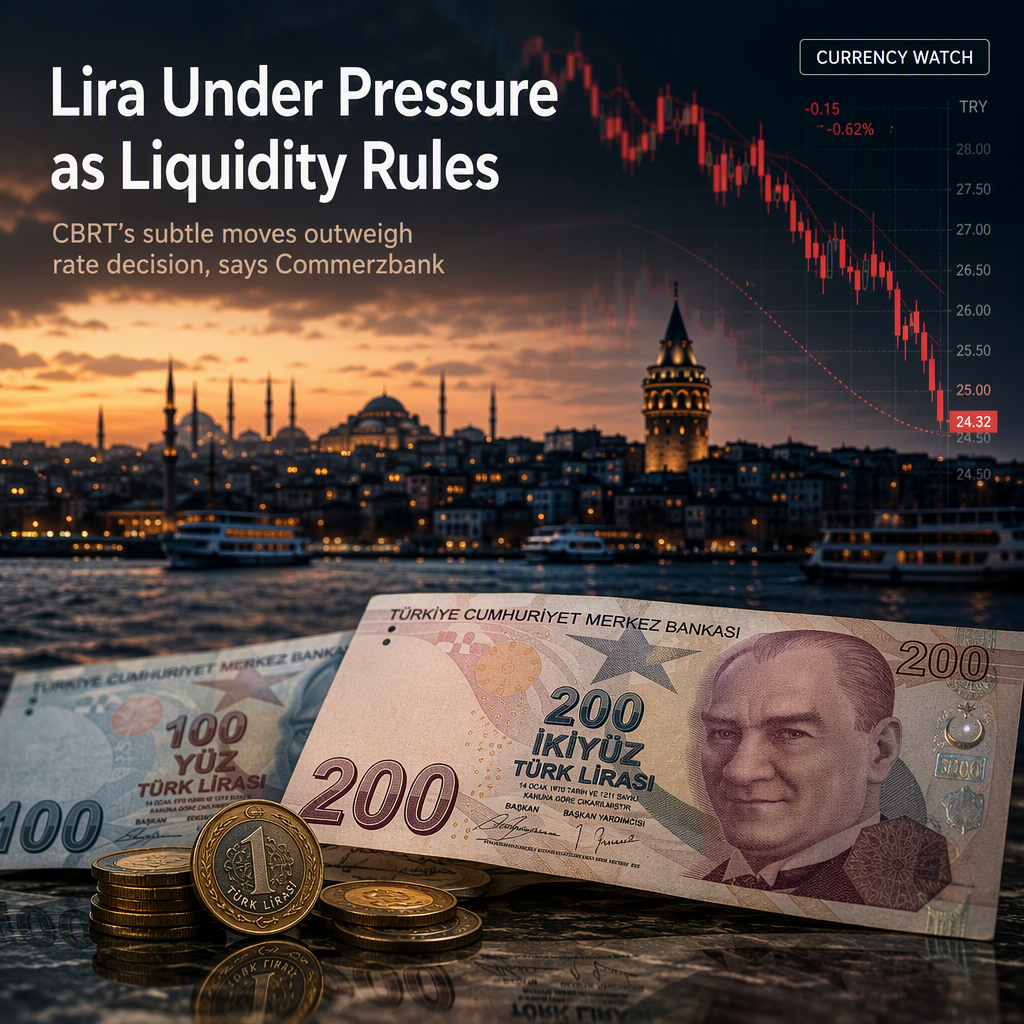
Commerzbank’s Tatha Ghose anticipates that the Central Bank of the Republic of Türkiye (CBRT) will keep the one-week repo rate unchanged at 37.0%, aligning with near-unanimous market expectations. However, Ghose emphasizes that the official policy rate is less significant than the central bank’s liquidity management tools in determining effective monetary conditions for the Turkish Lira (TRY) [1].
The report highlights that since the Middle East conflict, the CBRT had shifted funding to the 40% overnight lending facility by restricting access to one-week repo funding. On 24 August, the central bank resumed one-week repo auctions, effectively lowering the funding cost back toward 37.0%. This technical normalization, while not a formal rate cut, amounted to monetary easing in practice and was immediately followed by a noticeable acceleration in Lira depreciation [1].
Ghose warns that any further signals of easing—such as increased repo funding, softer liquidity management, or guidance suggesting the unwinding of exceptional tightening—would likely exacerbate Lira weakness, especially given persistent inflationary pressures. The seasonally-adjusted CPI rose by 2.3% month-on-month in August, unchanged from July, with core inflation measures (Core B and Core C) at 2.0% and services inflation at 2.9% month-on-month [1].
The analysis concludes that the CBRT’s communication and liquidity stance will be more influential for the Lira’s trajectory than the unchanged policy rate. If the central bank signals that liquidity normalization marks the start of easier financial conditions, the Lira is expected to remain under pressure due to ongoing strong inflation trends [1].
CONCLUSION
The Turkish central bank’s liquidity management, rather than its unchanged policy rate, is the key driver for the Lira’s outlook. Persistent inflation and any further signs of monetary easing are likely to keep the Lira under pressure, according to Commerzbank’s analysis.