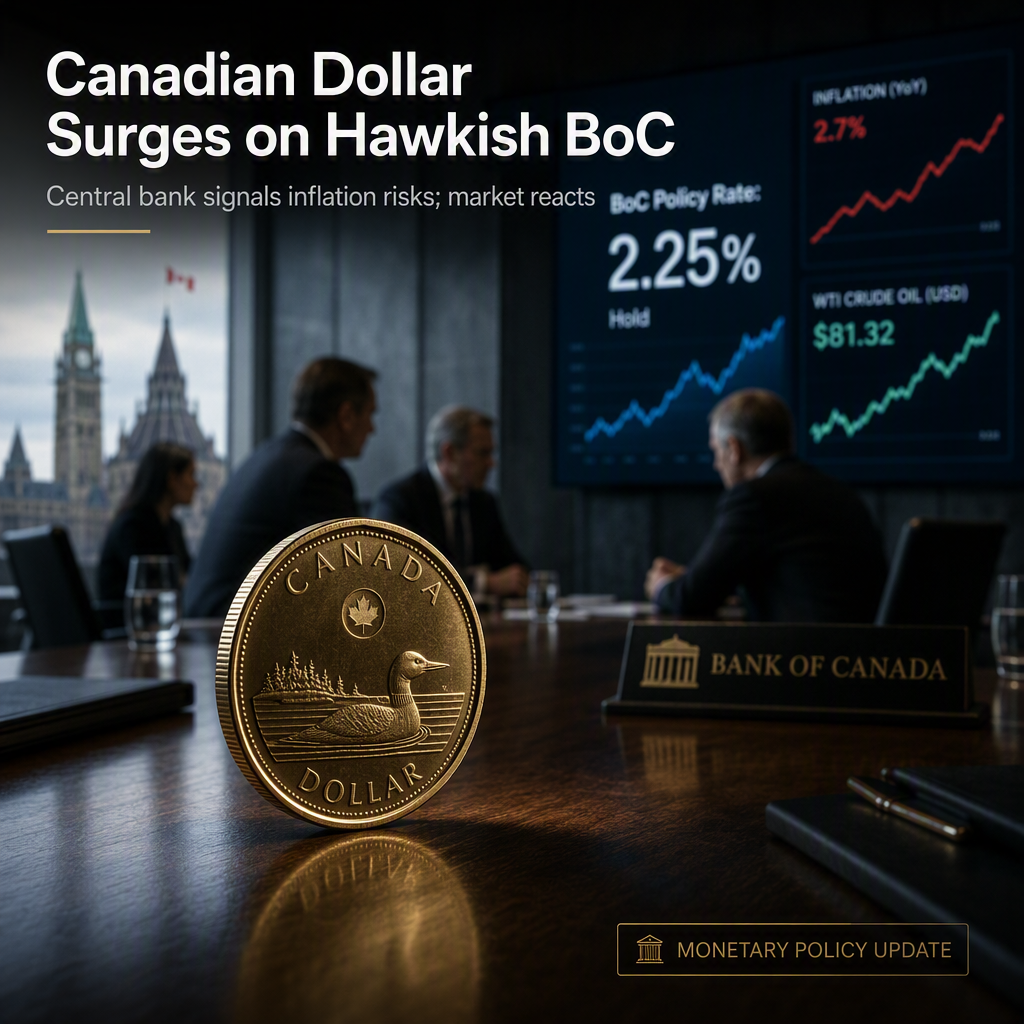
The Canadian Dollar (CAD) advanced immediately following the Bank of Canada's (BoC) decision to keep its policy rate unchanged at 2.25%, as the central bank's accompanying communications signaled increased concern over inflation risks, which was more hawkish than market participants had anticipated [1]. The BoC omitted its previous reference to the policy stance being appropriate for achieving its inflation goal and instead emphasized upside risks to inflation, particularly highlighting the 'heightened risk' that rising energy prices could spill over into broader inflation measures [1].
During the press conference, Governor Macklem addressed the impact of tariffs, noting that they were applied to a 'relatively narrow base' and, as such, the BoC did not expect a 'big ongoing impact on overall economic activity' [1]. Despite the immediate CAD strength, MUFG's short-term valuation models suggest that the USD/CAD exchange rate is currently undershooting, with both the model and the 2-year swap spread indicating that USD/CAD should be trading between 1.40 and 1.41 [1].
MUFG expresses skepticism about a sustained CAD rebound, citing these valuation divergences and noting that oil prices and Middle East risks continue to influence CAD performance [1]. The prospect of a BoC rate hike has become more relevant, which could further strengthen the correlation between CAD and oil prices, as the BoC's reaction function becomes more closely tied to energy market developments [1].
CONCLUSION
The Bank of Canada's heightened focus on inflation risks led to an immediate rise in the Canadian Dollar, though MUFG analysts remain cautious about the sustainability of this move. Short-term models suggest the CAD may be overvalued, with oil prices and geopolitical risks continuing to play a significant role in its outlook.