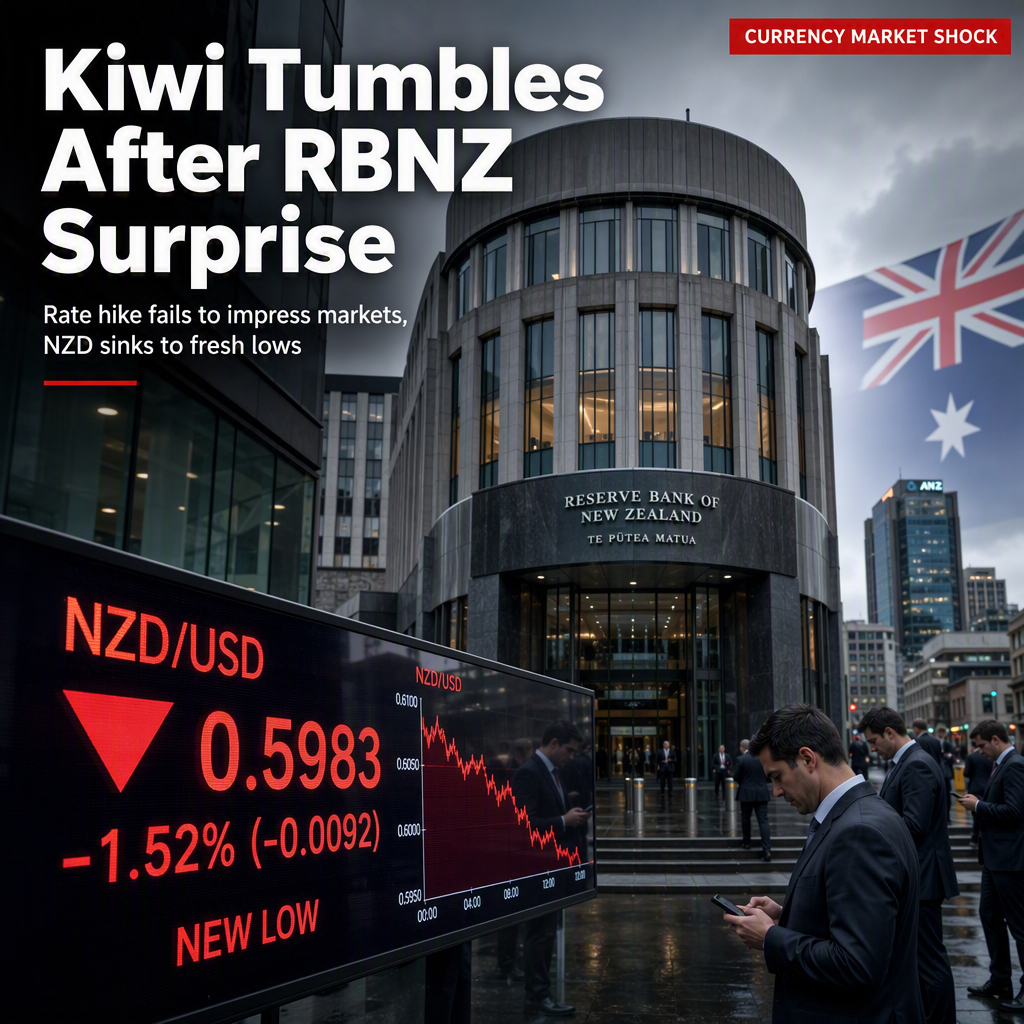
The Reserve Bank of New Zealand (RBNZ) raised its Official Cash Rate (OCR) by 25 basis points to 2.75% in a unanimous decision, marking the second consecutive increase and matching consensus expectations [1]. Despite the hike, the New Zealand Dollar (NZD) fell nearly 1.7% against the US Dollar, with NZD/USD dropping from near 0.5900 to the 0.5800 area before recovering to around 0.5850, resting on its 200-day Exponential Moving Average (EMA) [1]. The market reaction was driven by disappointment in the RBNZ's forward guidance, which projected only one more quarter-point hike before year-end and no further increases, in contrast to market expectations of a much longer tightening cycle extending into 2027 [1]. Rate markets had priced in approximately 95 basis points of additional tightening out to mid-2027, leading to a significant repricing and making the Kiwi the weakest major currency on the day [1].
The RBNZ's press conference reinforced the perception of a potential pause, with the Governor indicating the bank would now assess the effects of the two consecutive hikes, signaling a flatter policy rate trajectory [1]. The underlying inflation being targeted is largely due to imported energy shocks, with New Zealand's headline inflation at 4.1% in Q2—over two points above the target midpoint—while core inflation excluding vehicle fuels is at 2.9%, within the target band [1]. The market has interpreted the tightening as less credible since it addresses external price shocks beyond the central bank's control, and if energy prices decline, the case for further hikes may dissipate [1]. Cross-currency movements confirmed the NZD's weakness, as AUD/NZD gained 1.07% and approached the top of a long-standing range [1].
Meanwhile, the Australian Dollar (AUD) strengthened against the US Dollar, with AUD/USD rising 0.35% to 0.7169, buoyed by softer US labor data and stronger-than-expected Australian GDP growth for Q2 2026 (0.4% QoQ and 2.1% YoY) [2]. The AUD's advance was further supported by positive market sentiment and technical factors, with the pair holding above key moving averages and trend-line supports [2]. The AUD/NZD cross also reflected the NZD's underperformance, as noted in both the price action and the broader market context [1][2].
Looking ahead, the RBNZ's cautious stance and the market's repricing suggest limited upside for the NZD unless external inflation pressures persist or reverse [1]. In Australia, upcoming economic data, including PMIs and trade balance figures, may influence the AUD's trajectory, but the Reserve Bank of Australia remains focused on inflation [2].
CONCLUSION
The RBNZ's rate hike failed to meet market expectations for a prolonged tightening cycle, triggering a sharp selloff in the New Zealand Dollar and making it the weakest major currency on the day. The market's focus has shifted to the credibility of further tightening amid external inflation pressures, while the Australian Dollar has benefited from stronger domestic data and relative NZD weakness. The outlook for the NZD remains cautious, with further moves likely dependent on global energy prices and central bank guidance.