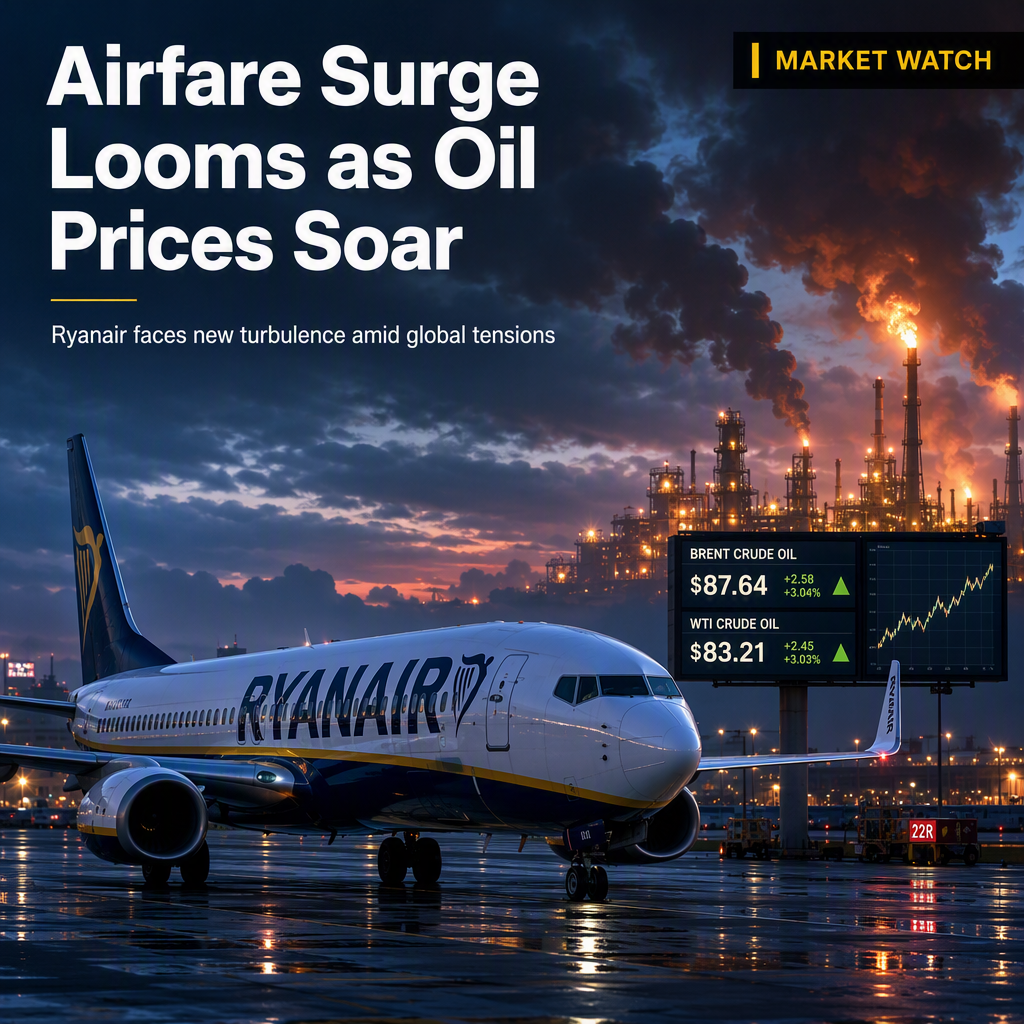
Ryanair CEO Michael O'Leary has cautioned that airfares could experience a 'significant uplift' next year if oil prices remain elevated, citing the ongoing surge in jet fuel costs as a major pressure point for the airline industry [1]. O'Leary stated, 'We expect pricing to be very modestly down in the second quarter (from July to September), but the December and March quarters are entirely up in the air.' He emphasized that if oil prices stay high into next year, a substantial increase in airfares is likely, though the company hopes to avoid this outcome [1].
Oil prices have continued to rise, with Brent crude remaining above $100 per barrel and U.S. West Texas Intermediate crude futures climbing 1.4% to $97.4 per barrel, driven by concerns over escalating tensions in the Middle East and their potential impact on energy supplies [1]. The cost of jet fuel, a critical input for airlines, has soared to $171 per barrel for the week ending September 4, marking a 90% increase from the prior year's average, according to the International Air Travel Association's Jet Fuel Price Monitor [1].
Ryanair has taken steps to mitigate some of the impact by hedging 80% of its jet fuel needs for the summer period. For 2027, the company is hedged at $67 per barrel, but for 2028, only 15% of its requirements are hedged at $85 per barrel, indicating increased exposure to price volatility in the future [1]. The airline's first-quarter profit suffered a 34% decline due to delayed consumer bookings following the onset of the U.S.-Iran war on February 28, with ticket prices lowered to stimulate demand amid heightened consumer anxiety [1].
In April, O'Leary had assured that there would be no price increases, fuel hedging, or fuel surcharge levies for the summer, regardless of supply conditions. However, the current environment of rising oil and jet fuel prices, coupled with geopolitical instability, has cast uncertainty over future pricing strategies [1].
CONCLUSION
Ryanair faces significant cost pressures from soaring oil and jet fuel prices, exacerbated by Middle East tensions. While the company has hedged a portion of its fuel needs, CEO Michael O'Leary warns that sustained high oil prices could force a notable increase in airfares next year. The situation remains fluid, with future pricing dependent on energy market developments and geopolitical events.