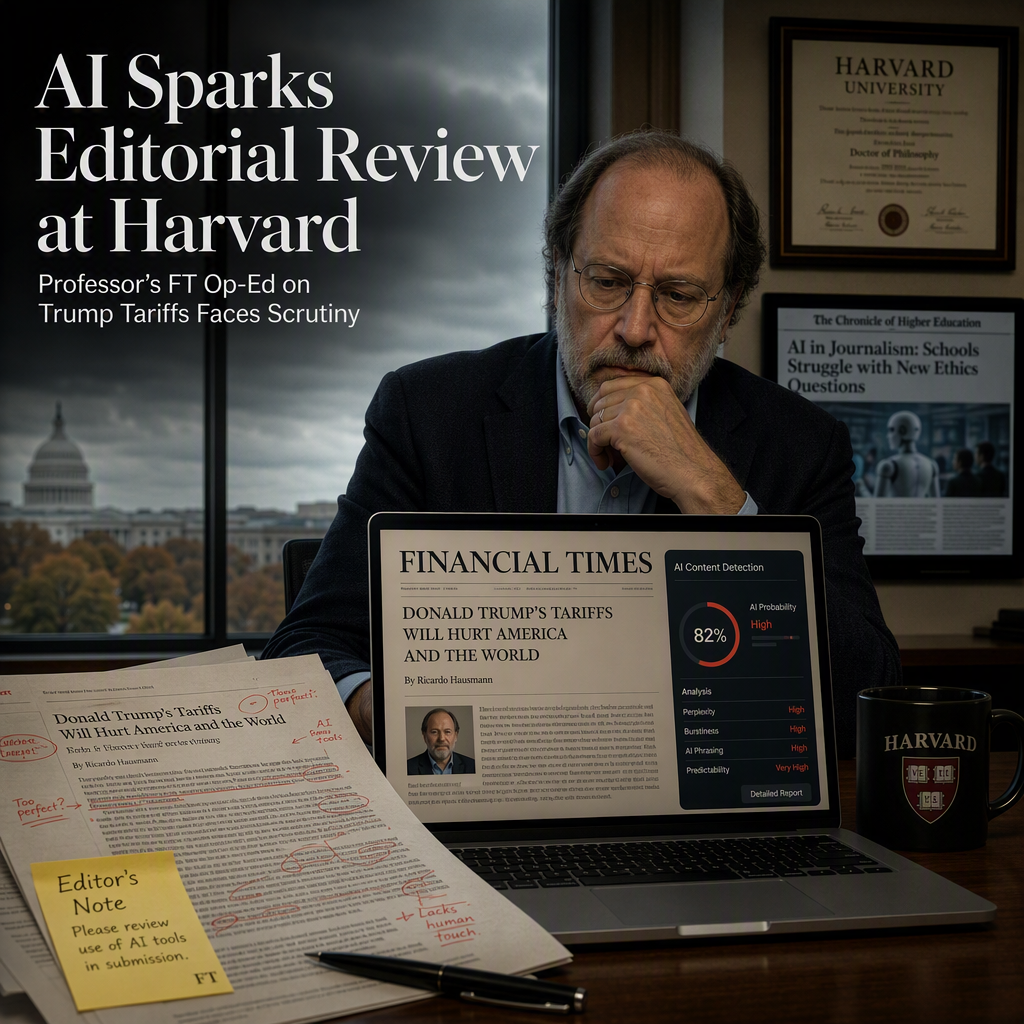
Harvard professor Ricardo Hausmann has come under criticism after it was revealed that he used artificial intelligence to condense a longer draft of his opinion piece published in the Financial Times (FT) on August 13, which criticized Trump-era tariffs. The FT attached an editor's note to Hausmann's column, stating that the use of AI in the writing process is prohibited by the publication's editorial code of conduct and that an editorial review process would be conducted to examine the piece further [1].
Hausmann's op-ed, titled 'Trump is taxing the dark matter that pays America’s way,' argued that the largest US tariff increase in nearly a century did not reduce America's current account deficit, which remained at $1.18 trillion in 2025, virtually unchanged from the previous year. He stated, 'A current account deficit is not a scorecard of trade cheating; it is the gap between what a country invests and what it saves, and tariffs alter neither' [1].
The revelation of AI use in the op-ed sparked online reactions. Bloomberg's Joe Weisenthal expressed astonishment at both the writing and publication of the piece, while Dartmouth political scientist Brendan Nyhan shared an image showing Pangram, an AI detection software, indicating that 71% of the text was 'AI-generated.' Harvard student and freelance writer Alex Bronzini-Vender criticized the quality of the AI-generated content [1].
This incident occurs amid broader debates in higher education about the appropriate use of AI, with some universities implementing stricter policies and others questioning whether current approaches adequately prepare students for a world where AI is increasingly prevalent [1].
CONCLUSION
The use of AI by a Harvard professor to condense a Financial Times op-ed has prompted editorial review and sparked debate about AI's role in journalism and academia. While the op-ed itself critiqued the effectiveness of Trump-era tariffs, the controversy centers on editorial standards and the evolving challenges posed by AI in content creation.