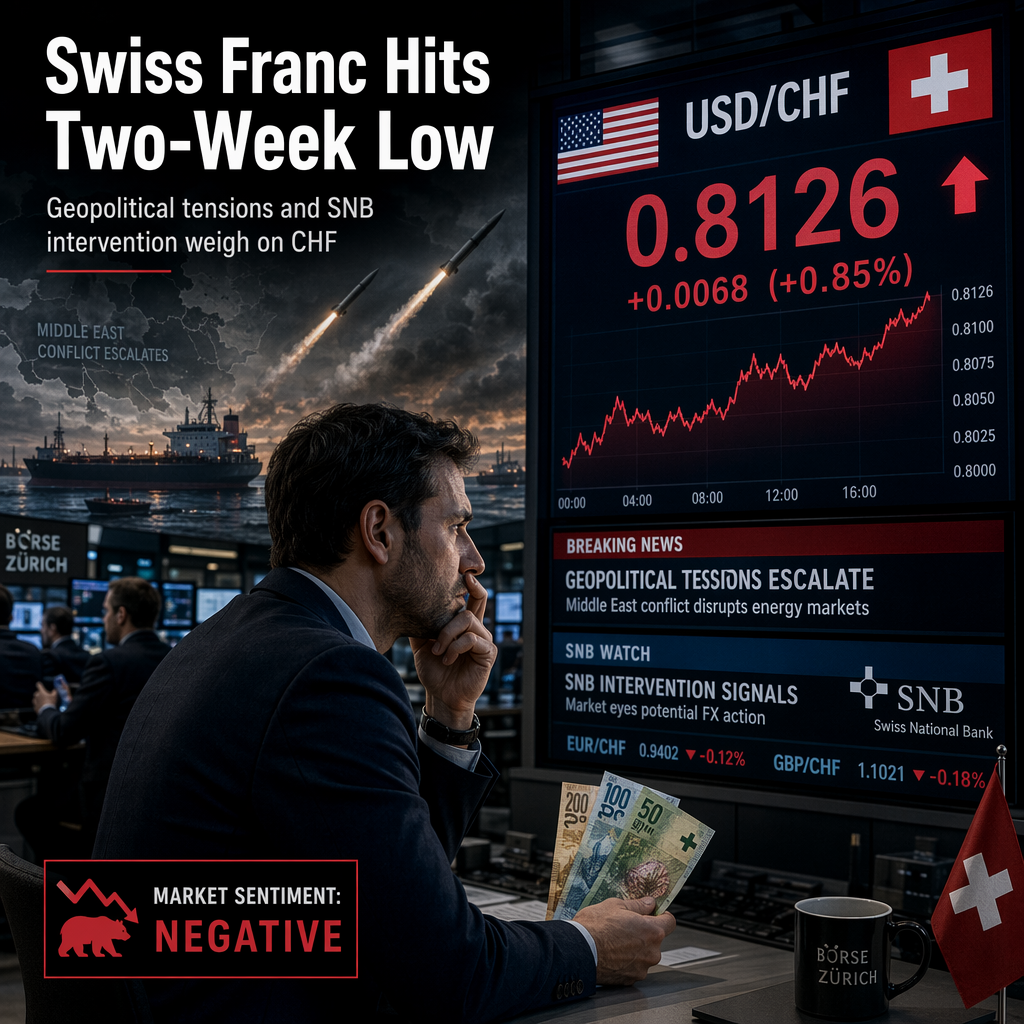
The Swiss Franc (CHF) weakened to its lowest level against the US Dollar (USD) in more than two weeks on Monday, with the USD/CHF pair trading around 0.8126, up 0.50% on the day and marking its highest level since June 25 [1]. This decline occurred despite only modest gains in the US Dollar, as the US Dollar Index (DXY) was up 0.17% at 101.13 [1]. The market reaction was driven by renewed hostilities in the Middle East, specifically missile and drone exchanges between the United States and Iran over the weekend, and Tehran's claim of closing the Strait of Hormuz, which pushed oil prices higher and stoked inflation concerns [1].
Despite the heightened geopolitical uncertainty, the Swiss Franc failed to attract sustained safe-haven demand. Since the outbreak of the US-Iran war in late February, the CHF has depreciated by more than 5% against the USD [1]. The Swiss National Bank's (SNB) increased willingness to intervene in the foreign exchange market has also pressured the currency. According to foreign exchange transaction data published on June 30, the SNB purchased CHF 3.94 billion worth of foreign currency in the first quarter of 2026 [1]. Rabobank Senior FX Strategist Jane Foley noted that SNB President Schlegel reiterated the central bank's readiness to intervene if necessary, emphasizing that FX intervention remains a policy tool to dissuade speculative buying and prevent CHF appreciation [1].
Looking ahead, traders are cautious about pushing the US Dollar higher before the release of Tuesday's US Consumer Price Index (CPI) data and Fed Chair Kevin Warsh's congressional testimony, which could provide further guidance on the interest rate outlook [1]. The CHF was the strongest against the Japanese Yen today, but overall, it showed weakness against most major currencies, including a 0.45% decline versus the USD [1].
CONCLUSION
The Swiss Franc's decline against the US Dollar reflects a combination of geopolitical tensions, inflation concerns, and the Swiss National Bank's intervention stance. Market participants are awaiting key US economic data and Fed commentary for further direction, while the SNB's actions continue to weigh on the CHF. The overall market sentiment towards the Swiss Franc remains negative in the short term.