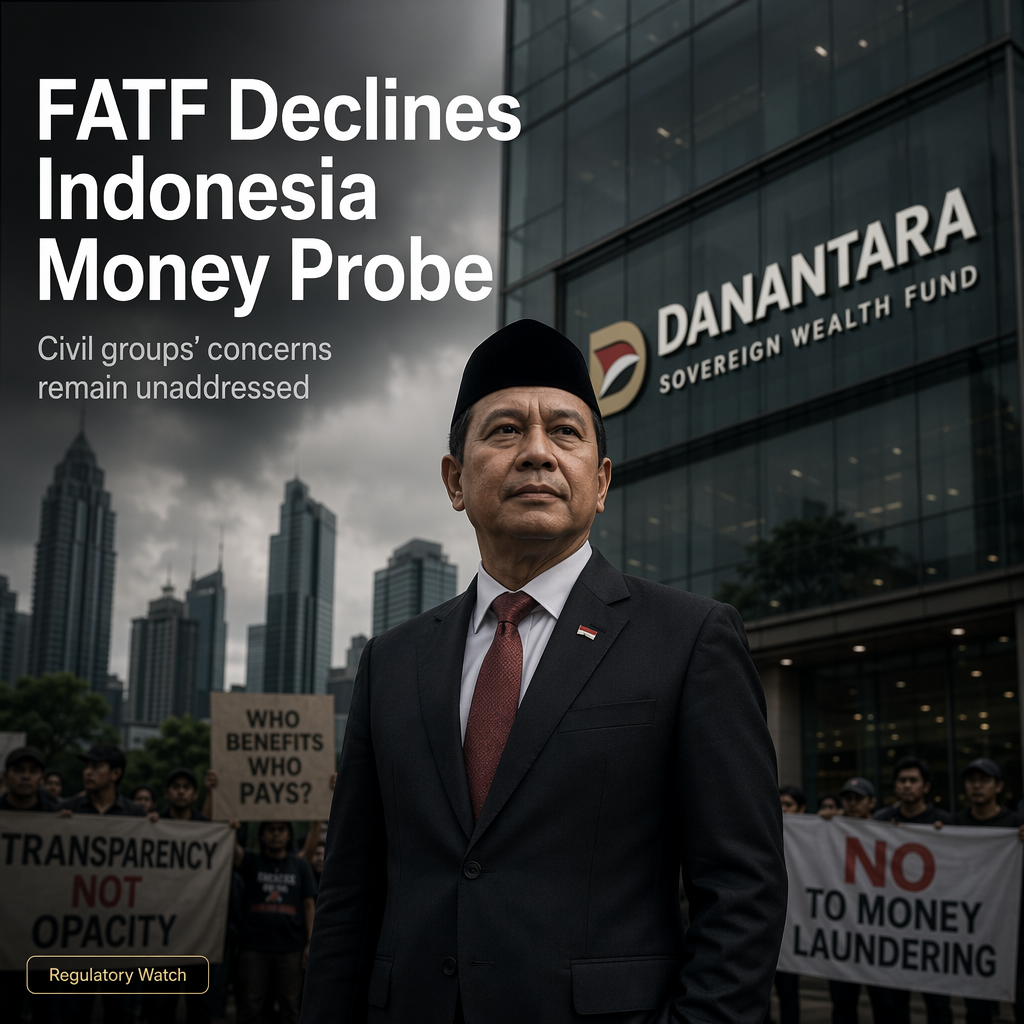
A coalition of Indonesian civil society groups raised alarms over recent changes to Indonesia's financial law, claiming that the new legislation permits corrupt assets to be used for purchasing bonds issued by the Danantara sovereign wealth fund. These groups formally requested that the Financial Action Task Force (FATF), a global anti-money laundering watchdog, investigate the potential for money laundering facilitated by these legal revisions [1].
Despite the concerns presented by the coalition, the FATF has decided not to launch a probe or review into the Indonesian legislation at this time. The watchdog's decision means that, for now, there will be no international scrutiny or intervention regarding the alleged risks associated with the Danantara bond issuance and the revised financial law [1].
The article does not provide specific market reactions, analyst opinions, or forward-looking statements regarding the potential impact of the FATF's decision on Indonesia's financial markets or the Danantara sovereign wealth fund [1].
CONCLUSION
The FATF's decision not to investigate Indonesia's new financial legislation leaves concerns from civil society groups unaddressed at the international level. The absence of a probe may ease immediate regulatory pressure, but questions about the potential for money laundering through Danantara bonds remain unresolved.