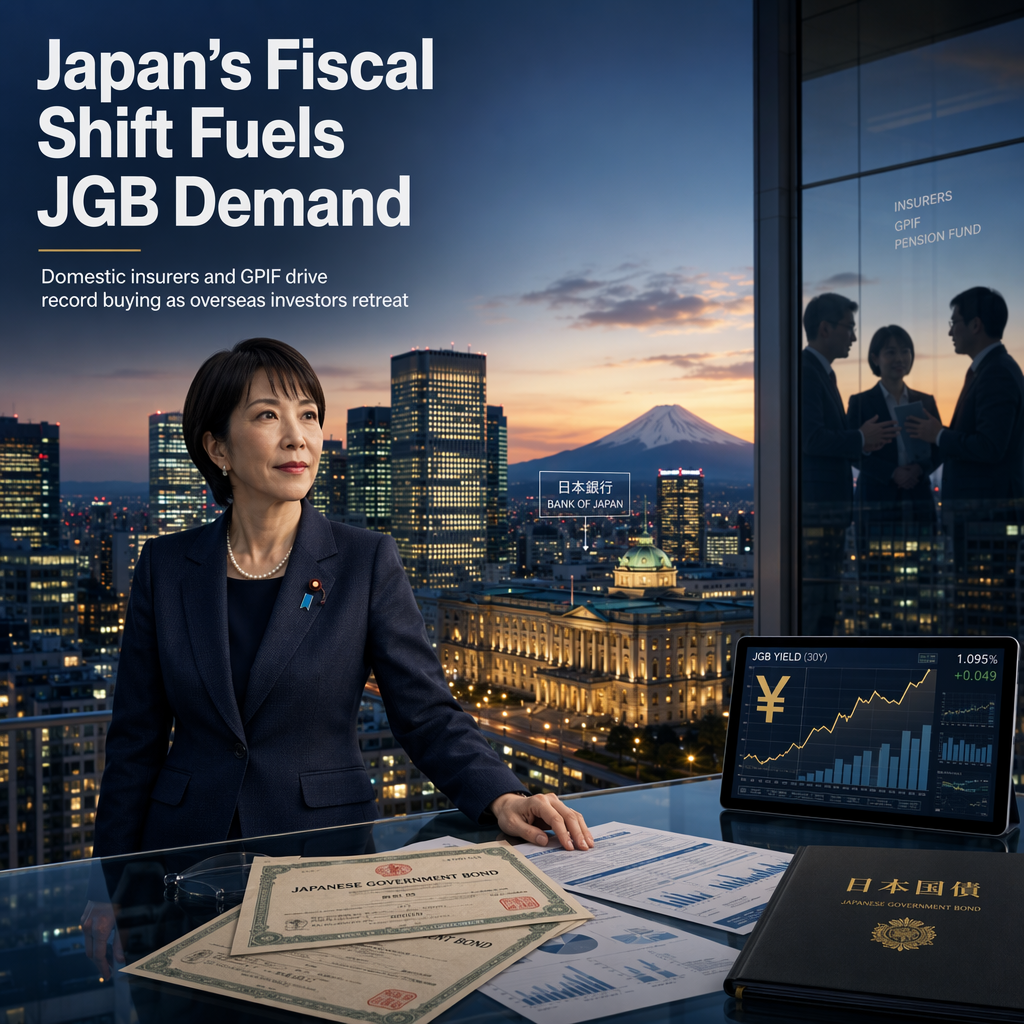
Japan's Cabinet, under Prime Minister Sanae Takaichi, has approved its first economic and fiscal policy guidelines, marking a significant shift toward aggressive and strategic fiscal spending. The new blueprint abandons the traditional single-year primary surplus goal and instead focuses on long-term investment, targeting ¥370 trillion in combined public-private investment by fiscal 2040, with a particular emphasis on 17 sectors, especially semiconductors [1]. The guidelines introduce a new budget allotment from fiscal 2027 and aim to steadily lower the debt-to-GDP ratio over time, with government targets set for real growth above 1% and nominal growth above 3% [1].
The policy shift has influenced Japanese government bond (JGB) markets. In June, Japanese insurers purchased a net ¥630.5 billion of super-long JGBs (maturities over 10 years), the largest amount since July 2023, indicating renewed demand from key domestic buyers as yields have become more attractive following a peak in mid-May [1]. This trend is supported by policy proposals such as adding government bonds to a tax-free investment program and Prime Minister Takaichi's encouragement for the Government Pension Investment Fund (GPIF) to increase investment in Japanese financial assets [1].
Conversely, overseas investors sold the most 2-year and 5-year JGB notes since December 2022, reflecting weakened demand after the Bank of Japan (BoJ) raised rates in mid-June and signaled the possibility of further hikes if economic conditions warrant [1]. The government reiterated that monetary policy remains the BoJ's responsibility and announced plans to decide on a possible food tax cut by early August [1].
Overall, the combination of proactive fiscal policy, increased domestic demand for long-dated JGBs, and shifting overseas investor sentiment is reshaping Japanese yen rate dynamics and the broader fixed income market [1].
CONCLUSION
Japan's new fiscal guidelines under Prime Minister Takaichi signal a decisive move toward long-term investment and proactive spending, with significant implications for JGB demand and yen rates. Increased domestic buying of super-long JGBs contrasts with overseas selling, reflecting diverging investor responses to policy changes and BoJ rate signals. The market is likely to remain sensitive to further fiscal and monetary developments.