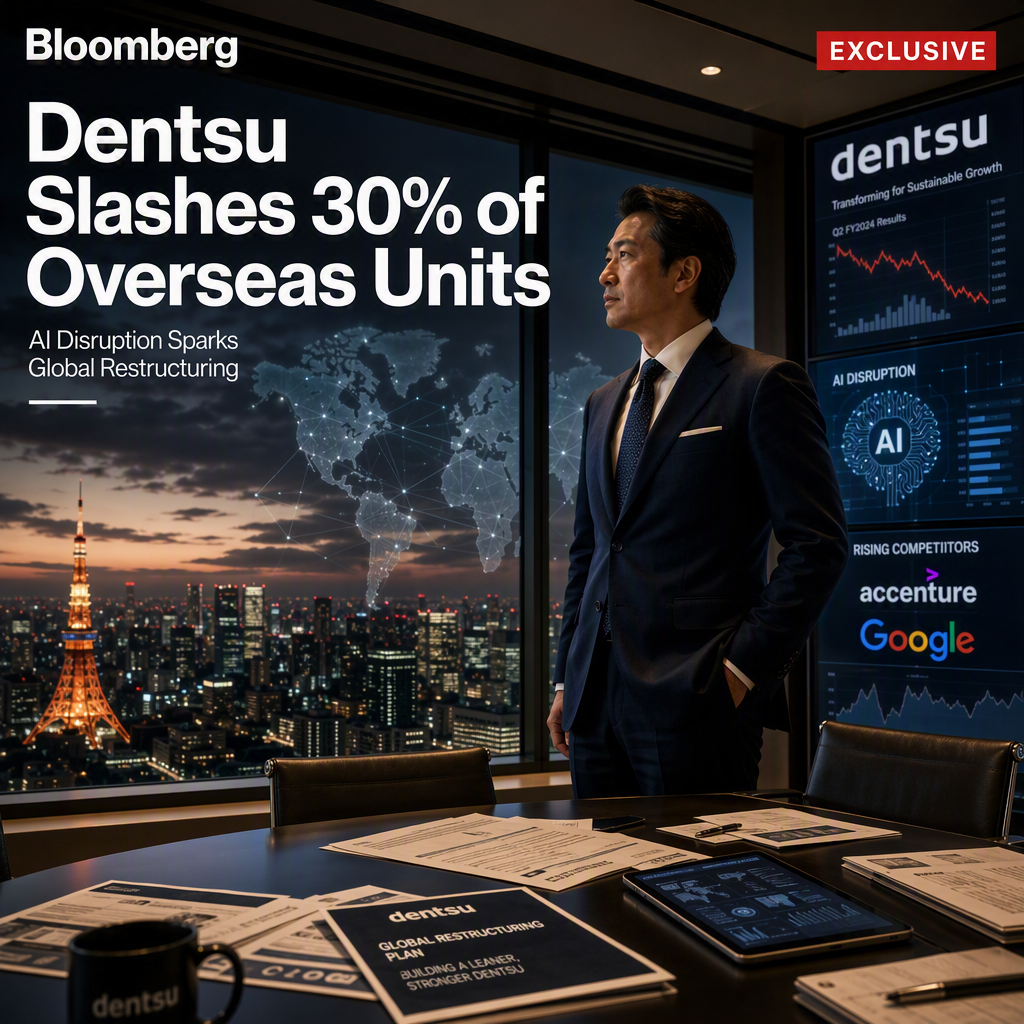
Japanese advertising giant Dentsu Group announced on Friday that it will reduce the number of its overseas subsidiaries by up to 30% by fiscal 2028, as part of a major restructuring effort to address the growing influence of artificial intelligence in the advertising sector [1]. This move comes as Dentsu seeks to streamline its international operations and focus on its core strengths, responding to heightened competition from consulting and technology firms such as Accenture and Google, which are leveraging AI to disrupt traditional advertising models [1].
Financially, Dentsu reported a profit for the January-June period, marking a significant turnaround from a loss in the same period the previous year [1]. The company is undertaking business and structural reforms aimed at restoring and sustaining profitability in the face of industry changes [1].
Market analysis in the article highlights that the rise of AI is fundamentally altering the competitive landscape, putting pressure on traditional agencies like Dentsu to innovate and improve efficiency [1]. Dentsu's restructuring is seen as a strategic response to these evolving market demands and technological advancements [1].
While no specific trading advice or price targets were provided, the article notes that investors may interpret Dentsu's return to profitability and aggressive restructuring plans as positive signals. However, the company's long-term success will depend on its ability to adapt and compete with AI-driven rivals in the rapidly changing advertising market [1].
CONCLUSION
Dentsu's decision to cut 30% of its overseas subsidiaries by fiscal 2028 signals a proactive response to the challenges posed by AI-driven competitors. The company's return to profitability and focus on restructuring are likely to be viewed positively by investors, though its future performance will hinge on successful adaptation to industry changes.