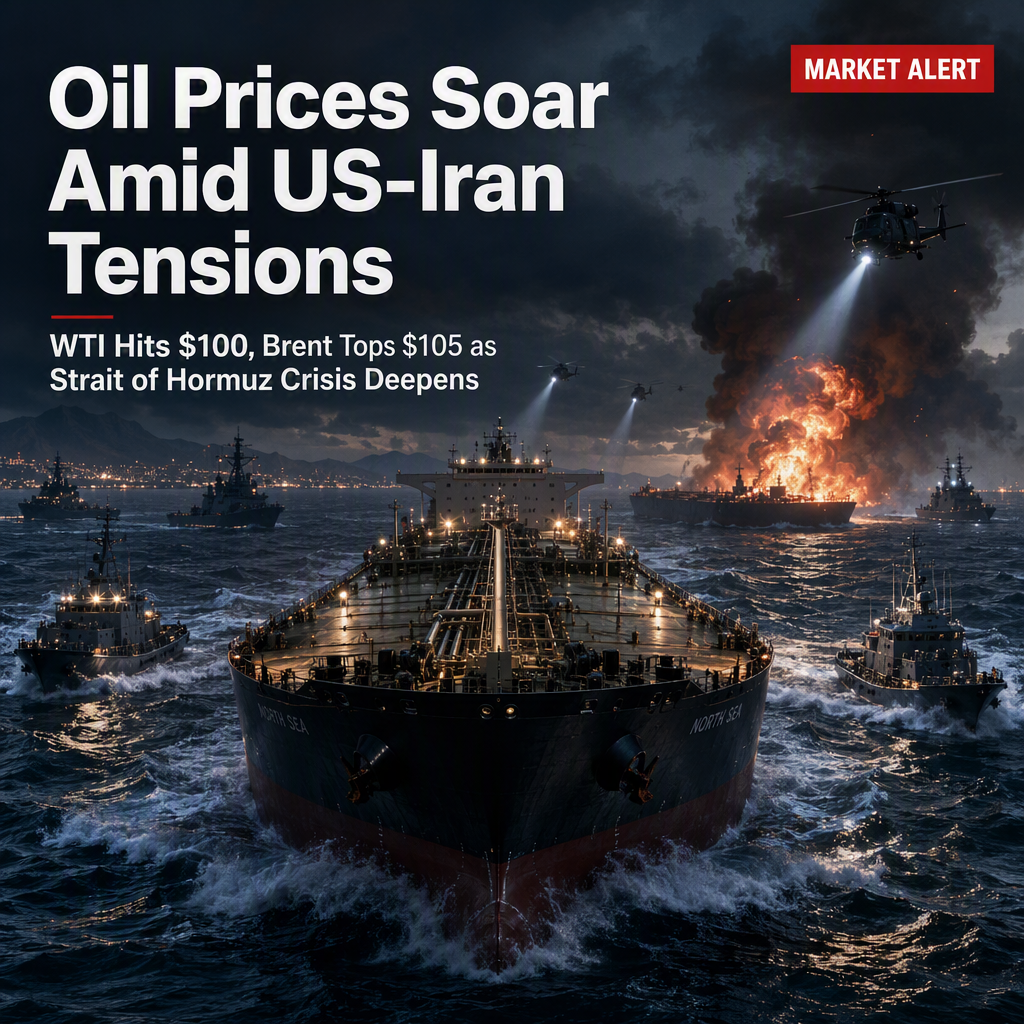
Oil prices surged sharply on Thursday amid escalating conflict between the United States and Iran, with West Texas Intermediate (WTI) crude trading around $97.00 per barrel, up 2.93% on the day according to FXStreet [1], and hitting $100 per barrel, its highest level since mid-May, as reported by NBC News [2]. Brent crude also surpassed $105 per barrel for the first time since May [2]. The renewed geopolitical risk premium is driven by heightened tensions following a series of maritime attacks near the Strait of Hormuz, where Iran reportedly attacked 10 ships after the US sank five Iranian oil tankers, marking the largest wave of attacks on shipping since the conflict began six months ago [1].
The Strait of Hormuz remains a critical route for Middle Eastern energy exports, and the market is highly sensitive to any threats that could disrupt oil flows through the region [1]. Additional supply concerns have arisen from attacks by Iran-backed Houthi militants on Saudi Arabian energy facilities, which led to temporary suspensions of some operations [1]. Overnight, Saudi Arabia informed OPEC that its crude oil output plunged to the lowest level since 1990 due to renewed hostilities with Iran, according to Bloomberg News, though NBC News was unable to immediately confirm this report [2].
On the US supply side, the American Petroleum Institute (API) reported a decline in US crude oil inventories by 300,000 barrels for the week ending September 4, which was smaller than the 1.3 million barrel decline expected by the market and the 2.6 million drop recorded the previous week [1]. Investors are awaiting official inventory figures from the Energy Information Administration (EIA), which could further influence prices [1].
Market reactions have been significant: the national average gas price rose 5 cents overnight to $4.27, and diesel fuel increased 3 cents to $5.97 [2]. The surge in energy prices has contributed to a sell-off in US Treasury bonds, pushing the 10-year yield to 4.9%, its highest since 2023, and the 30-year yield to 3.34%, the highest since 2007 [2]. US stocks also fell, with the S&P 500 down 0.6%, the Nasdaq Composite down 0.8%, and the Dow Jones Industrial Average dropping 200 points [2].
Forward-looking statements from President Donald Trump indicate that he does not expect oil prices to fall until "right after" the November midterm elections, despite previous suggestions that the war would end quickly [1][2]. Commodities experts warned that Brent prices could rise to $120 or even $150 per barrel if the stalemate with Iran continues [2]. ING analysts noted that the market is still pricing in persistent geopolitical risk, with no credible path to de-escalation in Persian Gulf tensions [2].
CONCLUSION
The escalation of the US-Iran conflict has driven oil prices to multi-month highs, with both WTI and Brent crude experiencing significant gains. The market remains highly sensitive to geopolitical developments, and analysts expect continued volatility and elevated prices unless tensions ease. Rising energy costs are also impacting broader financial markets, fueling inflation concerns and pressuring equities.