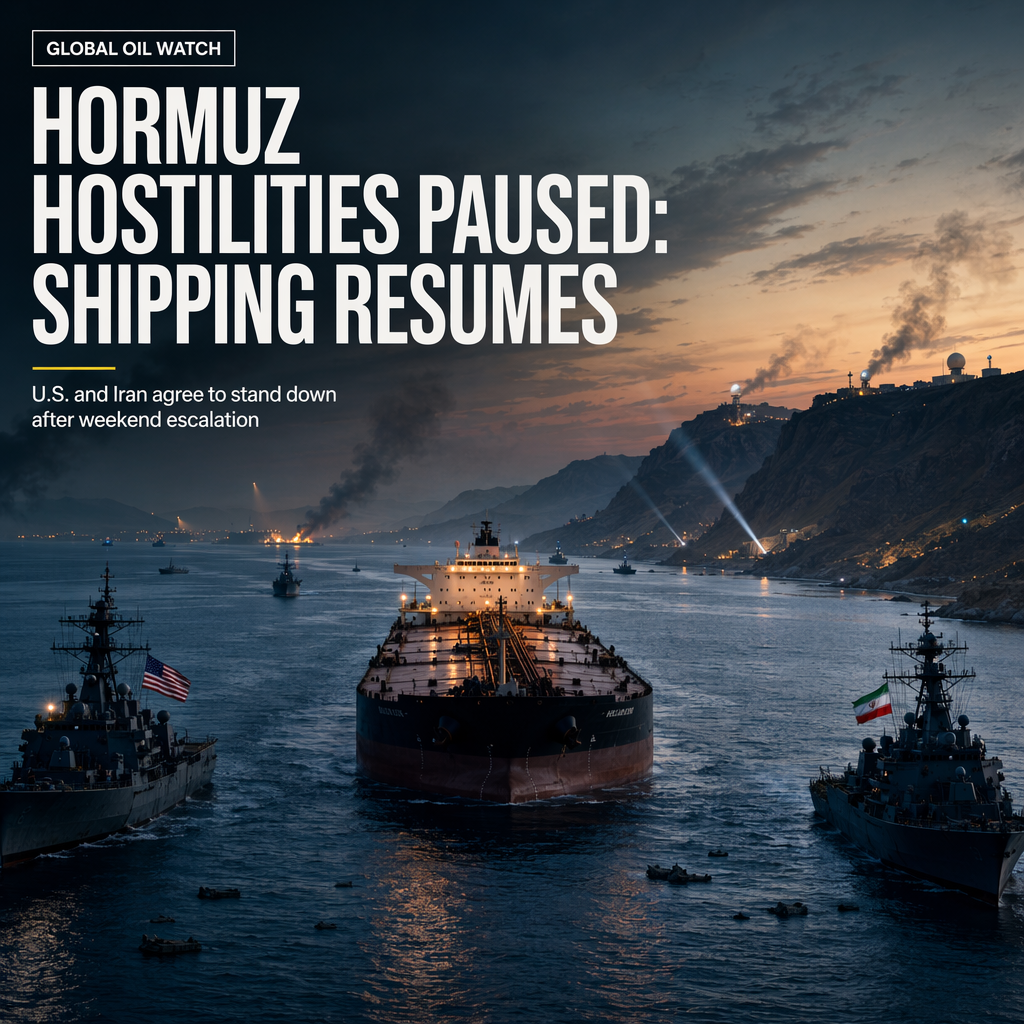
The United States and Iran have agreed to pause hostilities and resume technical talks after a weekend of military exchanges in the Strait of Hormuz, a critical waterway for global oil shipments [1]. This agreement follows U.S. strikes on Iranian military targets, which were conducted in response to Iranian attacks on commercial shipping in the region [1]. According to a U.S. official, both sides will 'stand down for now and vessels can move freely,' with technical discussions set to continue on all areas of the memorandum of understanding [1].
The escalation began when a commercial tanker, the Panamanian-flagged M/T Kiku, carrying more than two million barrels of crude oil, was struck by a projectile while transiting the strait on Saturday [1]. In retaliation, U.S. Central Command reported that fighter jets struck 10 Iranian military targets in and near the Strait of Hormuz, including missile and drone storage locations and coastal radar sites [1]. President Donald Trump responded to the attacks by threatening Iran with annihilation, stating, 'There may come a point when we are no longer able to be reasonable, and will be forced to militarily complete the job that we very successfully started. If that happens, the Islamic Republic of Iran will no longer exist!' [1].
The conflict extended beyond the Strait of Hormuz, as Iran claimed to have struck U.S. military targets in Kuwait and Bahrain following the U.S. strikes on its coastal facilities [1]. Kuwait's army reported confronting hostile missile and drone attacks, while Bahrain's Ministry of Foreign Affairs condemned the renewed Iranian aggression, describing it as a 'dangerous escalation' [1]. Gulf states, including Kuwait and Bahrain, have condemned Iran's missile and drone attacks as tensions in the region persist [1].
Despite the pause in hostilities, President Trump has maintained a hardline stance, referencing previous threats to send Iran 'back to the stone age' and warning of severe consequences if Iran continues its actions [1]. The situation remains tense, with both sides agreeing to stand down temporarily while technical negotiations continue [1].
CONCLUSION
The agreement to pause hostilities and resume shipping in the Strait of Hormuz marks a temporary de-escalation after a weekend of significant military action between the U.S. and Iran. However, the situation remains volatile, with strong rhetoric from U.S. leadership and ongoing regional tensions. Market participants are likely to remain cautious given the strategic importance of the Strait of Hormuz and the potential for renewed conflict.