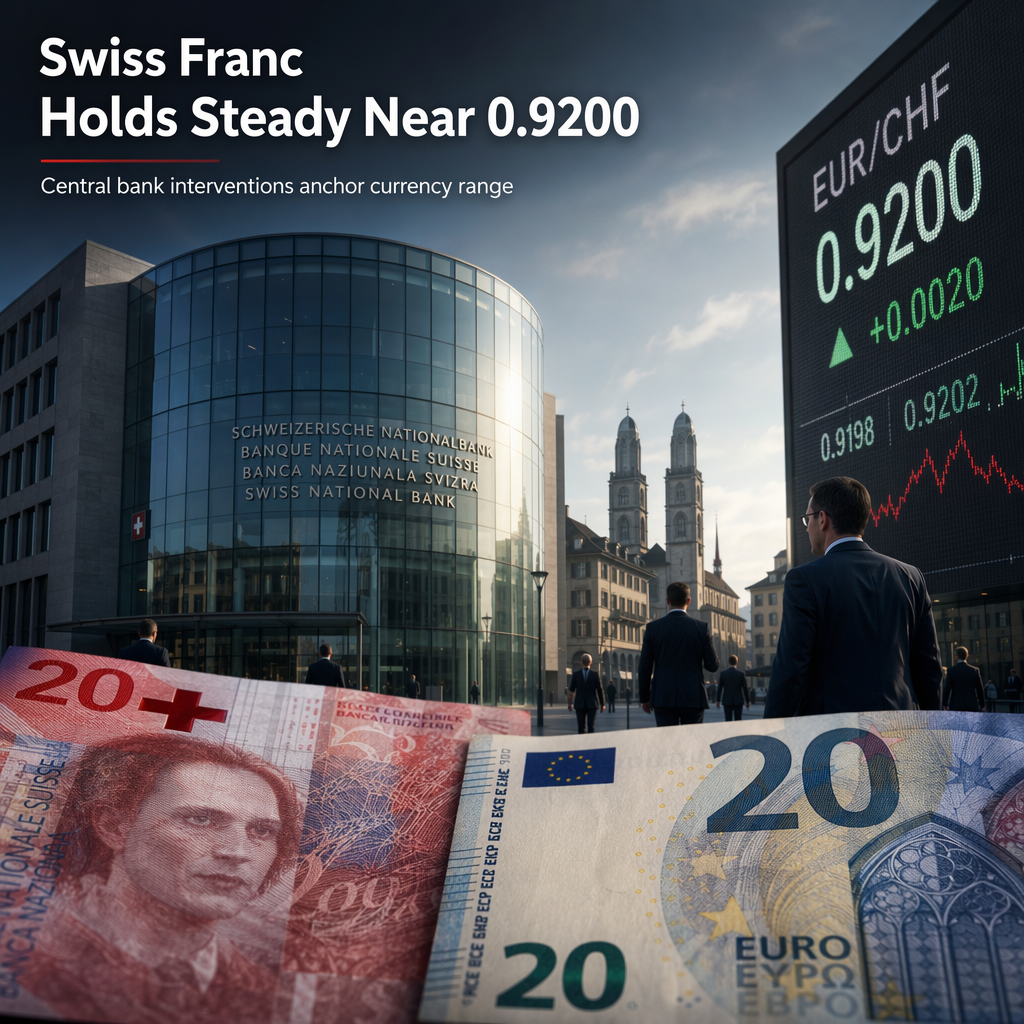
The Swiss Franc (CHF) is currently trading in a narrow range against the Euro (EUR), with the EUR/CHF pair consolidating around the 0.9200 level. This stability is attributed to the Swiss National Bank's (SNB) active efforts to neutralize safe-haven inflows resulting from heightened geopolitical tensions. The SNB has engaged in direct foreign exchange interventions, purchasing billions in foreign currency during the first quarter to prevent excessive appreciation of the Franc, as confirmed by official data. SNB President Martin Schlegel has reiterated that such interventions remain the central bank's preferred tool to dissuade speculative buying and maintain currency stability [1].
On the other side, the European Central Bank's (ECB) restrictive monetary policy and recent rate hikes have provided structural support for the Euro. Senior FX strategists at Rabobank note that the ECB's persistent hawkishness has alleviated downward pressure on the EUR/CHF exchange rate, reducing the urgency for the SNB to act further. Analysts suggest that if the ECB continues its tightening cycle, the SNB may be compelled to reconsider its stance toward the end of the year [1].
Market analysts, including those at Rabobank, anticipate that the EUR/CHF pair will remain range-bound near the 0.9200 mark over the next three months, with a slight upside bias due to the ECB's hawkish posture. However, any significant appreciation of the Swiss Franc is expected to be countered by swift and unannounced SNB interventions, keeping the currency pair within a well-defined lateral band for the foreseeable future [1].
While concerns about imported inflation into Switzerland have emerged following a modest rebound in the EUR/CHF pair, domestic inflation remains low and growth risks are considered modest. The consensus among banks is that the SNB will continue to prioritize FX interventions to maintain stability in the currency market [1].
CONCLUSION
The EUR/CHF exchange rate is projected to remain stable around 0.9200 in the near term, supported by the SNB's active interventions and the ECB's hawkish monetary policy. Market participants expect limited volatility in the pair, with central bank actions serving as key anchors for the currency cross.