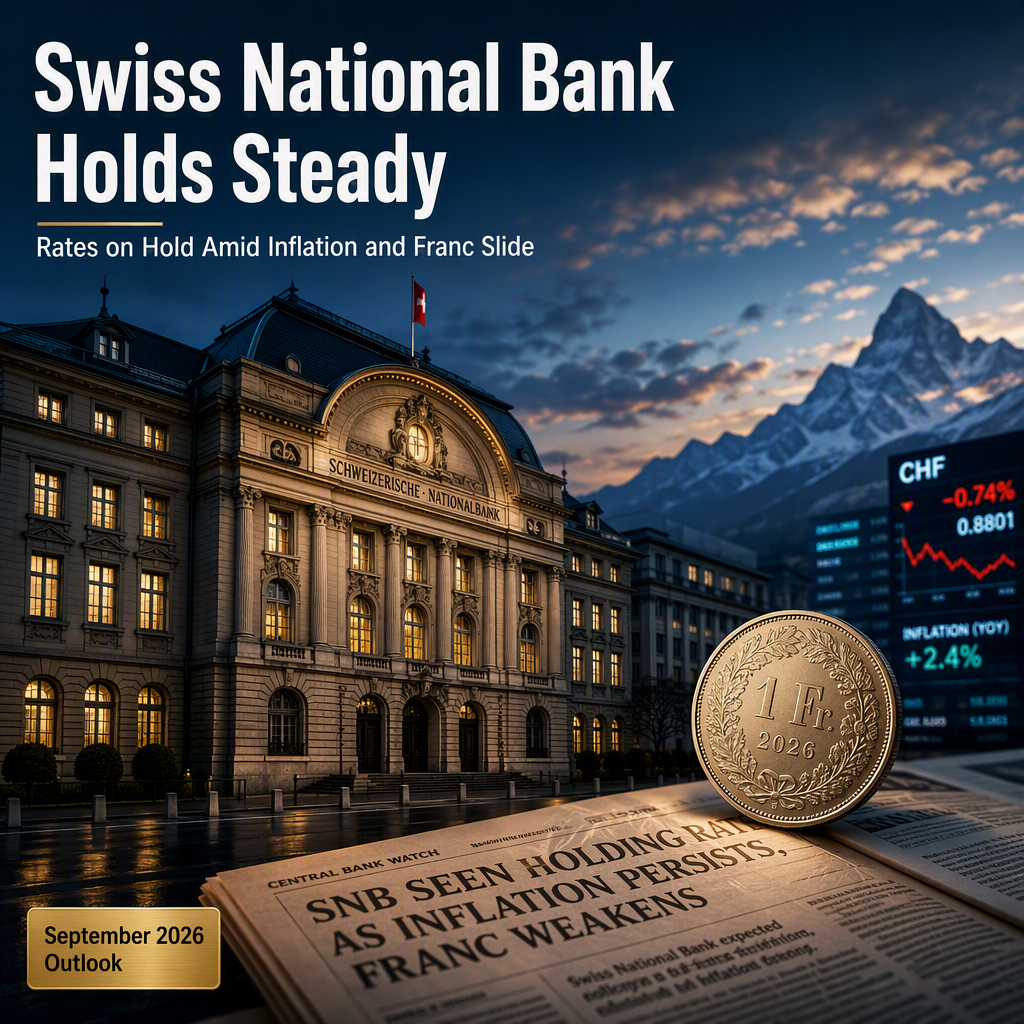
Nomura’s European Economics team, led by Josie Anderson, George Buckley, and Andrzej Szczepaniak, anticipates that the Swiss National Bank (SNB) will maintain its policy rate at 0.00% during the September 2026 meeting. This expectation is based on several factors, including stronger GDP growth, a recent uptick in inflation, and the depreciation of the Swiss franc (CHF) [1].
Recent data shows that inflation in Switzerland accelerated, rising to 0.8% year-on-year in August from 0.4% in July, marking the fastest rate since September 2024. The increase was primarily driven by higher energy prices, while core inflation remained subdued at 0.4% year-on-year [1]. Nomura forecasts that inflation in the third quarter will align with the SNB’s projection of 0.7% quarter-on-quarter, with a further acceleration to 1.0% quarter-on-quarter expected in the fourth quarter [1].
Despite the rise in inflation, Nomura does not foresee any rate hikes before 2028 at the earliest. The team notes that as the EUR/CHF exchange rate is near its highest level since early 2025, Swiss policymakers may not feel compelled to signal increased foreign exchange intervention. However, ongoing geopolitical risks, such as the re-escalation of the Iran war, could prompt the SNB to maintain its current guidance to remain vigilant against upward pressures on the CHF [1].
Nomura also expects the SNB to revise its GDP growth estimate for the year, as even with no growth in the second half, the economy would expand by 1.8% for the year—well above the SNB’s June expectation of 'around 1%' [1]. Looking ahead, if inflation sustainably rises to 1% or higher, which is around the midpoint of the SNB’s 0-2% target range, policymakers may consider discussing rate hikes in 2028 [1].
CONCLUSION
Nomura expects the SNB to keep its policy rate unchanged at 0.00% through at least 2027, despite recent inflationary pressures and CHF depreciation. The central bank may revise up its GDP growth forecast, but no rate hikes are anticipated before 2028. Market participants are likely to interpret this as a signal of continued monetary stability in Switzerland.