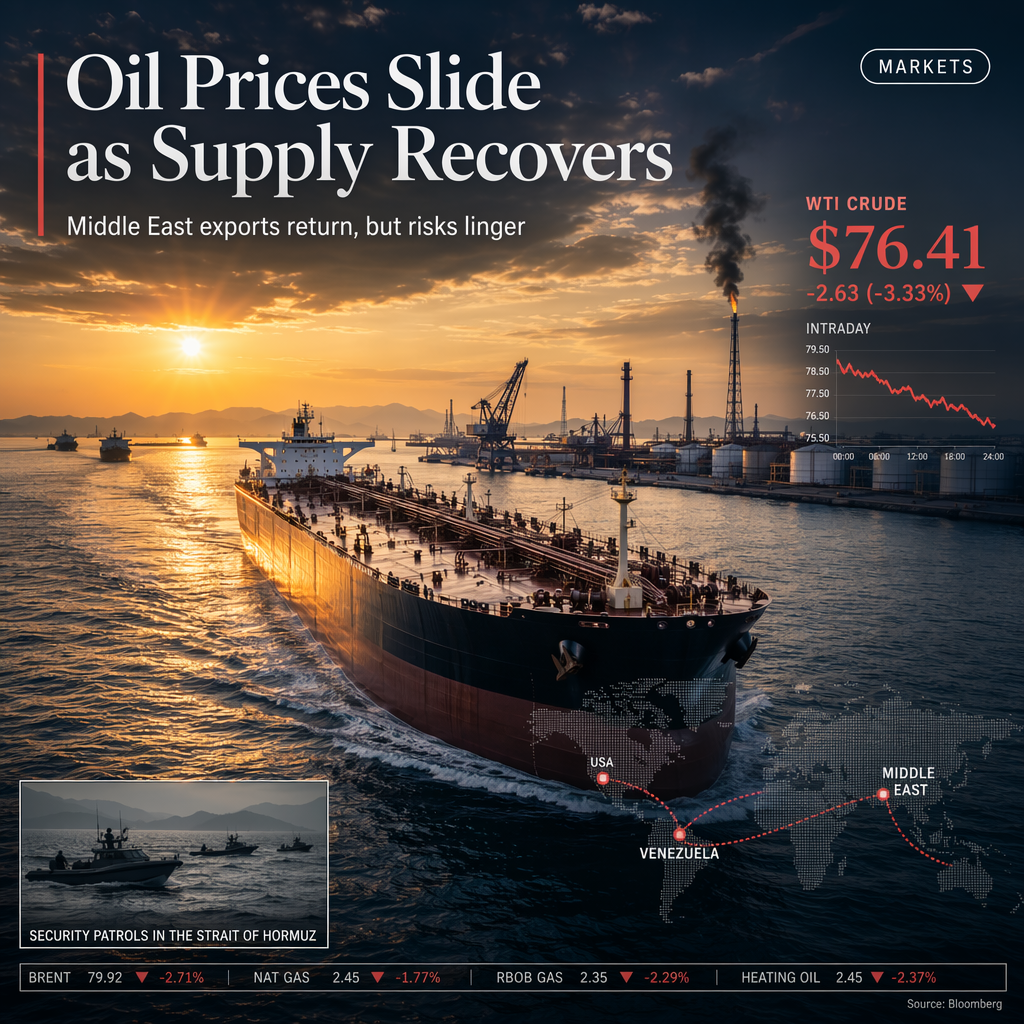
West Texas Intermediate (WTI) US Oil fell by 3.25% on Friday, trading around $69.05 after reaching its lowest level since late February at $68.48 earlier in the day [1]. This decline extends a weekly downtrend, driven by investor expectations of a recovery in global oil supply following disruptions related to the conflict with Iran [1]. Market sentiment improved as oil flows through the Strait of Hormuz continued to recover, with QatarEnergy launching its first July-August crude tender since the conflict began and Saudi Aramco resuming loadings at its Ras Tanura terminal after several months of disruption [1]. Additional supply from Iraq, Kuwait, and Abu Dhabi further reinforced expectations of a stronger supply outlook [1].
US Energy Secretary Chris Wright reported that tanker traffic through the Strait of Hormuz has returned to near pre-conflict levels, with approximately 20 million barrels transiting the waterway on Wednesday [1]. Wright also noted that Venezuelan oil production is increasing rapidly and could continue to grow through the end of US President Donald Trump's term, adding to the outlook for stronger global supply [1].
Despite the improved sentiment, several banks remain cautious. Commerzbank argued that the market may be underestimating supply risks, pointing out that tanker traffic data do not yet indicate a full normalization of shipping activity [1]. The bank also highlighted that combined US inventories of crude oil, gasoline, and distillates remain about 7% below their seasonal average, which could support prices if exports recover more slowly than expected [1]. Rabobank echoed this caution, citing a recent attack on a cargo vessel off the coast of Oman as evidence of the fragile security situation in the Strait of Hormuz [1]. Rabobank believes that while the market expects the memorandum of understanding between the US and Iran to remain in place—supporting Iranian oil exports and limiting immediate escalation risks—the situation remains delicate [1].
CONCLUSION
WTI Oil prices have weakened significantly as recovering Middle East exports and increased Venezuelan production ease supply concerns. However, analysts from Commerzbank and Rabobank warn that supply risks and regional security issues persist, suggesting that the market may be overly optimistic about a swift normalization. The overall market takeaway is one of cautious optimism, tempered by ongoing geopolitical and inventory uncertainties.