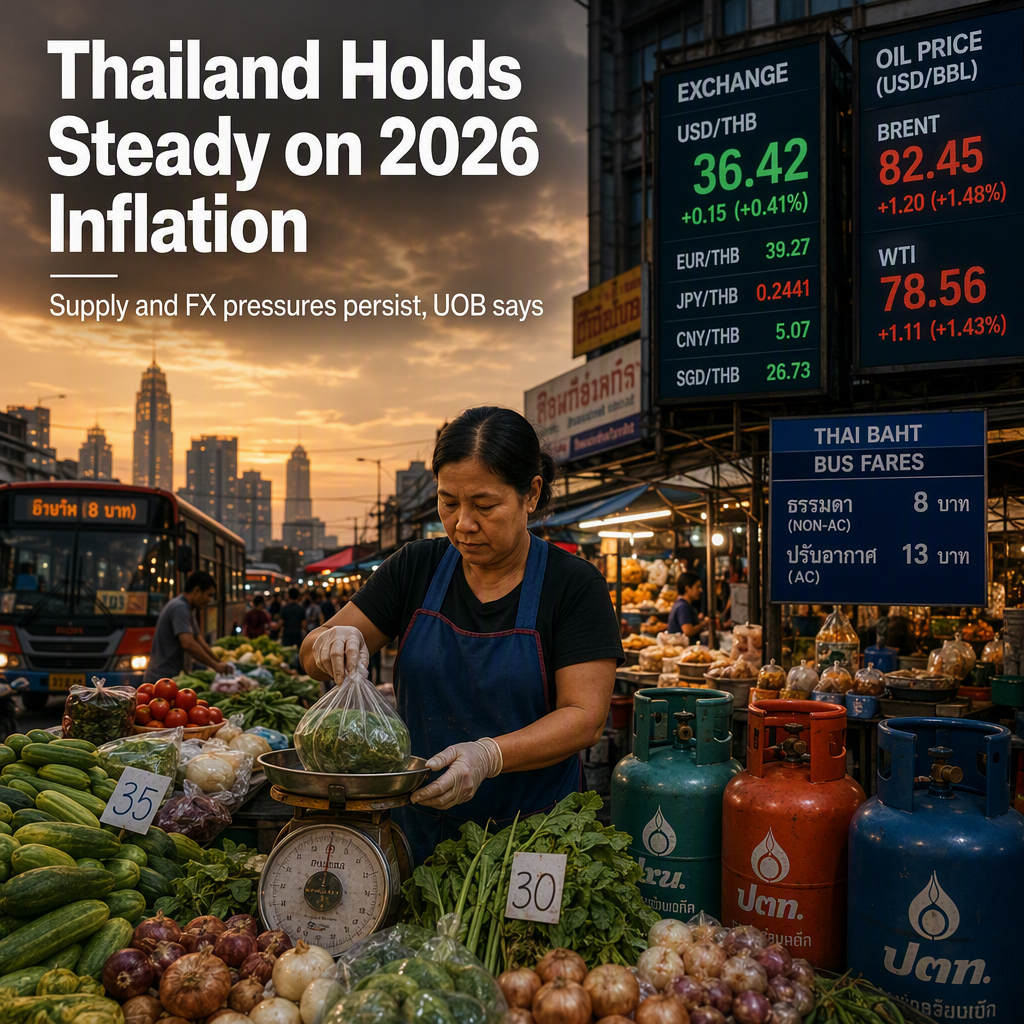
UOB economists report that Thailand's inflation outlook is being shaped by supply-side factors and external variables, notably oil prices and the USD/THB exchange rate, according to the Ministry of Commerce (MoC) and UOB's analysis. The MoC has maintained its 2026 headline inflation forecast at 1.5%–2.5%, with a midpoint of 2.0%, based on assumptions including Dubai crude oil at USD80–90 per barrel and USD/THB at 32.0–33.0 [1]. The inflation trajectory is projected to average -0.54% in the first quarter of 2026, rise to 2.70% in the second quarter, and then moderate to 2.09% and 2.33% in the third and fourth quarters, respectively [1].
Key sensitivities highlighted by UOB include a potential 3%–5% increase in single-dish meal prices, an electricity tariff of THB3.93 per unit, diesel prices at THB35–40 per liter, and the risk of a stronger El Niño event, whose full impact has yet to be realized [1]. For August, upside risks to inflation are identified as retail fuel prices remaining above year-ago levels, adjustments in prepared-food and ingredient prices, higher bus fares, and increased fresh-vegetable prices, especially given a low base and the potential intensification of El Niño. Offsetting factors include slightly lower electricity tariffs and an abundant supply of fresh fruit [1].
The Bank of Thailand (BoT) concurs that second-round effects on inflation remain limited, suggesting that the critical threshold for policy reassessment would be a sustained broadening into wage setting, market-based services prices, inflation expectations, FX pass-through, and stronger credit creation, rather than another volatile headline inflation print [1]. UOB states, "We will continue to monitor energy prices, geopolitical developments, the baht, wages, inflation expectations, and credit conditions, and will revise our forecasts if the underlying dynamics change" [1].
CONCLUSION
Thailand's 2026 inflation forecast remains steady, with authorities closely monitoring supply-side and external risks, particularly energy prices and currency movements. While upside risks exist, the Bank of Thailand and UOB see limited second-round effects for now, but remain vigilant for any broadening inflation pressures.