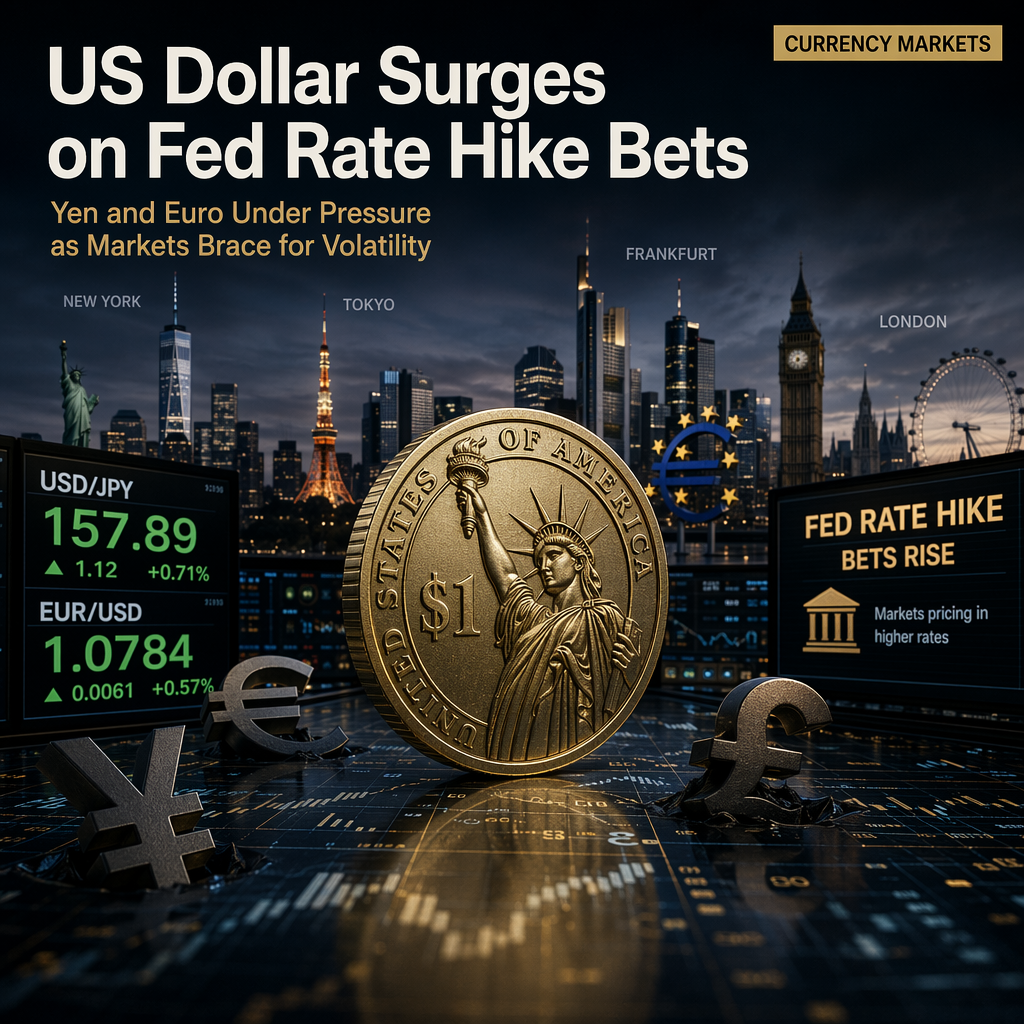
The US Dollar continued to strengthen against major currencies, driven by rising expectations of further Federal Reserve rate hikes and robust US economic data. The USD/JPY traded around 162.65, up 0.44% on the day and near multi-decade highs, as the wide interest rate gap between the Bank of Japan's 1% policy rate and the Federal Reserve's 3.5% to 3.75% target range—approximately 250 basis points—supported carry trades and pressured the Japanese Yen [1]. Despite repeated warnings from Japanese authorities, including Chief Cabinet Secretary Minoru Kihara and Finance Minister Satsuki Katayama, about potential foreign exchange intervention, the Yen remained weak. ING noted that the risk of intervention is elevated after USD/JPY broke above 162, but the persistent strength of the US Dollar could limit the effectiveness of any Japanese action [1].
US economic data further bolstered the Greenback. The Job Openings and Labor Turnover Survey (JOLTS) showed job openings rose to 7.594 million in May, surpassing market expectations of 7.3 million and the previous month's revised 7.585 million [1][2][3]. The Conference Board's Consumer Confidence Index increased to 91.2 in June from 90.6 in May, though it missed economists' expectations of 94.7 [2][3]. Danna Peterson, Chief Economist at the Conference Board, noted that consumer appraisals of current business conditions were slightly more positive, but perceptions about the labor market had weakened [3].
Federal Reserve commentary remained hawkish, with Cleveland Fed President Beth Hammack stating, "Inflation is still too high" and that the Fed "may need to consider rate hikes" if price pressures persist [1][2][3]. The CME FedWatch Tool indicated that traders are pricing in a 67% probability of a September rate hike [2]. Money markets have priced in 35 basis points of Fed tightening by the end of 2026, while traders expect the Fed to hold rates steady at the July meeting [3].
The Euro rebounded modestly against the US Dollar, trading around 1.1415 after hitting an intraday low of 1.1382, but gains were capped by Fed rate hike bets and upbeat US data [2]. On the Eurozone side, ECB policymakers expressed mixed views: Olli Rehn saw no major second-round effects from inflation and cautioned against committing to a predetermined rate path, while Pierre Wunsch suggested another hike might be needed [2].
The British Pound advanced 0.11% to 1.3270, supported by political stability despite weaker UK growth signals. UK Q1 2026 GDP expanded by 0.6% quarter-on-quarter as expected, but annual growth of 0.9% missed estimates and the prior reading of 1.1% [3]. Bank of England Governor Andrew Bailey warned that UK inflation could still rise to 3.2% this year [3]. GBP/USD cleared June’s 29 peak following the US data release, but technical indicators suggest a bearish near-term tone [3].
CONCLUSION
The US Dollar's strength is underpinned by robust economic data and rising expectations of further Federal Reserve tightening, pressuring both the Japanese Yen and the Euro. Despite intervention warnings from Japanese officials and mixed signals from ECB policymakers, the Greenback remains supported by hawkish Fed commentary and labor market resilience. Market participants are closely watching upcoming US labor data for further policy clues, with the risk of continued volatility in major currency pairs.