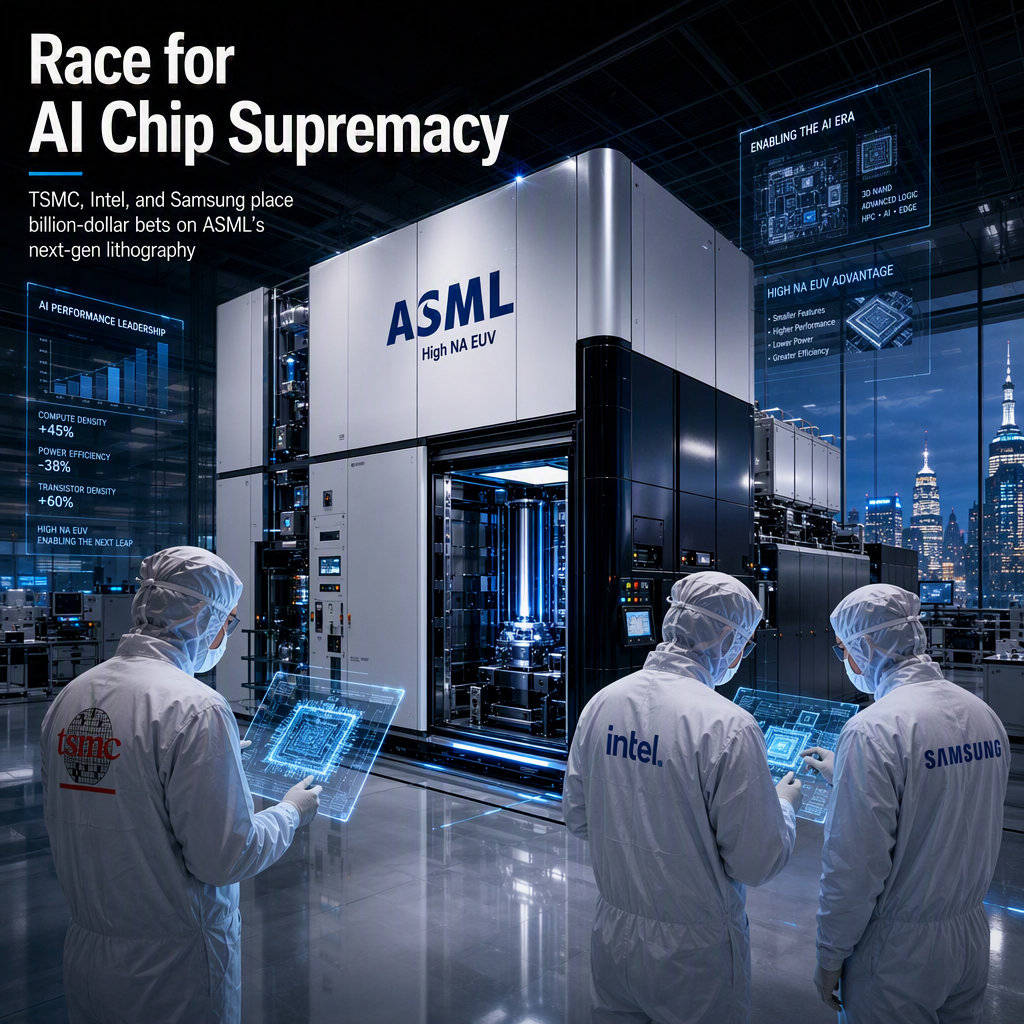
Taiwan Semiconductor Manufacturing Co. (TSMC), Intel, and Samsung Electronics are making significant commitments to ASML's high numerical aperture (NA) extreme ultraviolet (EUV) lithography machines, the most advanced chipmaking tools currently available, as they compete to lead the next generation of semiconductor technology for artificial intelligence (AI) applications [1]. TSMC announced it will begin using ASML's high NA EUV machines for mass production by 2030, aligning with anticipated demand for advanced chips driven by AI and high-performance computing [1]. In contrast, Samsung aims to adopt the technology as early as 2028, potentially gaining a competitive edge in producing smaller and more powerful semiconductors [1]. Intel claims it is already mass producing chips with the new machine, positioning itself as a leader in the AI and advanced computing space [1].
Market analysts highlight that ASML's high NA EUV machines enable finer patterning and higher transistor densities, which are expected to result in faster and more efficient processors. This technological leap is anticipated to fuel growth in the AI sector and could reshape the competitive dynamics among leading chipmakers [1]. Industry experts believe that mastering high NA EUV technology will be crucial for determining market leadership over the next decade, with the substantial capital investment required underscoring the high stakes of the AI race [1].
A senior analyst at Nikkei Asia described this as a pivotal moment for the semiconductor industry, emphasizing that companies capable of mastering high NA EUV will be able to produce the most advanced chips, which are critical for AI, data centers, and next-generation consumer devices [1]. While financial details of the investments have not been disclosed, the machines are described as among the most expensive and sophisticated ever made for chip manufacturing [1]. The collective commitment by TSMC, Samsung, and Intel is viewed as a strong endorsement of ASML's technology and its central role in the future of semiconductors [1].
CONCLUSION
TSMC, Intel, and Samsung's adoption of ASML's high NA EUV lithography marks a major technological shift in the semiconductor industry, with significant implications for AI and advanced computing. Their investments signal confidence in ASML's technology and set the stage for intensified competition in producing the most advanced chips. Market leadership in the coming decade is likely to hinge on mastery of this cutting-edge manufacturing process.