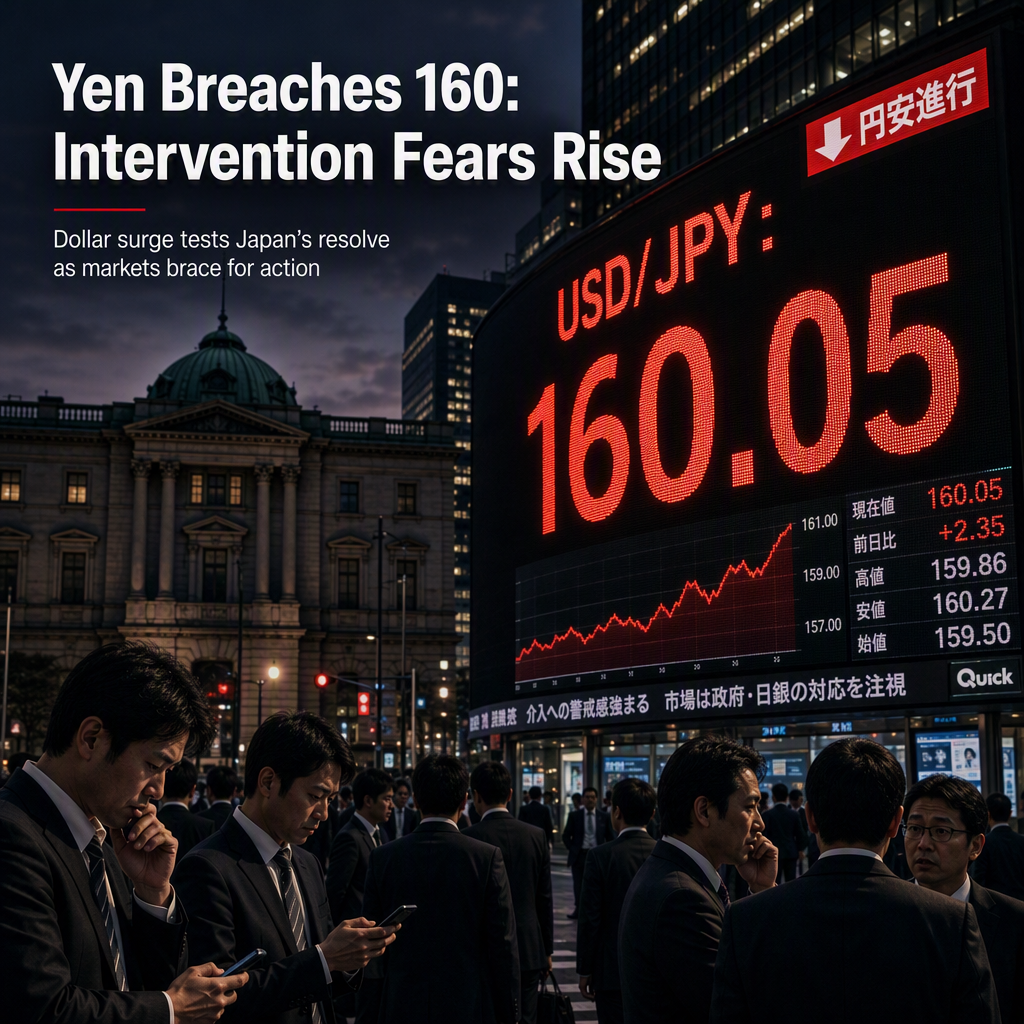
The Japanese yen weakened beyond the 160-per-dollar mark on Friday, a level not seen since the coordinated currency intervention by Japan and the U.S. in late July, following comments from Federal Reserve Chair Kevin Warsh indicating openness to further interest rate hikes if inflation remains above target [1]. The rise in U.S. Treasury yields has increased demand for dollars, contributing to the yen's decline and marking a significant milestone, as the last breach of this level preceded the recent joint intervention aimed at stabilizing currency markets [1].
Warsh's remarks that the Fed still has 'work to do' on inflation have heightened expectations of additional tightening, reinforcing dollar strength and intensifying downward pressure on the yen [1]. The previous intervention, which involved $96 billion in yen-buying between July and August, temporarily stabilized the currency but has not prevented renewed weakness as U.S. interest rates remain elevated [1].
Market participants are closely monitoring for any signals of further intervention by Japanese authorities. Traders interpret the move past 160 yen per dollar as a technical break, with little immediate support until the 162 level, and dollar bulls are targeting higher levels [1]. Analysts warn that further depreciation could prompt another round of intervention by the Bank of Japan and Ministry of Finance [1].
Additionally, traders are watching U.S. Treasury buyback operations and their impact on dollar liquidity, as well as the broader implications for Japanese investors and their foreign asset allocations. The market remains alert for any official statements or policy actions aimed at stemming the yen's slide [1].
CONCLUSION
The yen's fall past 160 per dollar signals renewed pressure on the Japanese currency, driven by persistent U.S. dollar strength and expectations of further Fed tightening. Market participants are bracing for potential intervention by Japanese authorities if the yen continues to weaken, highlighting elevated uncertainty and volatility in currency markets.