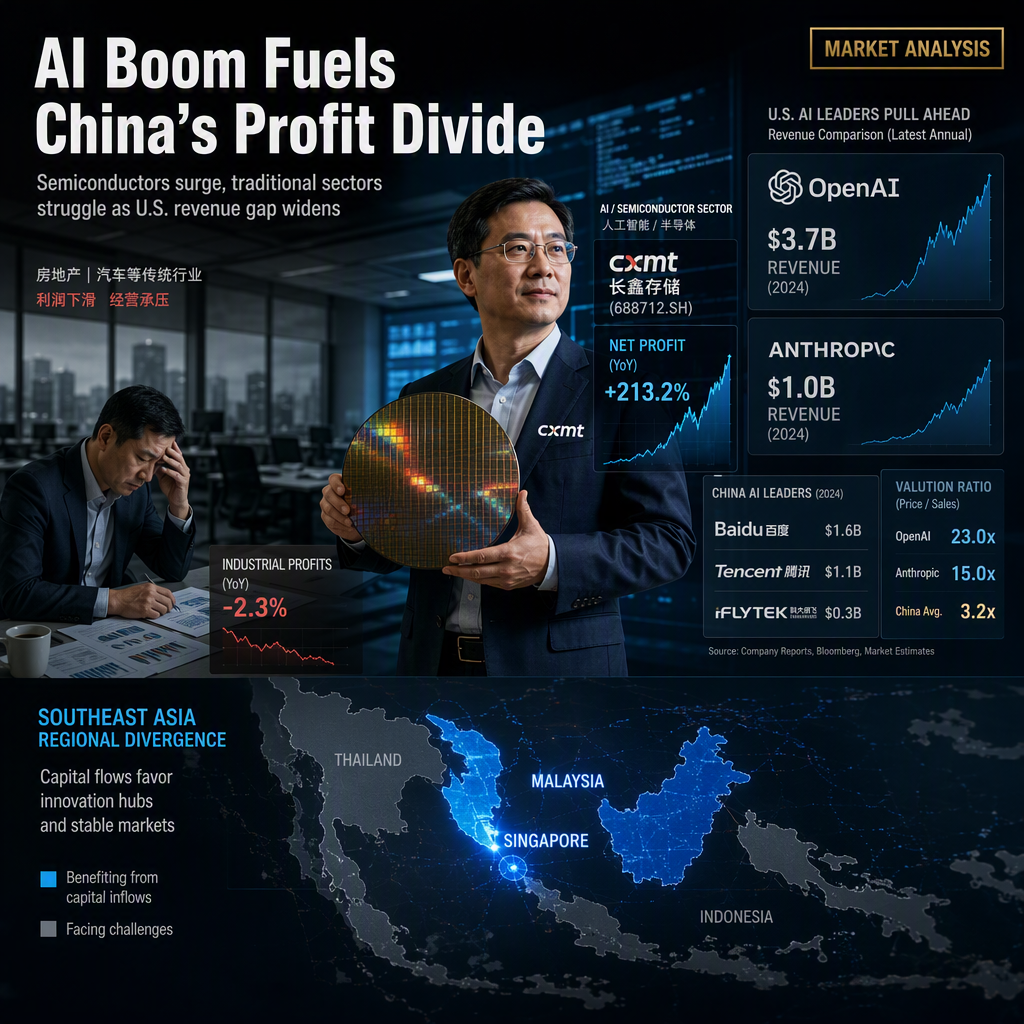
A significant divergence has emerged among Chinese listed companies in the first half of the year, with a quarter posting net losses despite an overall net profit growth of around 20% for the group, according to financial data. This divergence is largely attributed to the robust performance of chipmakers and AI-related companies, such as CXMT, which swung to a net profit and topped memory profit margins compared to global competitors like SK Hynix and Micron. In contrast, traditional sectors like real estate and automotive have struggled, with companies such as Vanke reporting widening losses amid a domestic demand slump and new property measures. The listing of CXMT has notably boosted the STAR Market, signaling strong investor confidence in technology and AI sectors, while property development faces liquidity crunches and negative sentiment. Market analysis and trading advice from the period favor exposure to semiconductor and AI-driven companies, with caution advised for sectors affected by weak domestic demand and regulatory headwinds [1].
On a broader regional scale, a report from DBS, Bain, and Vriens & Partners warns that the AI era is likely to exacerbate economic disparities within ASEAN. Singapore and Malaysia are expected to benefit the most from AI and technology investments due to their strong infrastructure and regulatory frameworks, while Thailand and Indonesia may lag behind because of internal risks and weaker infrastructure. The report highlights that AI-driven productivity gains are substantial but cautions that uneven adoption will likely widen existing gaps. Sectors such as finance, manufacturing, and supply chain management in Singapore and Malaysia are identified as likely beneficiaries, while countries with less developed digital infrastructure risk missing out. The sentiment suggests investors may favor Singapore and Malaysia for their readiness to capitalize on the AI boom, while exercising caution with Thailand and Indonesia until reforms are implemented [2].
Despite rapid adoption of AI models in China, revenue generation remains far behind U.S. leaders. According to research from Rhodium Group, all Chinese AI models combined generate only about 10% of the revenue reported for OpenAI and Anthropic, with OpenAI alone generating $40 billion and Anthropic $65 billion in annual recurring revenue (ARR). In comparison, major Chinese AI companies such as DeepSeek, MiniMax, Moonshot, and Z.ai report significantly lower ARR figures, with Z.ai forecasting an increase to $3 billion by year-end. The report also highlights that valuations for Chinese AI startups like Moonshot and DeepSeek are much higher relative to their revenue compared to their U.S. counterparts, with estimated ratios of 50x and 163x, respectively, versus 34x for OpenAI and 21x for Anthropic. While U.S. tech stocks have recently tumbled following warnings from American AI executives about the risks of rapid development, Chinese AI leaders have not commented on these concerns. The Rhodium analysis notes that Chinese AI labs are seeking ways to increase revenue from third-party access to their models, which are mostly open-source, unlike the closed models of U.S. firms [3].
CONCLUSION
The AI sector is driving a clear divergence in corporate performance, with technology and semiconductor companies in China outperforming traditional industries. However, Chinese AI firms still lag far behind U.S. leaders in revenue, despite high valuations and rapid adoption. Investors are advised to favor AI and technology sectors, particularly in markets with strong infrastructure and regulatory support, while exercising caution in traditional and less developed sectors.