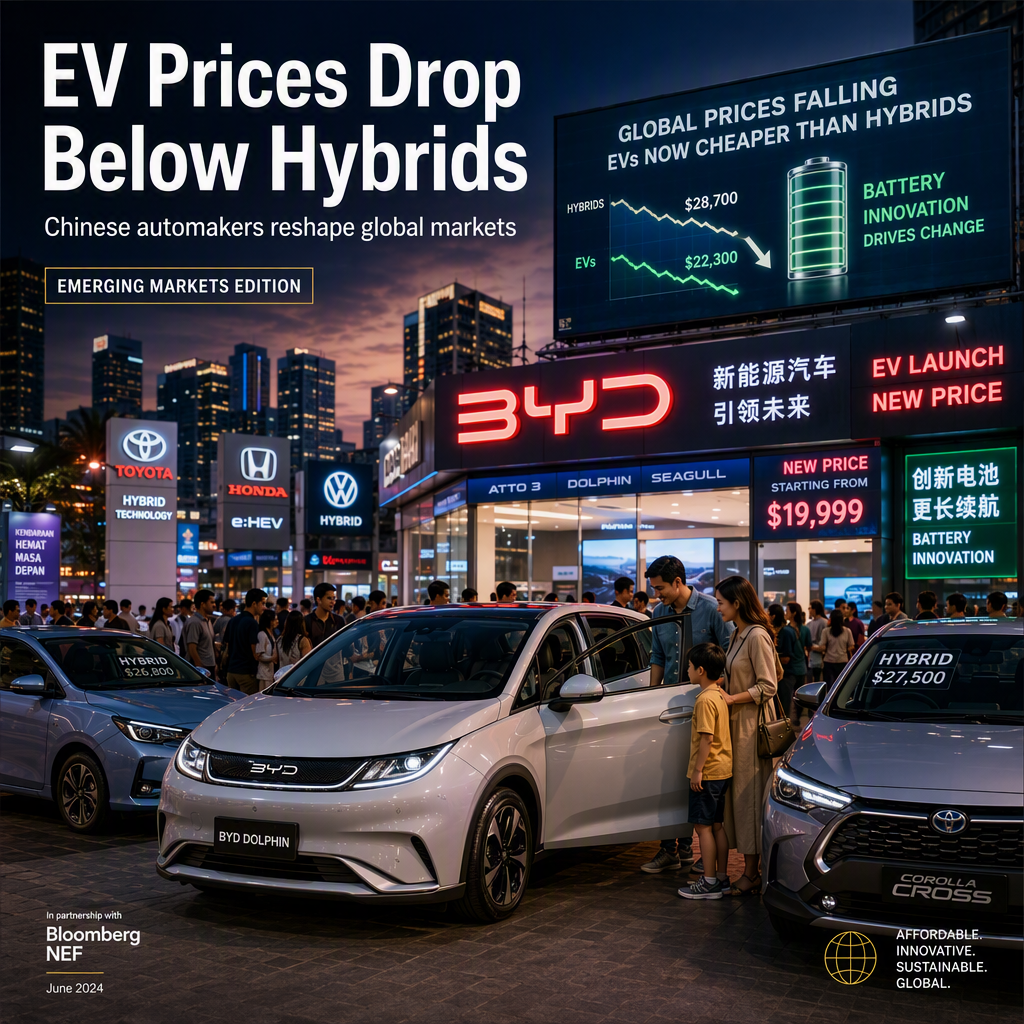
Prices for electric vehicles (EVs) were lower globally on average than for hybrids last year, a shift attributed to declining battery costs and the expansion of Chinese automakers such as BYD in emerging markets [1]. Chinese companies are leveraging economies of scale and cost advantages to offer affordable EVs, accelerating adoption in price-sensitive countries [1]. The reduction in battery costs, a major component of EV pricing, has been a key driver of this trend. As battery technology continues to improve and production scales up, analysts expect the price gap between EVs and traditional vehicles to narrow further, enhancing the competitiveness of EVs against both hybrids and internal combustion vehicles [1].
Industry analysts highlight that adoption is accelerating in emerging markets, with Chinese brands like BYD leading the charge [1]. The proliferation of low-cost Chinese EVs is reshaping the global automotive landscape and compelling legacy automakers to introduce more competitively priced models [1]. This shift in price dynamics is anticipated to influence global market shares, positioning emerging markets as critical arenas for EV adoption [1]. As competition intensifies on both price and technology, the balance between hybrids and EVs may continue to tilt in favor of fully electric vehicles [1].
CONCLUSION
The global automotive market is experiencing a significant shift as EV prices fall below those of hybrids, driven by cheaper batteries and the expansion of Chinese automakers in emerging markets. This trend is expected to accelerate EV adoption and force legacy automakers to adapt, with emerging markets becoming increasingly important for future growth.