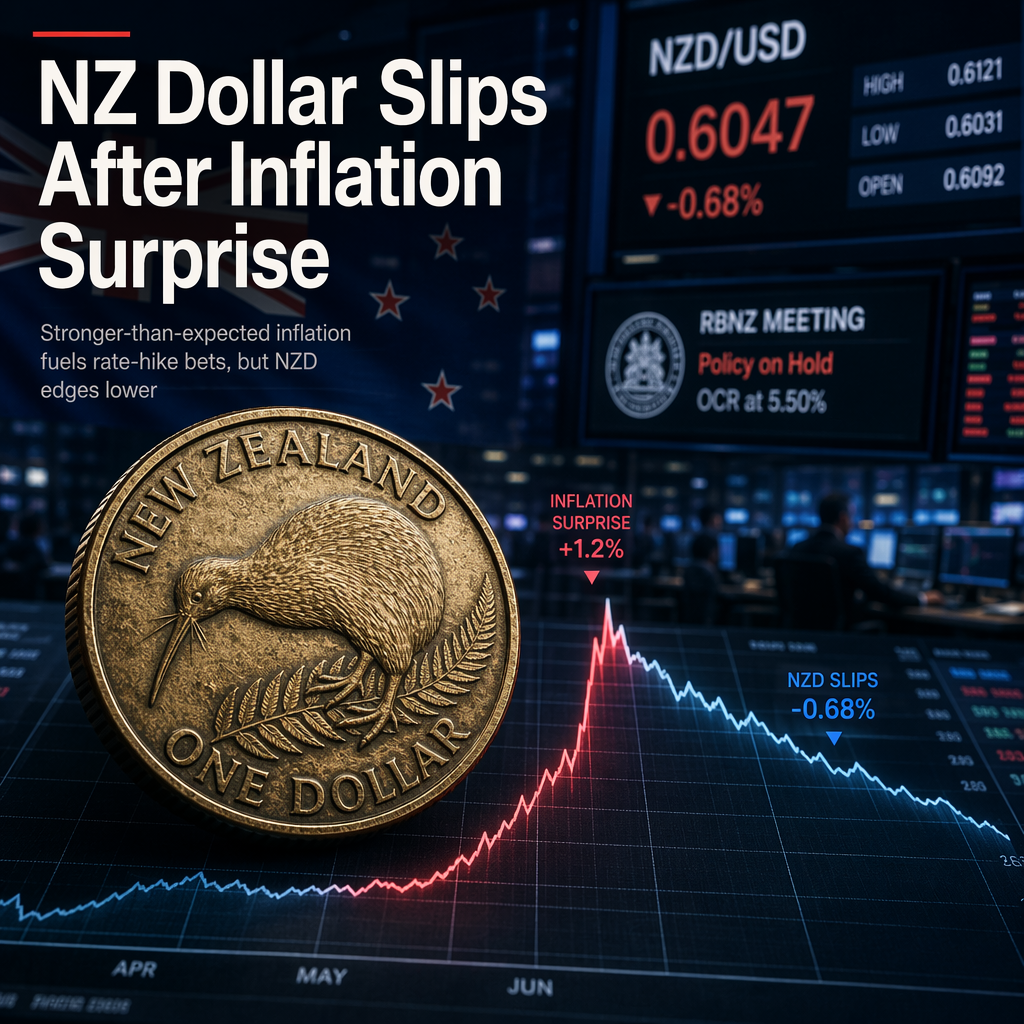
The New Zealand Dollar (NZD) experienced a modest decline against the US Dollar, trading around 0.5835 and down 0.07% on the day, despite support from stronger-than-expected inflation data in the second quarter of 2024 [1]. Statistics New Zealand reported that the Consumer Price Index (CPI) rose 1.5% quarter-on-quarter, up from 0.9% in the previous quarter and above market expectations of 1.4% [1][2]. On an annual basis, inflation accelerated to 4.1% from 3.1%, surpassing the market consensus of 4% but coming in just below the Reserve Bank of New Zealand's (RBNZ) projection of 4.2% [1][2]. Core inflation, measured as the average of several models, reached the top of the RBNZ's 1-3% target range [2].
The RBNZ raised the Official Cash Rate (OCR) by 25 basis points to 2.5% at its July 8 meeting and signaled that further increases are likely at upcoming meetings [1][2]. The swaps curve is pricing in 60 basis points of hikes by year-end and a total of 100 basis points over the next twelve months, which would bring the OCR to 3.5%, near the top of the RBNZ's estimated neutral range of 2.20%-4.10% [2]. According to Bloomberg, markets expect another hike in either October or December, followed by an additional increase in February 2027 [1].
Analysts at Brown Brothers Harriman (BBH) and TD Securities both argue that above-target inflation and a favorable domestic growth outlook support additional RBNZ rate hikes, which is seen as NZD supportive [1][2]. TD Securities specifically expects the central bank to hike again in September, citing upside inflation risks from higher oil prices [1].
Despite the hawkish outlook for the NZD, gains were limited by a firmer US Dollar, supported by ongoing Middle East tensions and safe-haven demand [1]. In the US, economic data point to a more accommodative stance from the Federal Reserve, with Fed funds futures pricing an 84.5% chance of rates being left unchanged at the July 29 meeting, up from 61.5% a month ago [1]. The NZD was the strongest against the British Pound among major currencies on the day [1].
CONCLUSION
Stronger-than-expected inflation data in New Zealand has reinforced expectations for further RBNZ rate hikes, supporting the NZD's outlook. However, the currency's gains remain capped by a resilient US Dollar and global risk factors. Market participants are closely watching upcoming RBNZ meetings for confirmation of additional tightening.