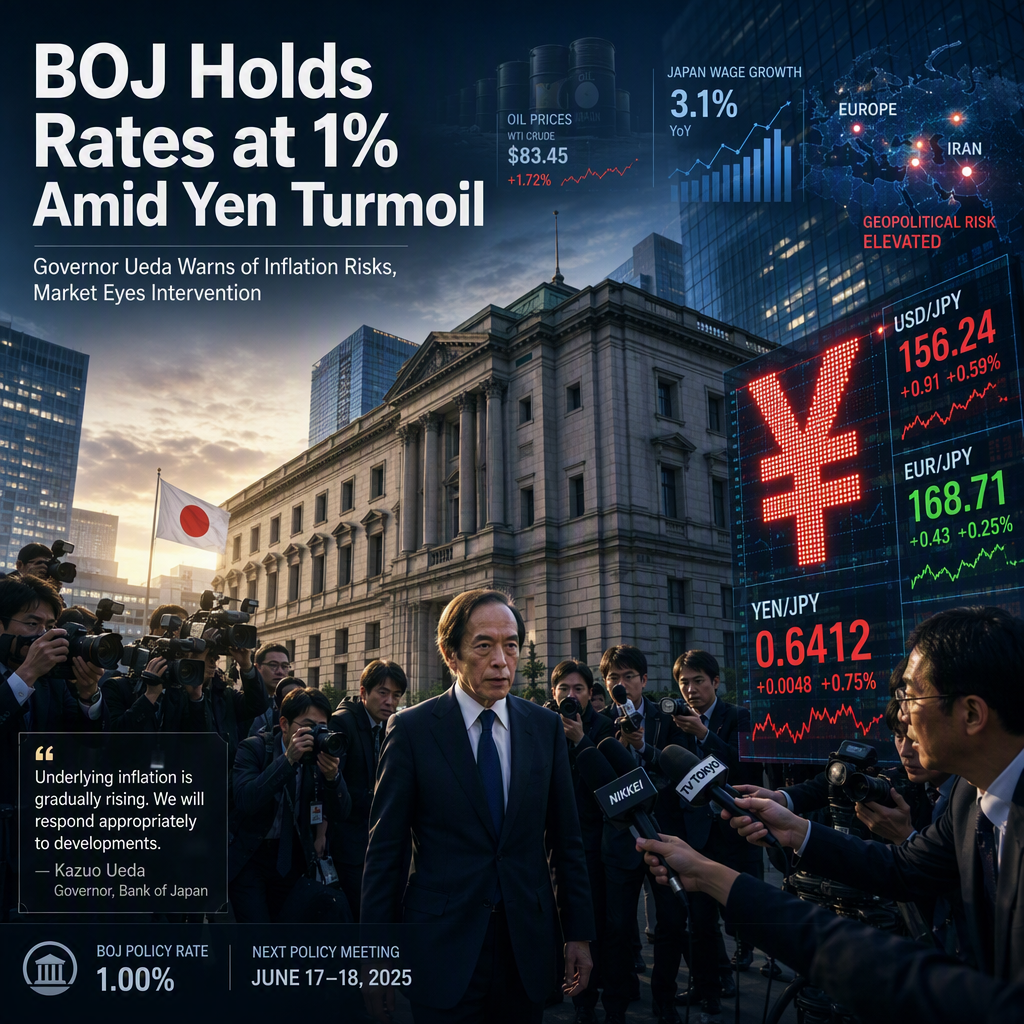
The Bank of Japan (BOJ) maintained its short-term policy rate at 1% following its July policy meeting, with the decision approved by an 8-1 vote. Board member Hajime Takata was the sole dissenter, advocating for another rate hike due to concerns that geopolitical tensions could drive more persistent inflation through higher energy prices and stronger demand [2]. Governor Kazuo Ueda signaled a more hawkish stance, warning of 'meaningful upside risks' to inflation stemming from rising wages, elevated oil prices, and a weak yen. Ueda stated that if financial conditions are deemed overly accommodative, the BOJ could 'accelerate the pace of rate hikes' [1].
The BOJ slightly upgraded its fiscal 2026 real GDP growth forecast to 0.6% from 0.5%, while lowering its fiscal 2026 core CPI forecast to 2.5% from 2.8% in April [2]. The central bank continues to monitor the yen, AI developments, and the ongoing Iran war as key factors influencing future monetary decisions [1][2]. The Middle East conflict was specifically highlighted as a risk to both the economic and inflation outlook, contributing to the yen's weakness [2].
Market reaction to the BOJ's decision was notable. The EUR/JPY pair rebounded to around 184.00 after plunging nearly 500 pips to 182.00 from 187.00, a move attributed to suspected intervention by Japanese authorities in the foreign exchange market [2]. Japanese Finance Minister Satsuki Katayama reiterated that authorities remain ready to intervene in the FX market at any time and confirmed ongoing coordination with the US on currency developments [2]. Despite Governor Ueda's hawkish tone, the yen's reaction was muted, with TD Securities expecting the next 25 bps hike only in December 2026 and projecting USD/JPY to trade in a broad 158–163 range in the coming weeks. Intervention risks remain if USD/JPY exceeds 162 [3].
Analyst commentary from TD Securities noted that while Ueda sounded 'the most hawkish that he's been in a long while,' the market is already pricing in an October hike, and further yen strength would likely require more than one hike in the second half of 2026 [2][3]. TD Securities also observed that verbal interventions are losing effectiveness in 2026, suggesting that more forceful actions may be needed to curb the yen's bearish trend [3].
On the European side, the Eurozone's July Harmonized Index of Consumer Prices (HICP) accelerated to 2.9% year-on-year, with core inflation at 2.5%, supporting the euro and contributing to the EUR/JPY rebound [2]. European Central Bank Governing Council member Martin Kocher emphasized that future ECB policy decisions will remain data-dependent, with energy prices and geopolitical developments closely watched [2].
CONCLUSION
The Bank of Japan's decision to hold rates at 1% and Governor Ueda's hawkish rhetoric have not significantly strengthened the yen, with markets already pricing in further tightening. Persistent inflation risks, ongoing geopolitical tensions, and the potential for further currency intervention keep volatility elevated in yen crosses. The market remains focused on upcoming macroeconomic data and the possibility of more decisive policy action from Japanese authorities.