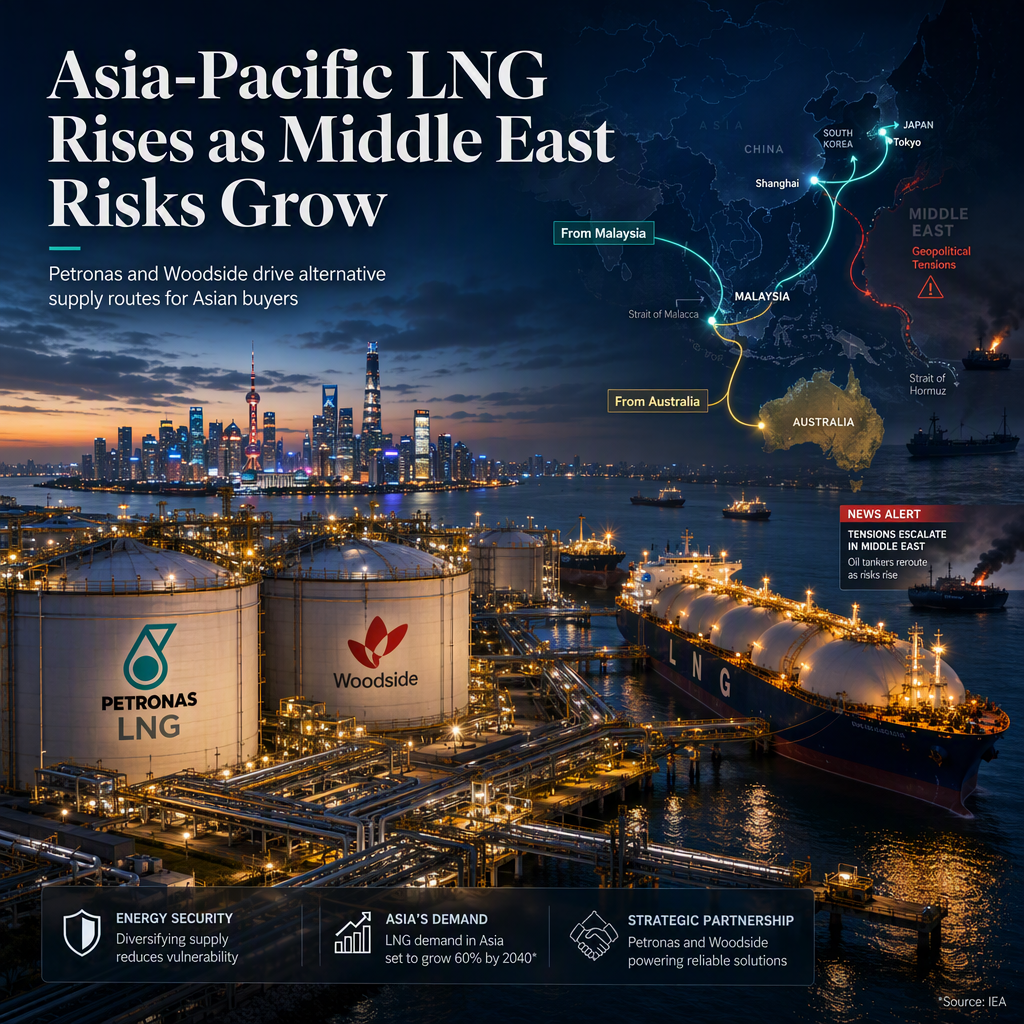
Malaysia's state-owned energy group Petronas is advancing its liquefied natural gas (LNG) projects in the Asia-Pacific region, positioning them as viable alternatives for Asian buyers seeking to reduce reliance on unstable Middle Eastern supplies [1]. Petronas announced plans to increase its LNG output by 38% by 2035, aiming to meet the rising demand from Asian markets for stable and reliable energy sources [1].
During the Gastech Bangkok 2026 conference, Petronas executives reaffirmed their commitment to expanding LNG operations and unveiled new projects designed to address the growing energy needs in the Asia-Pacific region [1]. The company's strategy focuses on diversifying supply options for Asian buyers, thereby minimizing exposure to potential disruptions stemming from Middle Eastern volatility [1].
Australian LNG producer Woodside echoed Petronas' approach, promoting its own regional LNG assets as alternative supply sources for Asian clients [1]. This initiative from both Petronas and Woodside comes at a time when Middle Eastern oil-producing nations are seeking pipeline alternatives to the Strait of Hormuz due to ongoing geopolitical tensions [1].
Asian buyers, particularly in Japan and China, are anticipated to benefit from a wider array of LNG supply sources, which could help stabilize prices and mitigate the risk of supply shocks [1]. The efforts by Petronas and Woodside are viewed as part of a broader trend to reshape the region's energy landscape and foster new partnerships between Asia-Pacific and other non-Mideast LNG producers [1].
CONCLUSION
Petronas and Woodside are actively positioning Asia-Pacific LNG as a stable alternative to Middle Eastern supplies, responding to geopolitical risks in the region. Their expansion efforts are expected to benefit Asian buyers by diversifying supply sources and potentially stabilizing energy prices.