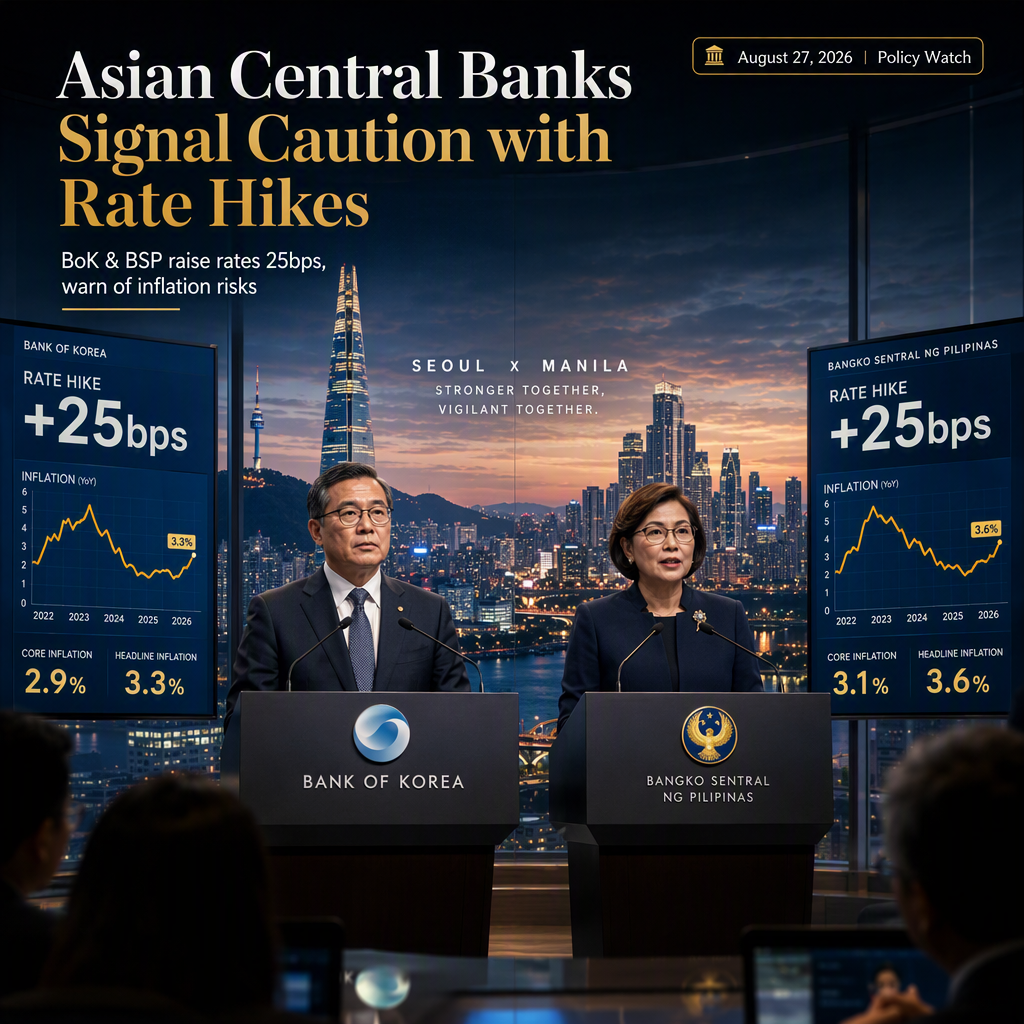
On August 27, 2026, three major Asian central banks—the Bank of Korea (BoK), Bangko Sentral ng Pilipinas (BSP), and Bank of Japan (BoJ)—demonstrated a shared risk-management approach in their recent policy decisions, according to MUFG’s Michael Wan [1]. Both the BoK and BSP raised their key policy rates by 25 basis points, with the BoK moving its rate to 3.00% from 2.75% and the BSP increasing its rate to 5.00% from 4.75% [1].
Despite these hikes, both central banks signaled a slower pace of rate increases ahead, while maintaining the flexibility to tighten further if inflation risks persist [1]. BSP Governor Remolona specifically cited the significant risks posed by a severe El Nino event and minimum wage hikes to inflation, emphasizing that the BSP will tighten policy as much as necessary to address these threats [1].
The BoK also updated its economic outlook, raising its GDP growth forecasts for 2026 and 2027 to 3.3% and 2.9%, respectively, up from previous projections of 2.6% and 2.1%. However, the BoK kept its inflation forecasts unchanged [1].
These policy moves and communications reflect a cautious and flexible stance by Asian central banks as they navigate ongoing economic uncertainties and structural changes [1].
CONCLUSION
The BoK and BSP’s 25bps rate hikes, coupled with signals of a slower tightening pace, highlight a cautious but vigilant approach to inflation risks. Market participants are likely to interpret these moves as a sign of central banks’ commitment to risk management amid ongoing uncertainties. Forward guidance suggests further tightening remains possible if inflation pressures intensify.